Architectural Motifs: Four Rinceaux
Original title: Architectural Motifs: Four Rinceaux
kurzbeschreibung
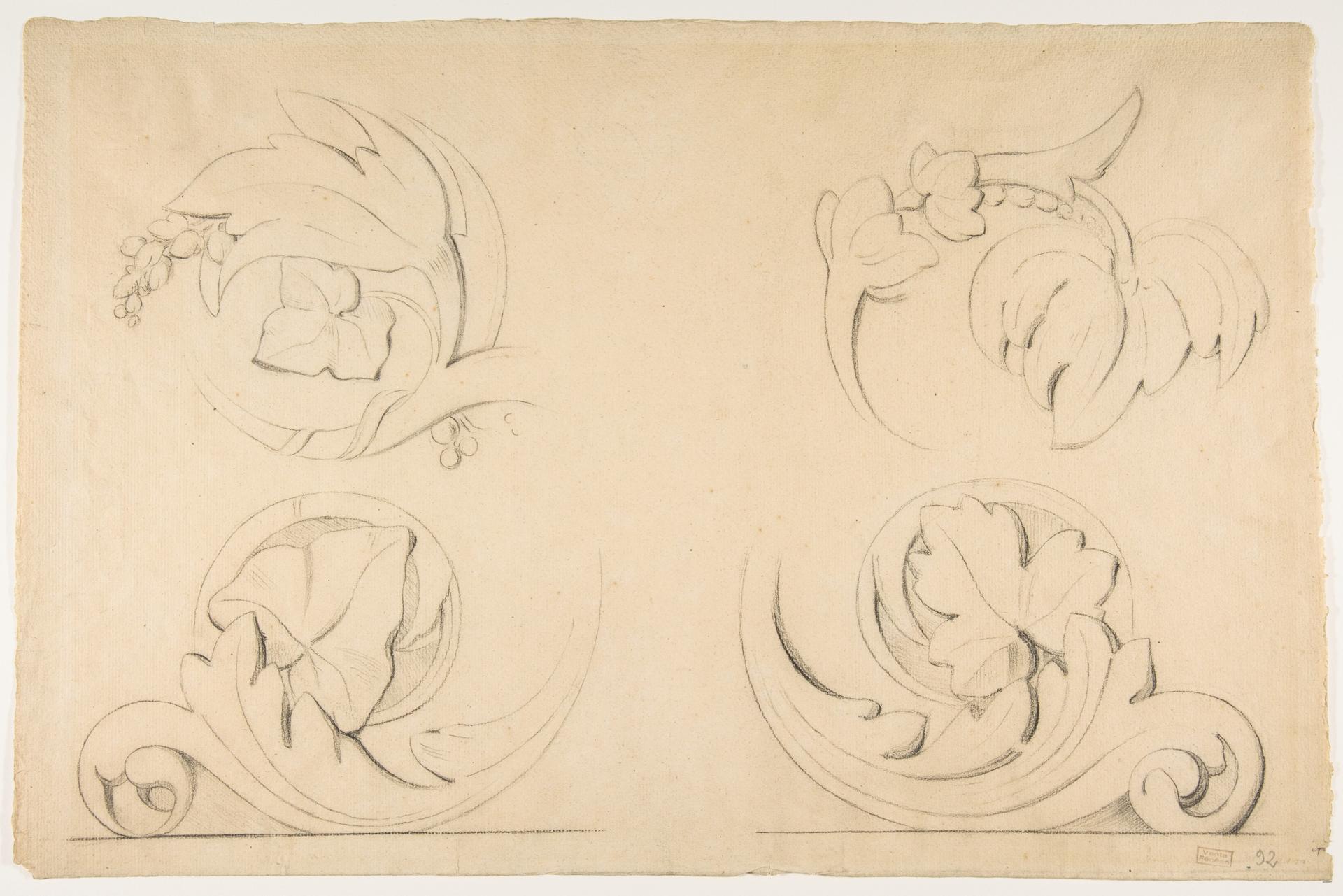
Around 1875, Georges Seurat drew four ornamental rinceaux motifs in black chalk on paper. Each motif sits within a circular frame and presents stylized flowers and leaves.
Description
Four separate motifs appear in round fields, two above and two below. Inside each field, a stylized blossom or foliage twists in interlacing lines. Shading is entirely absent; the areas remain flat, and the light feels even.
Context
This sheet dates from Seurat's early period, long before he turned to Neo-Impressionism. It serves as a study for ornamental architectural details. Rinceaux of this kind were common at the time in architecture and the decorative arts.
Impact
The precise, symmetrical lines lend the drawing a balanced and quiet quality. Because everything is confined to black and white and the forms are clear, the result is matter-of-fact, almost graphic in character.
Technique
Black chalk on paper allows for fine, detailed line work. This approach is typical of study drawings and attests to Seurat's early pursuit of precise formal representation.
AI-generated description text
Source: Metropolitan Museum of Art · Public Domain (CC0 1.0)