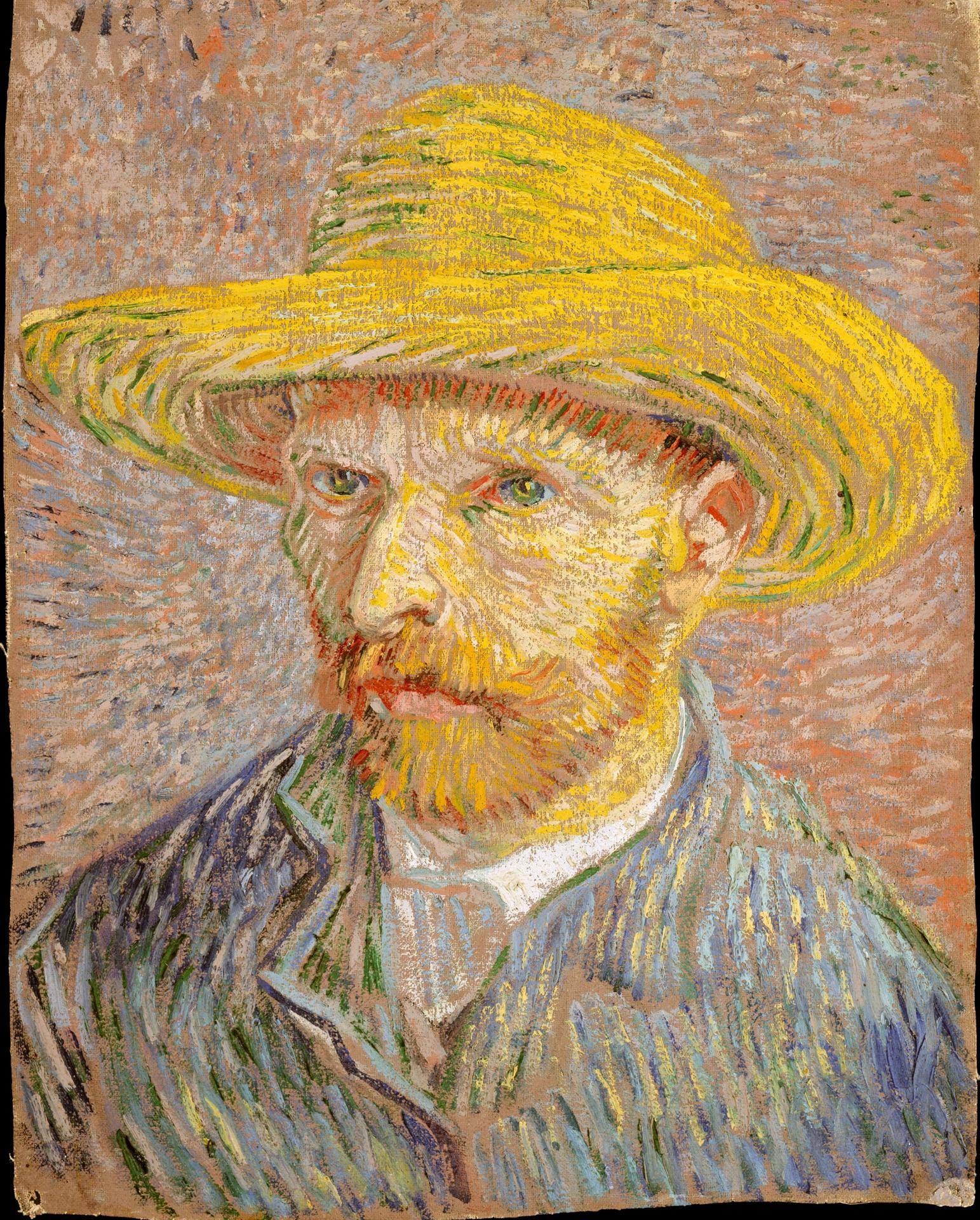
Self-Portrait with a Straw Hat (obverse: The Potato Peeler)
Original title: Self-Portrait with a Straw Hat (obverse: The Potato Peeler)
kurzbeschreibung
This 1887 oil on canvas by Vincent van Gogh presents a frontal, half-length portrait of the artist himself. Unlike many of his other self-portraits, he wears a yellow straw hat and work clothes. On the reverse of the canvas is another painting titled 'The Potato Peeler'.
Description
Van Gogh appears in half-length view, his face modeled with vigorous brushstrokes in yellows and reds, creating a lively, expressive effect. A large yellow straw hat covers his head; its surface is built up with layers of green and brown paint. The blue shirt features green and yellow stripes that recall traditional workwear. The background, in warm earth tones, has a structured, almost textured surface that echoes the weave of the canvas.
Context
This self-portrait was made in 1887 in Paris, where Van Gogh lived from 1886 to 1888. At the time, he was experimenting with pointillist techniques and brighter colors, influenced by the Impressionists and Neo-Impressionists. The presence of 'The Potato Peeler' on the reverse of the canvas points to the reuse of materials and Van Gogh's frugal approach. The straw hat was a typical attribute of rural laborers and reflects his interest in peasant life.
Impact
The visible, energetic brushstrokes and luminous colors give the self-portrait an immediate, expressive quality. The central placement and the artist's direct gaze create an intense presence that engages the viewer directly. From the combination of work clothes and artistic portrayal arises a blend of simplicity and artistic self-assertion.
Technique
Van Gogh painted in oil on canvas, applying colors in visible, impasto strokes. The brushwork remains clearly evident and contributes to the textured surface characteristic of Post-Impressionism. On the reverse is another oil sketch, indicating that the canvas was painted on both sides.
AI-generated description text
Source: Metropolitan Museum of Art · Public Domain (CC0 1.0)