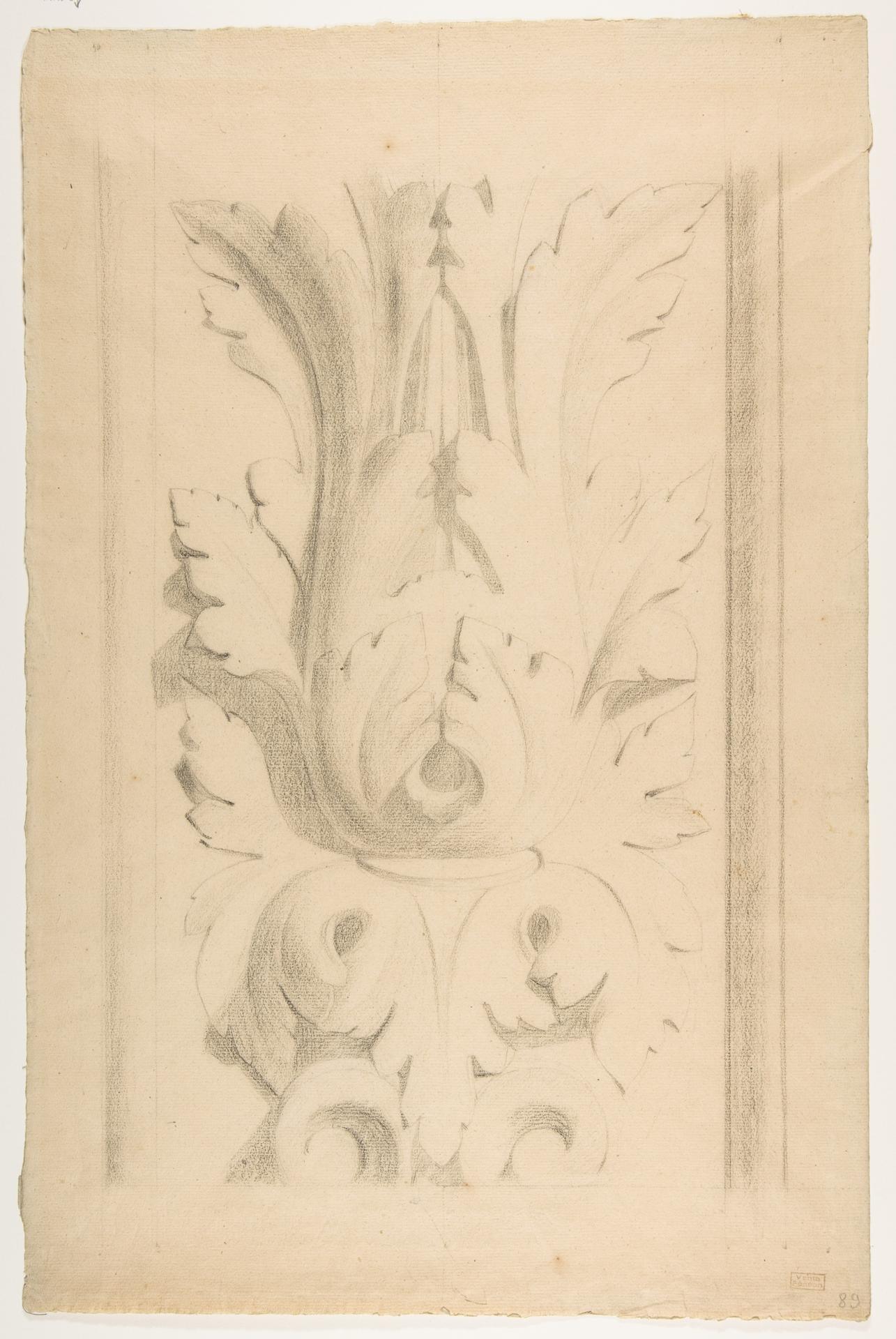
Architectural Motif: Double Acanthus Fleuron
Original title: Architectural Motif: Double Acanthus Fleuron
kurzbeschreibung
Georges Seurat drew "Architectural Motif: Double Acanthus Blossom Ornament" around 1875 in black chalk. The sheet presents a symmetrical ornament: two acanthus leaves extending vertically and enclosing a stylized blossom knob at the center.
Description
Two acanthus leaves reach upward and downward, arranged symmetrically. Their surfaces are covered with fold lines that emphasize texture. Between them sits a stylized blossom knob. The motif oscillates between floral form and architectural capital. The paper appears in a plain cream tone, with no additional colors or background.
Context
Seurat made this study during his early creative phase, before turning to Neo-Impressionism. The acanthus ornament points to classical architecture and likely served as an exercise for decorative elements. In the 19th century, such ornament studies were part of academic training. Even here, Seurat's interest in structure and line is evident.
Impact
The symmetrical arrangement and precise linework give the sheet a calm, balanced presence. Black and cream dominate, so the ornamental motif is brought fully into focus. The detailed leaves lend the work a decorative, almost sculptural quality.
Technique
Black chalk on paper forms the basis. This technique allows fine shading and exact lines, which highlight the structure of the leaves. Seurat used the hardness of the chalk to render clear contours and folds.
AI-generated description text
Source: Metropolitan Museum of Art · Public Domain (CC0 1.0)