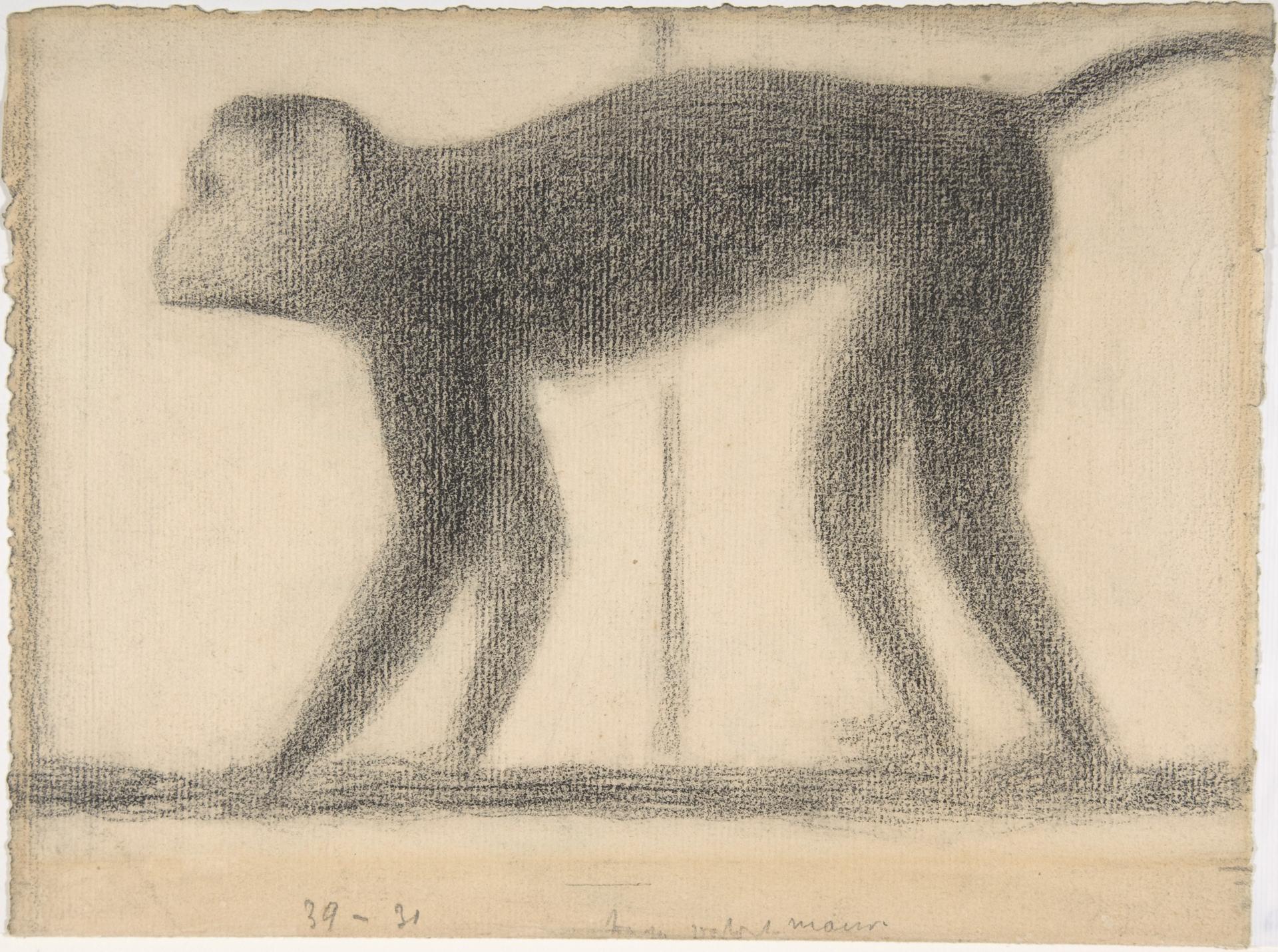
Monkey
Original title: Monkey
kurzbeschreibung
In 1884 Georges Seurat drew a monkey in profile. This study stands apart from many animal depictions of its time because it focuses on a single, striding body with no accessories. The sheet is executed in Conté crayon on paper and measures 31.1 x 23.9 cm. Only the monkey is visible, moving across the surface, with no background or additional pictorial elements.
Description
Unlike related sheets that embed the monkey in an environment, here the body appears in profile: the front legs slightly extended, the hind legs set back, the back rounded, and the shoulders emphasized. Short, dense strokes of Conté crayon cover the surface, making the fur seem almost fluffy. The drawing remains black and white on beige, slightly cracked paper; there are no visible highlights or shading, and the distribution of strokes appears even.
Context
Seurat drew this sheet in 1884, the same year he created his large painting A Sunday Afternoon on the Island of La Grande Jatte. Conté crayon was one of his frequent mediums for studies and sketches, in which he tested light and form. Whether as a preparatory study for a larger work or as an independent exercise, the drawing fits into his interest in movement and texture.
Impact
The reduced layout and evenly placed strokes convey calm and concentration. Through the fluffy fur texture and clear silhouette, the monkey gains an almost physical presence. Because any background is missing, nothing distracts from the animal itself.
Technique
Conté crayon on paper—a material valued for rich, matte tones—forms the basis. The strokes are dense and regular, creating a homogeneous surface. Seurat used the roughness of the paper to mimic the structure of the fur.
AI-generated description text
Source: Metropolitan Museum of Art · Public Domain (CC0 1.0)