Chemin sous bois à Pontoise
Original title: Chemin sous bois à Pontoise
kurzbeschreibung
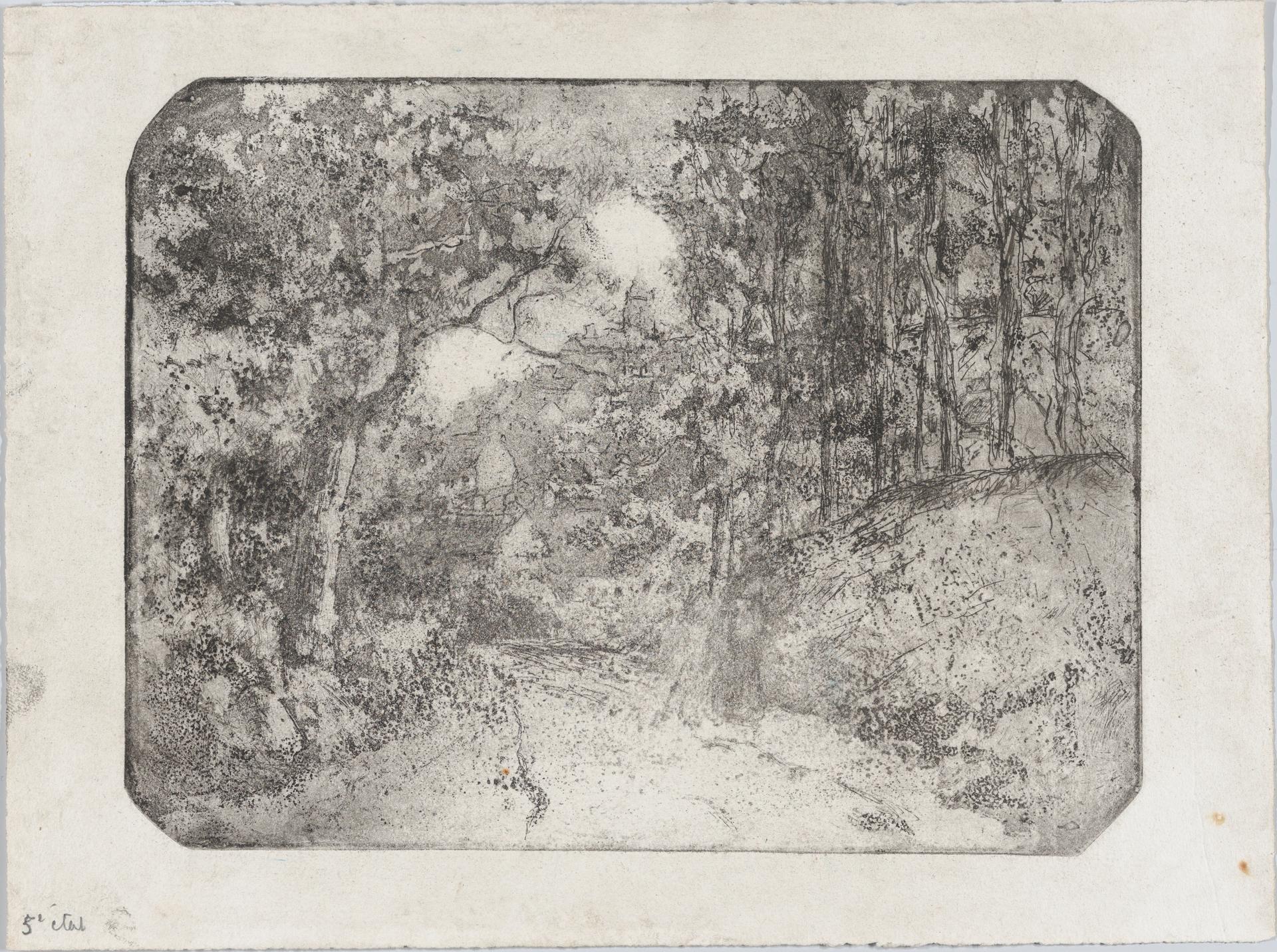
Camille Pissarro made this aquatint and etching in 1879, calling it Waldweg bei Pontoise. A path winds through dense woods, with a town suggested beyond.
Description
A path cuts through the forest and leads toward a distant town. The trees grow close together, their shapes and sizes varying. The town stays small and indistinct, so the eye is drawn to the path and the woods. Light falls from above onto the path and trees, while the town lies in shadow.
Context
In 1879 Pissarro turned increasingly to printmaking. He was living in Pontoise, northwest of Paris, and returned to it as a subject again and again. This etching belongs to the circle of the Impressionist movement, where artists tested everyday landscapes with new techniques.
Impact
The graded greys and soft aquatint give the sheet a calm, atmospheric presence. Because the path remains bright and the town recedes, nature comes forward and a quiet, reflective mood arises.
Technique
The fine grey values come from combining etching and aquatint: the etching provides the lines, the aquatint the flat tones. The plate measures 15.9 × 21.6 cm.
AI-generated description text
Source: Metropolitan Museum of Art · Public Domain (CC0 1.0)