Life in Camp, Part 2: A Deserter
Original title: Life in Camp, Part 2: A Deserter
kurzbeschreibung
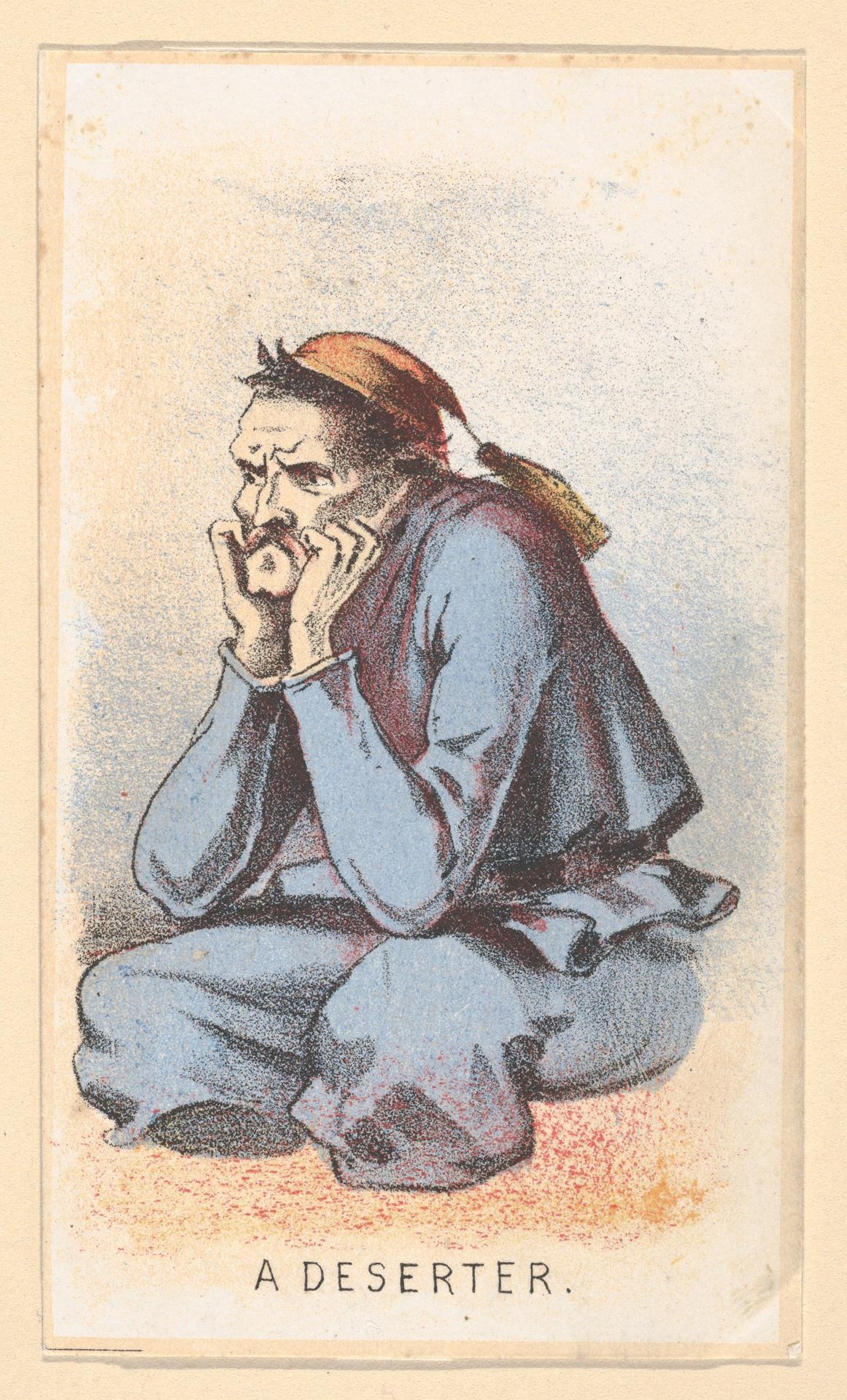
A man in a red cap and dark blue garb sits with his face buried in his hands. Winslow Homer's 1864 lithograph is titled 'A DESERTER' and belongs to a series on Civil War camp life. This print, labeled 'Life in Camp, Part 2', shows the deserter alone, with no other figures.
Description
The layout centers entirely on the solitary seated man, who has taken his place on a plain, bluish-toned ground. Across his long dark blue garment, a yellow bag is strapped to his back, and on his head sits the red cap. Both hands are brought up to his face—a posture that suggests shame or despair. Blue, red, and yellow dominate the palette, with subdued grays and whites. Light falls evenly across the sheet, with no striking shadows or highlights.
Context
Homer drew this lithograph in 1864, in the midst of the American Civil War, while working as an artist-correspondent for Harper's Weekly. It is part of the 'Life in Camp' series, which chronicles soldiers' daily life with a humorous, caricature-like stroke. The appearance of a deserter here struck a nerve: desertion was a widespread problem in the Union Army. For the series, Homer drew on camp incidents he had observed at the front.
Impact
The spare arrangement and restrained color give the print an immediate, haunting impact. The caricatural exaggeration lends a humorous yet thoughtful undertone. Looking at the deserter, one wavers between pity and detachment—a trait characteristic of Homer's early graphic work.
Technique
The print was executed as a color lithograph, a printing process in which greasy ink is transferred to a stone. Homer limited himself to blue, red, and yellow so that the figure stands out clearly from the background. Such lithographs could be reproduced cheaply, which was crucial for distribution in magazines like Harper's Weekly.
AI-generated description text
Source: Metropolitan Museum of Art · Public Domain (CC0 1.0)