Life in Camp, Part 1: Riding on a Rail
Original title: Life in Camp, Part 1: Riding on a Rail
kurzbeschreibung
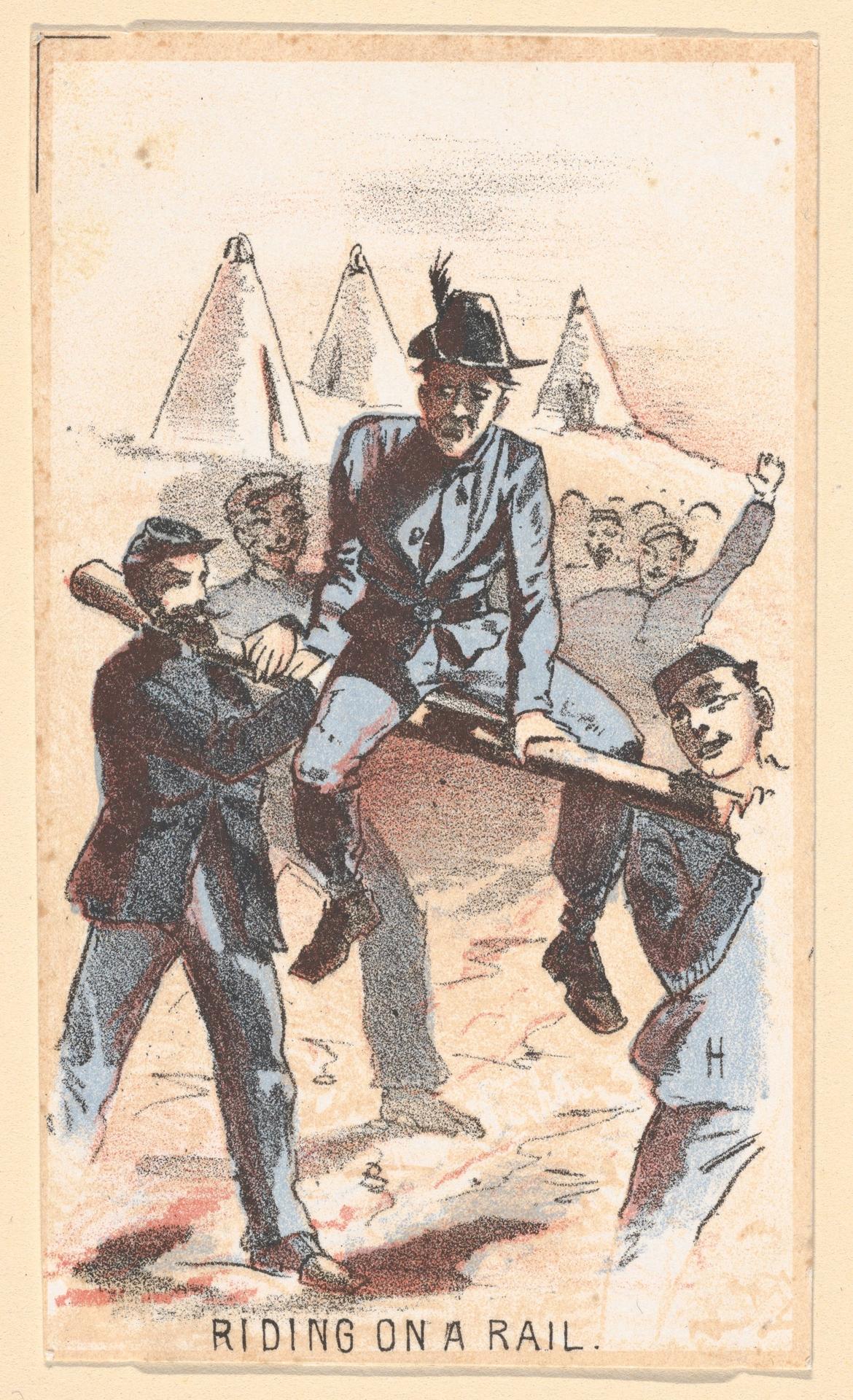
A soldier straddles a rail while three uniformed comrades hold him steady — a rough camp prank that Winslow Homer set down as a color lithograph in 1864. The small print (10.4 x 6.1 cm) belongs to a series on everyday life during the American Civil War and turns coarse camp entertainment into a pointed, caricature-like scene.
Description
Four men in uniform fill the sheet: one sits astride a rail, two grip him, and another pins his arms. Tents rise behind them, marking the setting as a military camp. Blues and grays dominate the palette, in keeping with the uniforms of the period. Light falls evenly, with no harsh shadows, which reinforces the illustrative character. The faces are exaggerated, and the layout drives toward the comic punchline.
Context
Homer drew the lithograph in 1864, in the middle of the American Civil War, while working as an artist-correspondent for Harper's Weekly. It forms part of a series on camp life that portrayed soldiers' daily routines with humor and a critical eye. Scenes of this kind of rough justice were widespread in the popular culture of the day and were meant to entertain readers on the home front.
Impact
The caricatural streak and the restless arrangement provoke immediate amusement while keeping the event at arm's length. Because the tones are few and the lines crisply drawn, the sheet gains graphic sharpness — and that sharpness carries the comic tone.
Technique
The image was printed as a color lithograph, a process that allowed wide distribution at the time. Flat color areas and precise lines are typical of nineteenth-century lithography. The small format, roughly 10 by 6 cm, suggests it served as an insert or collectible card.
AI-generated description text
Source: Metropolitan Museum of Art · Public Domain (CC0 1.0)