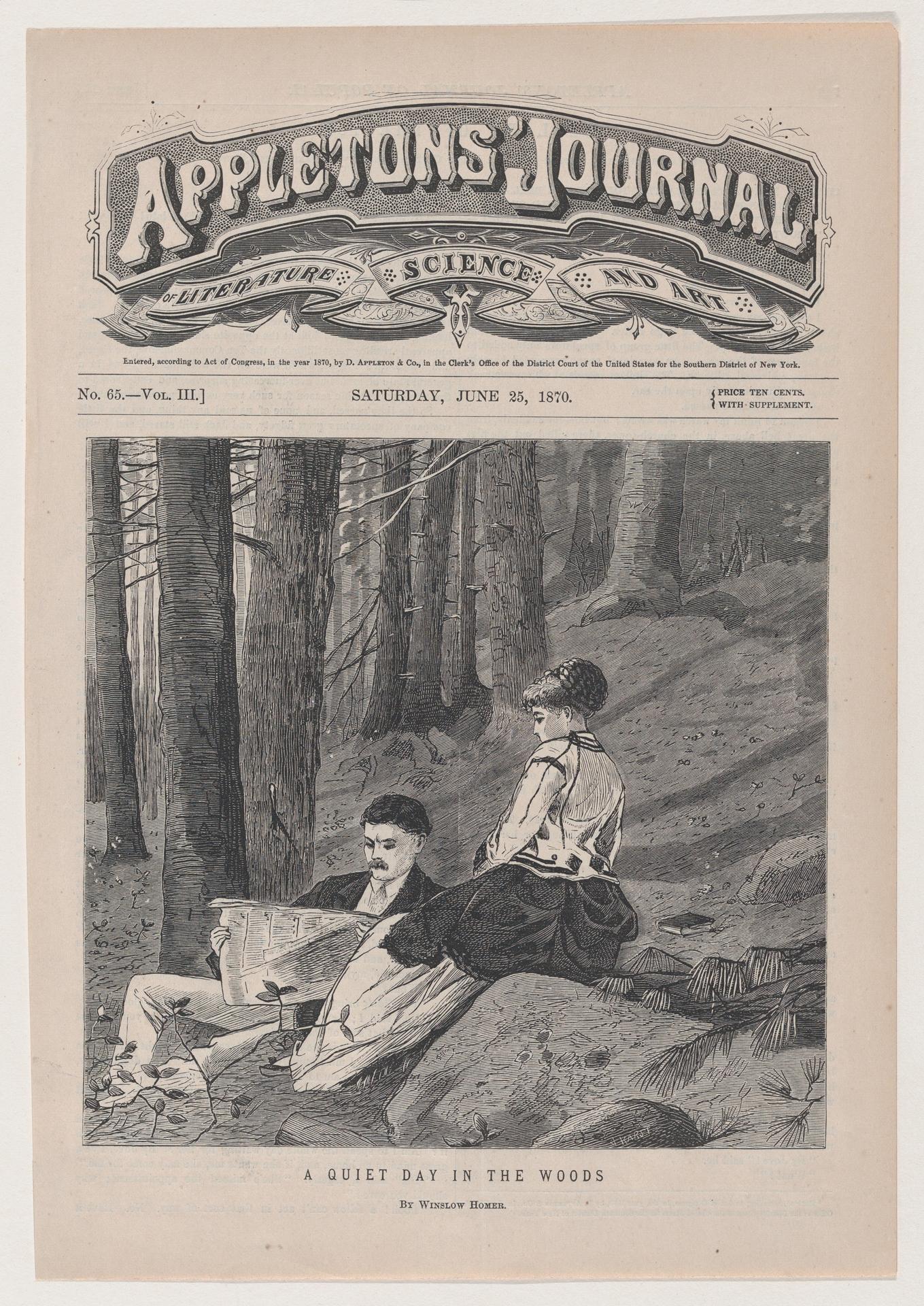
A Quiet Day in the Country (from "Appleton's Journal," Vol. III)
Original title: A Quiet Day in the Country (from "Appleton's Journal," Vol. III)
kurzbeschreibung
Winslow Homer's wood engraving A Quiet Day in the Country dates from June 1870 and places two figures in a clearing in the woods. A woman has settled on a boulder, while a man sits on the ground reading a paper. The print is executed in black and white.
Description
A woman in a dress and blouse sits on a block of stone and turns her gaze toward a man; dressed in a suit and cap, he reads a sheet of paper from his seat on the forest floor. Dense trees and a path running through the woods fill the rear of the picture and add to its quiet, secluded mood. Across the top runs the lettering "Appleton's Journal" with subtitles on literature, science and art; the artist's name and the work's title close the bottom. The illustration stays black and white throughout.
Context
On June 6, 1870, the image appeared as an illustration in Appleton's Journal, a widely read American weekly of the period. Homer was working as a freelance illustrator in these years and produced numerous wood engravings for various publications. This idyllic leisure scene met the contemporary appetite for nature and the emerging leisure culture of the post-Civil War United States.
Impact
The calm arrangement and clear drawing give the picture a peaceful, unhurried feel. Because everything stays in black and white, attention settles on the exchange between the two figures and on the natural surroundings, with nothing to distract it. Unassuming and welcoming, the view is a typical example of Homer's early illustrative work.
Technique
Homer worked here in wood engraving: the design was cut into a wood block and afterwards printed on paper. Fine lines and hatching bring out textures such as foliage and clothing in detail. The sheet measures 27.6 x 19.1 cm, a format common for magazine illustration pages.
AI-generated description text
Source: Metropolitan Museum of Art · Public Domain (CC0 1.0)