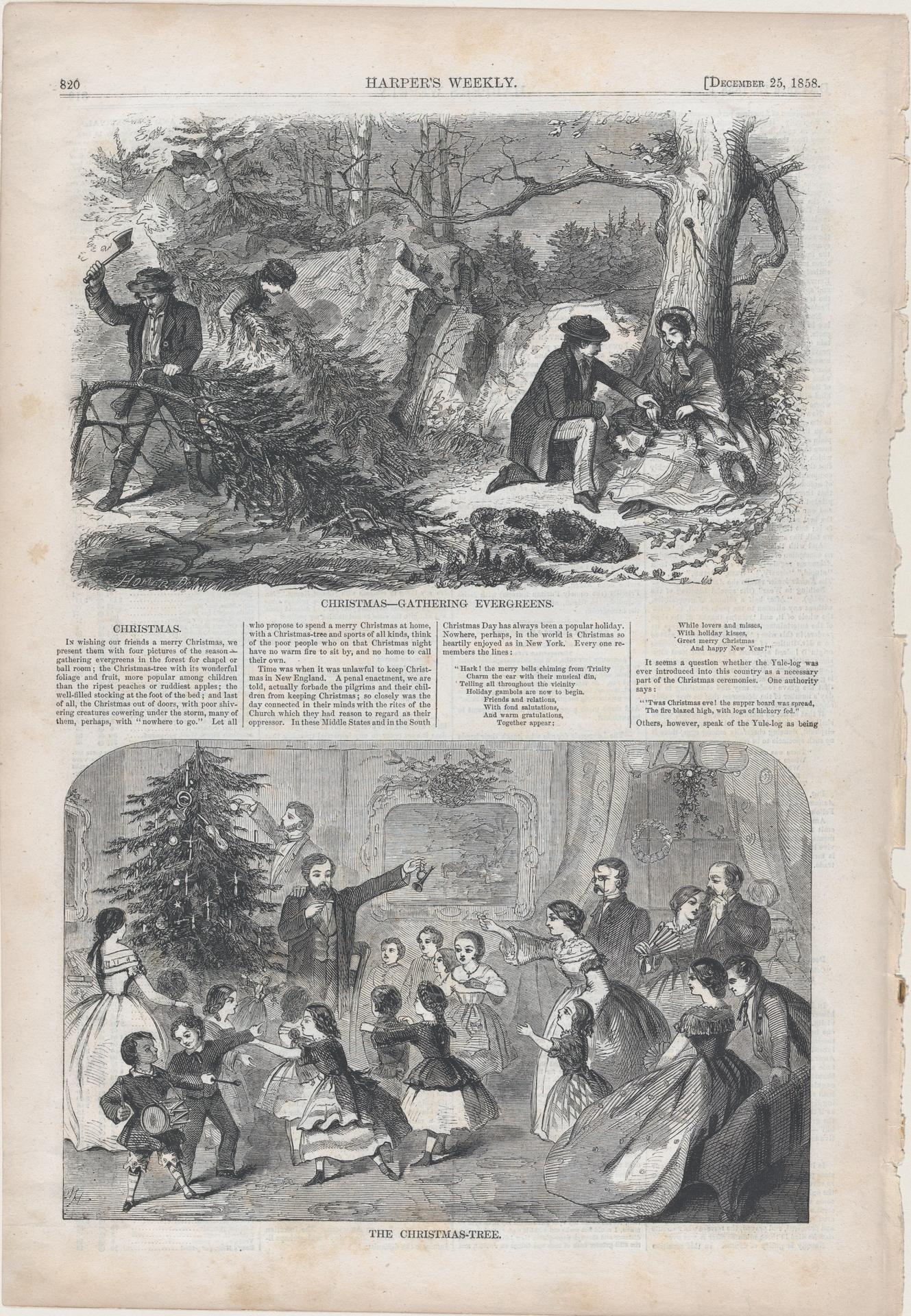
The Christmas Tree (from "Harper's Weekly," Vol. II)
Original title: The Christmas Tree (from "Harper's Weekly," Vol. II)
kurzbeschreibung
Unlike many contemporary Christmas images that focus on gift-giving, Winslow Homer's wood engraving 'The Christmas Tree' links two separate actions: felling a fir in a snowy forest and a family's domestic celebration around a decorated tree. The print appeared on December 25, 1858, in Harper's Weekly and counts among Homer's early works as an illustrator for the popular weekly magazine.
Description
Split into two register-like zones, the layout first presents a group of figures in historical dress surrounding a small, undecorated conifer in a snow-covered woodland. Below, a well-to-do family gathers around a large Christmas tree hung with baubles and garlands; children dance and play while adults look on. The precise execution of the wood engraving heightens the festive mood of the domestic scene.
Context
When the print appeared in 1858 in the Christmas issue of Harper's Weekly, Winslow Homer was working as a freelance illustrator for one of the leading American magazines of the nineteenth century. The Christmas tree was then still a young custom in the United States, introduced by German immigrants and only gradually spreading among the middle class. The illustration reflects the growing commercialization and the domestic focus of the holiday.
Impact
The contrast between the natural procurement of the tree and the festive celebration creates a narrative tension that draws the viewer into the scene. The detailed rendering of figures and tree conveys an idyllic yet idealized picture of Christmas in Victorian America.
Technique
For publication in Harper's Weekly, the image was cut into the woodblock. This process allowed fine lines and shading, which stand out clearly in the illustration. At 14.9 x 23.2 cm, the format matches the half-page illustrations common in magazines of the period.
AI-generated description text
Source: Metropolitan Museum of Art · Public Domain (CC0 1.0)