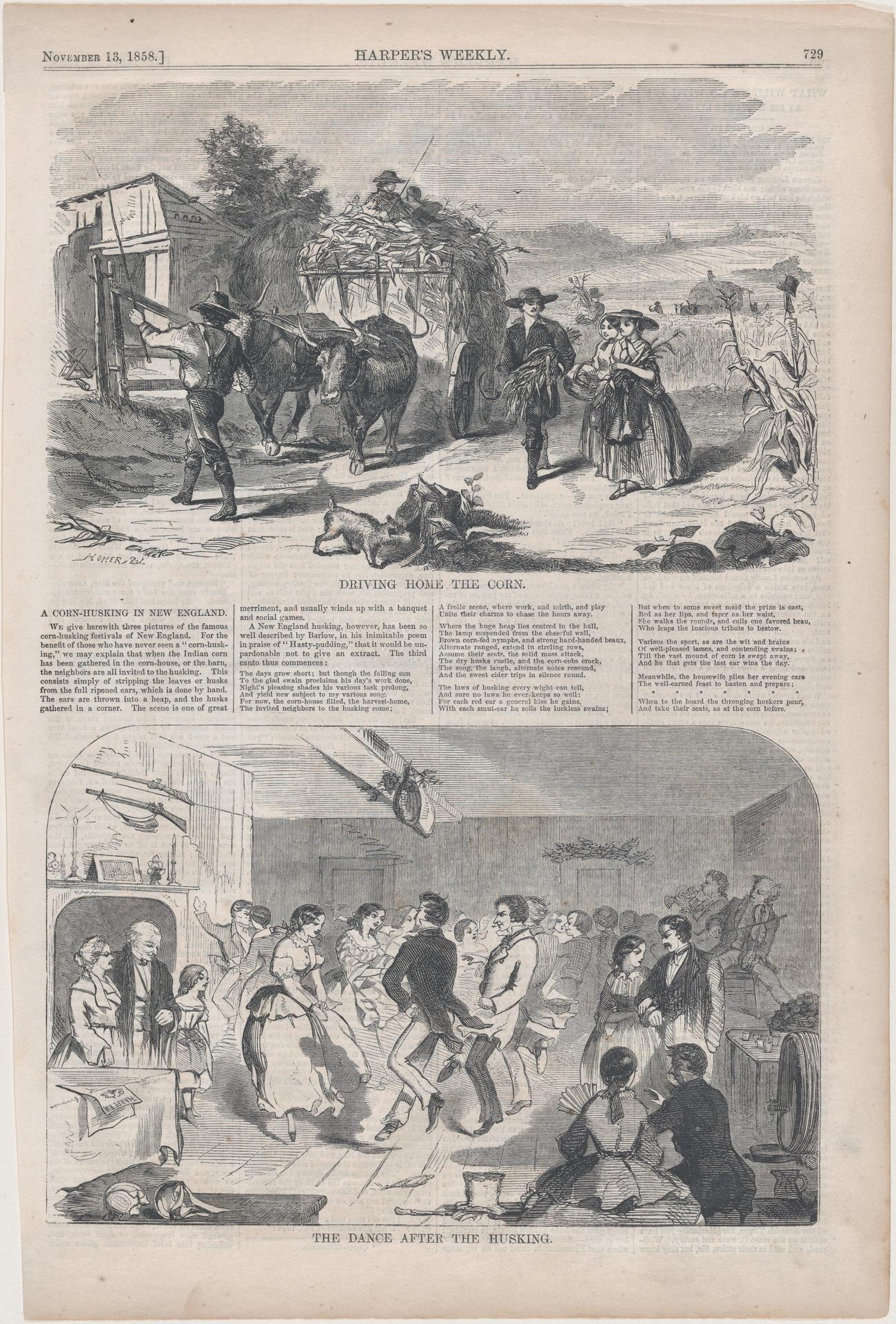
Driving Home the Corn and Dance after the Husking (from "Harper's Weekly," Vol. II)
Original title: Driving Home the Corn and Dance after the Husking (from "Harper's Weekly," Vol. II)
kurzbeschreibung
An ox team hauls a wagon loaded with corn toward home while, below, people dance after the husking. Winslow Homer's wood engraving ran in Harper's Weekly on November 13, 1858, and packs two scenes of rural life onto a single sheet. It stands among the examples of mid-nineteenth-century illustrated press work.
Description
At the front a man steers the ox team drawing the wagon of corn; the figures are strung one behind another, which heightens the sense of movement. The upper band holds this ride home, the lower an interior with dancing couples in period dress, others gathered around them. Furniture and an open door frame the action at the back of this scene. The layout reads frontally and in clear divisions, while fine hatching builds the range of grays.
Context
Homer drew the engraving for Harper's Weekly, one of the leading illustrated magazines in the United States, published since 1857. At the time he was earning a living as a freelance illustrator for the paper before turning later to painting. Harvest labor and celebration were motifs audiences wanted, since they prized idyllic pictures of country life. Such scenes often served as emblems of American rural life and were printed accordingly often.
Impact
Work and festivity stand in narrative contrast through the clear split into two halves. Thanks to the detailed hatching the figures feel lively, almost cheerful. Even light without hard shadows leaves a calm, harmonious impression.
Technique
For a wood engraving the design is cut into a woodblock and then printed. Fine crossing hatch marks produce the different grays and model contours and textures alike. The precision of the details points to careful handwork.
AI-generated description text
Source: Metropolitan Museum of Art · Public Domain (CC0 1.0)