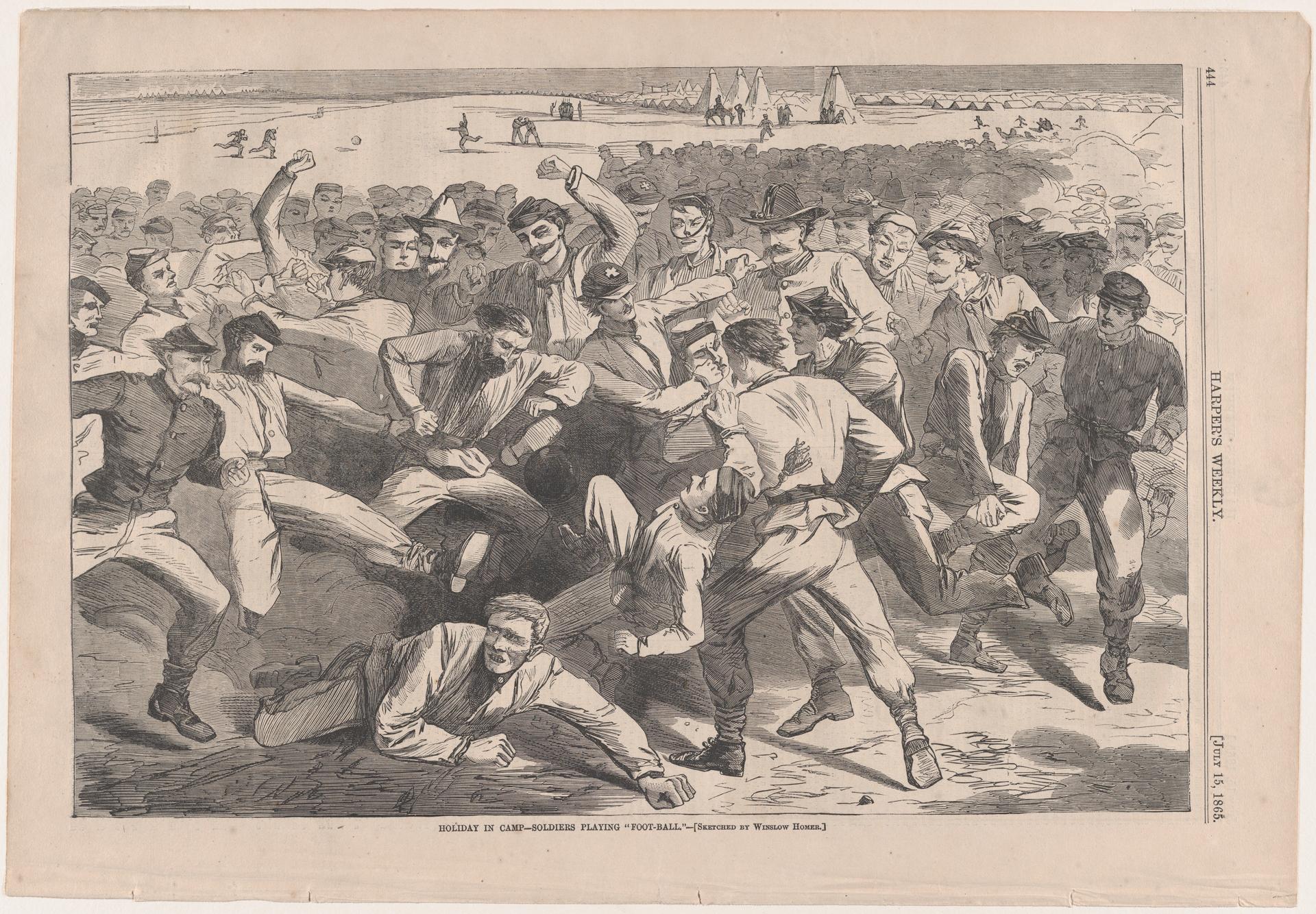
Holiday in Camp – Soldiers Playing "Foot-Ball" – Sketched by Winslow Homer
Original title: Holiday in Camp – Soldiers Playing "Foot-Ball" – Sketched by Winslow Homer (from "Harper's Weekly," Vol. IX)
kurzbeschreibung
Where many wartime illustrations of the period turn to battles or roll calls, this wood engraving by Winslow Homer from July 1865 puts Union soldiers' leisure front and center: they are kicking a ball around the camp ground. Drawn for Harper's Weekly, it captures an unusual slice of everyday military life.
Description
Uniformed men are scattered across the picture: one strides forward at full stretch, another leaps into the air, a third lies sprawled on the ground. Behind them tents and further figures line the open space, while onlookers follow the play. The poses are loose and varied, giving the arrangement a real sense of motion. Everything stays black and white, with the even tonal balance typical of wood engraving.
Context
The print appeared in July 1865, a few months after the end of the American Civil War, in the widely circulated illustrated magazine Harper's Weekly. Homer had covered the war as a correspondent and repeatedly recorded scenes of soldiers' lives. This sheet turns attention to idle hours in camp, setting a counterpoint to his earlier battle pictures.
Impact
An almost relaxed mood comes off the page: the soldiers look like a community taking some time off. The easy poses and clear grouping of figures make the viewer feel like someone watching from the edge of the field. The realistic, closely observed style reinforces the sense of authenticity.
Technique
Wood engraving is a relief process in which the design is cut into a block of wood. Fine hatching and lines allow details and movements to be reproduced precisely. The monochrome palette suits this technique and made it especially well suited to reproduction in magazines.
AI-generated description text
Source: Metropolitan Museum of Art · Public Domain (CC0 1.0)