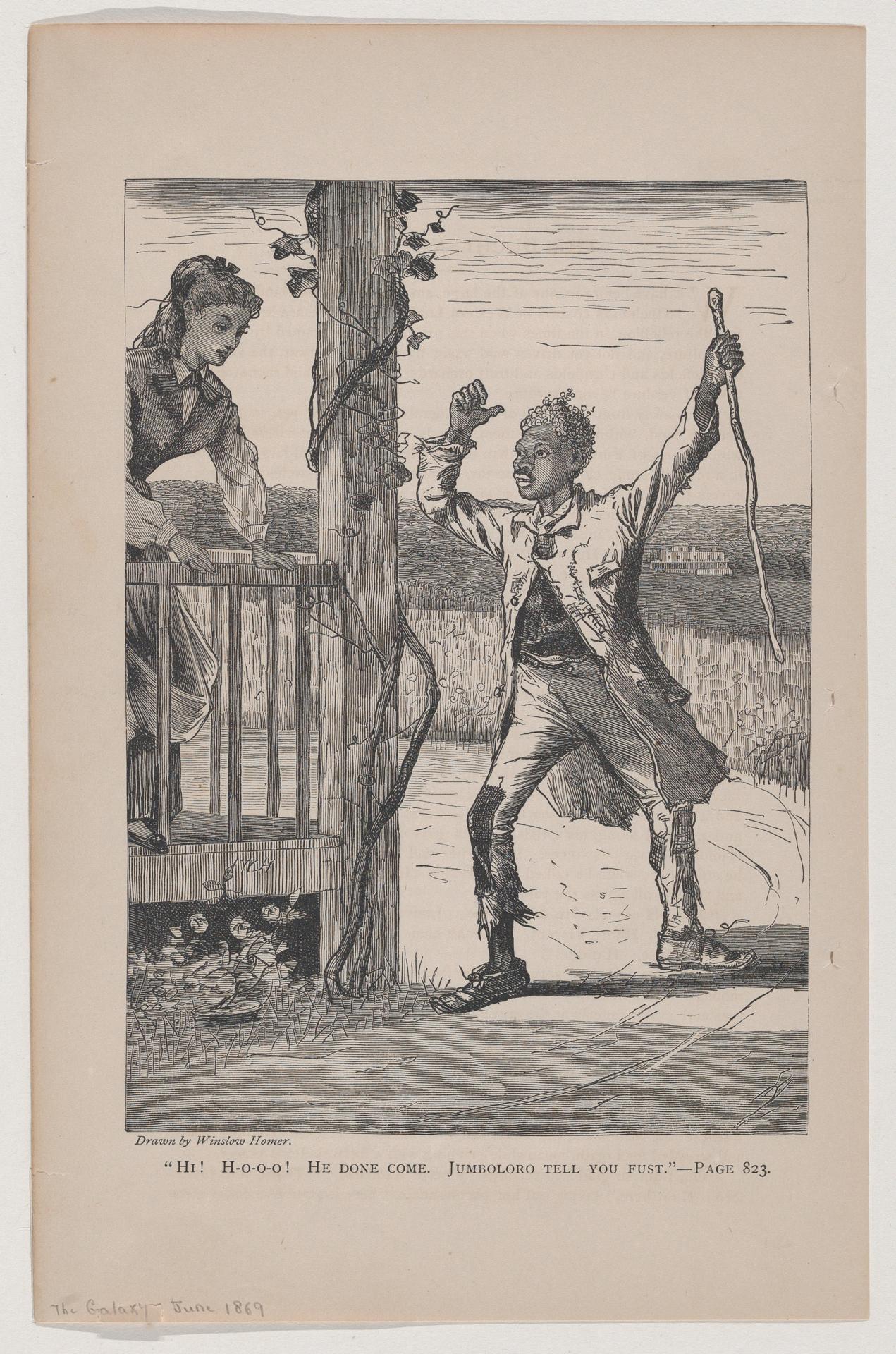
Hi! Ho-o-o! He Done Come. Jumbolor Tell you Fust
Original title: "Hi! Ho-o-o! He Done Come. Jumbolor Tell you Fust" (The Galaxy, An Illustrated Magazine of Entertaining Reading, Vol. VII)
kurzbeschreibung
Where many genre scenes of the period hold their figures at a polite distance, this Winslow Homer print goes straight for the body: a young man turns on a woman on a porch with a gesture that all but shouts. Published in The Galaxy in June 1869, the wood engraving stays black and white and measures 17.5 by 12.4 cm in the image area.
Description
Up front a young man with a stick in his hand leans toward a woman on the porch. His shirt sleeves are rolled high, he wears trousers and boots, and his arms are thrown up in a burst of excitement; his face is vivid. The woman, in a long-sleeved dress and shawl, looks down at him from the porch. A stretch of landscape, a tree and a house are merely suggested. The arrangement feels restless and pulls the eye toward the exchange between the two; light falls evenly, without shadow.
Context
The illustration was made for The Galaxy, an American magazine that ran from 1866 to 1878 and was valued for both its literary and its pictorial contributions. Its subject belongs to rural America after the Civil War and takes up an everyday, popular theme. During the 1860s Homer worked steadily as an illustrator for various magazines before turning to painting. The June 1869 date falls in a period when he was already known for realistic accounts of American life.
Impact
The young man's lively gestures and expression generate immediate tension and movement. Crisp, detailed lines and a plain layout aim the viewer's attention directly at the action. Because the lighting carries no shadows, the scene reads as matter-of-fact, almost documentary, a trait typical of wood-engraved illustration of the day.
Technique
The method was wood engraving: an image is cut into a block of wood and printed from it afterwards. With fine, precise lines Homer rendered textures and details such as clothing and setting. The black-and-white reproduction, with no gray tones, follows from this printing technique, which was widespread in nineteenth-century illustrated magazines.
AI-generated description text
Source: Metropolitan Museum of Art · Public Domain (CC0 1.0)