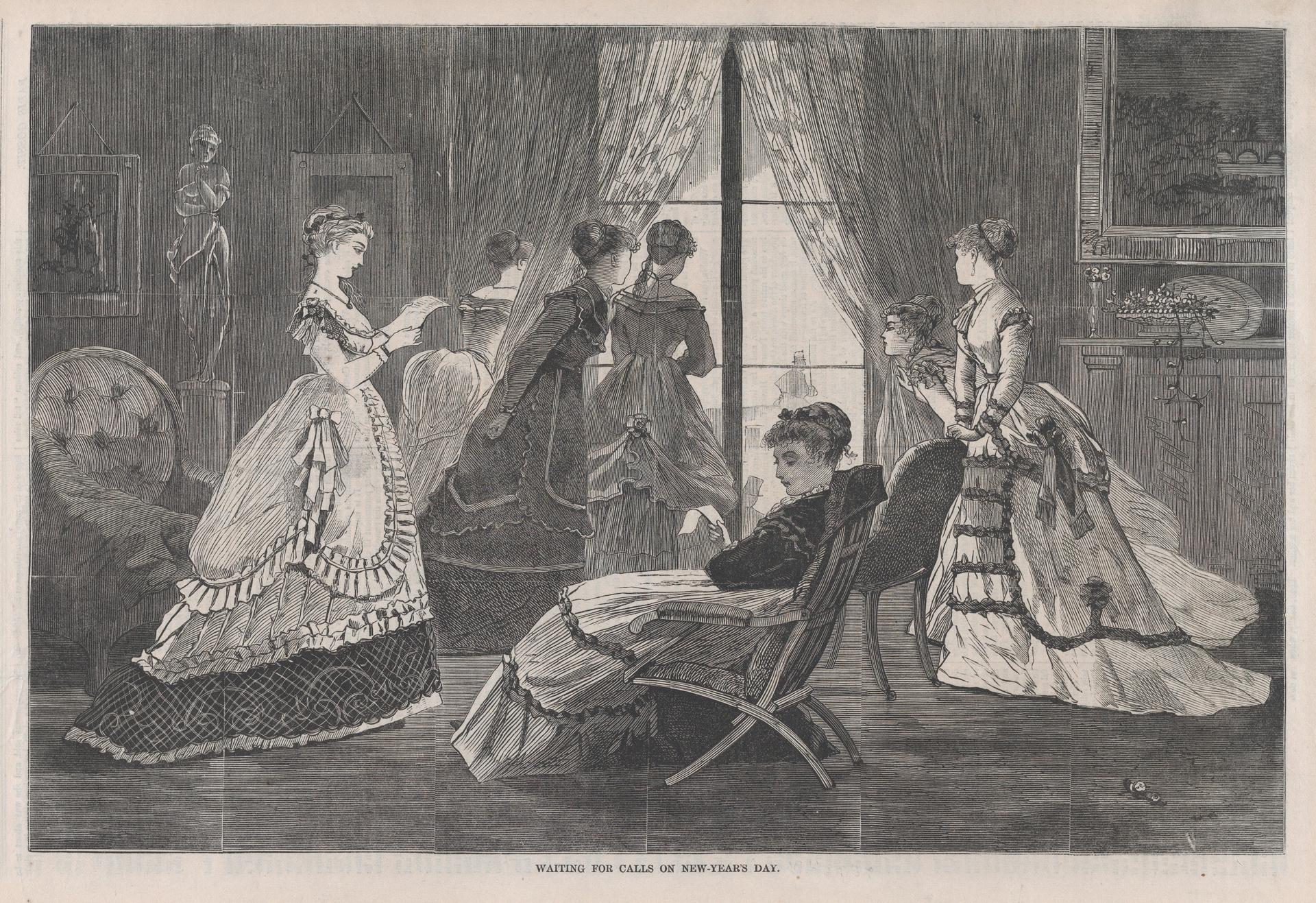
Waiting for Calls on New Year's Day (from "Harper's Bazar," Vol. II)
Original title: Waiting for Calls on New Year's Day (from "Harper's Bazar," Vol. II)
kurzbeschreibung
Women in long dresses fill a parlor, waiting for the visitors expected on New Year's Day. Winslow Homer's wood engraving from 1869 appeared on January 2 of that year in Harper's Bazar; the image area measures 22.9 x 34.9 cm.
Description
Several of the ladies stand together chatting, while others have taken seats or listen with obvious tension. Elaborate, floor-length gowns dominate the picture. On the left rises a statue, while on the right daylight falls through a window and a shelf crowded with objects comes into view. The layout feels balanced, with the figures gathered in the middle, and the sheet remains monochrome throughout, executed in delicate lines and gradations.
Context
Harper's Bazar catered to a middle-class readership in the United States. In the 19th century, the New Year's call was part of social life: ladies stayed at home to receive well-wishers. During the 1860s Homer drew for several magazines before turning to painting. Dated January 2, 1869, the print is tied directly to the turn of the year.
Impact
A quiet expectancy hangs over the image, carried by the balanced arrangement and the calm postures of the women. The delicate linework of the wood engraving gives the subject an elegant, almost ceremonial tone that suits the social occasion.
Technique
For printing, the design was cut into wood and then reproduced. This process allows for fine lines and shading, which here render fabrics and facial features. The monochrome execution matches the graphic art of that era.
AI-generated description text
Source: Metropolitan Museum of Art · Public Domain (CC0 1.0)