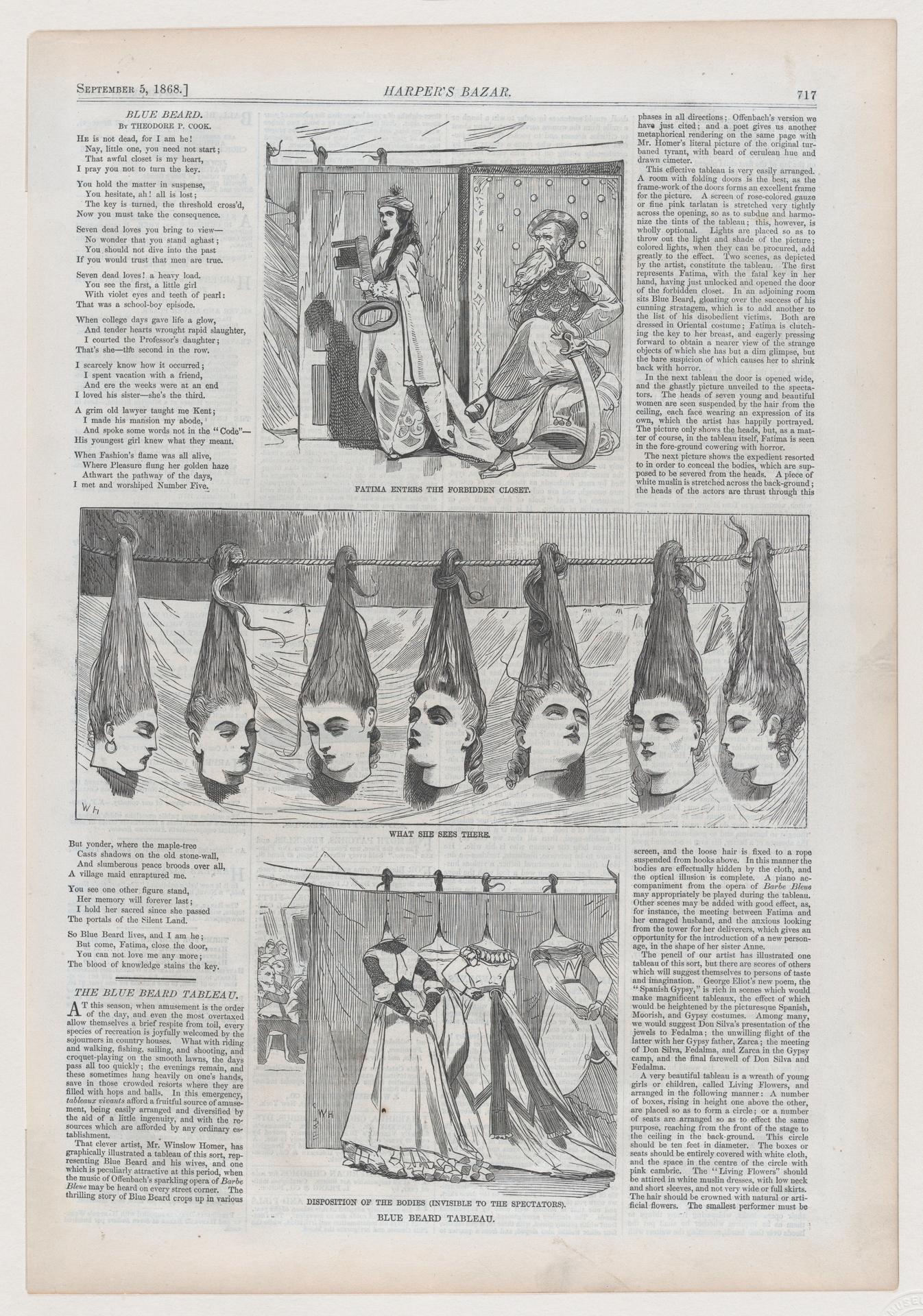
Blue Beard Tableau: Fatima Enters the Forbidden Court; What She Sees There; Disposition of the Bodies (Invisible to the Spectators) (from "Harper's Bazar," Vol. I)
Original title: Blue Beard Tableau: Fatima Enters the Forbidden Court; What She Sees There; Disposition of the Bodies (Invisible to the Spectators) (from "Harper's Bazar," Vol. I)
kurzbeschreibung
Dated September 5, 1868, this wood engraving by Winslow Homer takes up a scene from the Bluebeard tale as it was told in Harper's Bazar. Fatima is shown stepping into the forbidden chamber, and beneath her appear the corpses that stay hidden from the audience within the picture. The plate was executed as a wood engraving.
Description
The sheet is split into two registers. Above, a woman in a long robe—presumably Fatima—enters a room holding a chain or rope; behind her stands a man in traditional dress with a sword. Below, several heads are strung along a line, each with its own expression. Wooden doors and a wooden ceiling frame the view. Grays are spread evenly, with no strong contrasts, as is usual for wood engraving.
Context
The print appeared in Harper's Bazar, a weekly magazine for fashion and entertainment, on September 5, 1868. It belongs to a tableau—a living picture staged to retell the Bluebeard fairy tale. During the 1860s Homer worked as a magazine illustrator and supplied numerous wood engravings to Harper's Bazar. Marking the corpses as invisible to the audience follows the stage practice of the day, which kept violence off open display.
Impact
Because the image falls into two scenes, tension arises between what happens above and what lies hidden below. Even light and delicate lines give the sheet a sober, almost documentary air. Whoever looks becomes a silent witness to a moment that was meant to stay concealed.
Technique
Wood engraving is a relief process, requiring the design to be cut into hard wood. Extremely fine lines and the precise rendering of garments and faces are characteristic of the technique. Printing was in black on paper, which accounts for the gradations of gray.
AI-generated description text
Source: Metropolitan Museum of Art · Public Domain (CC0 1.0)