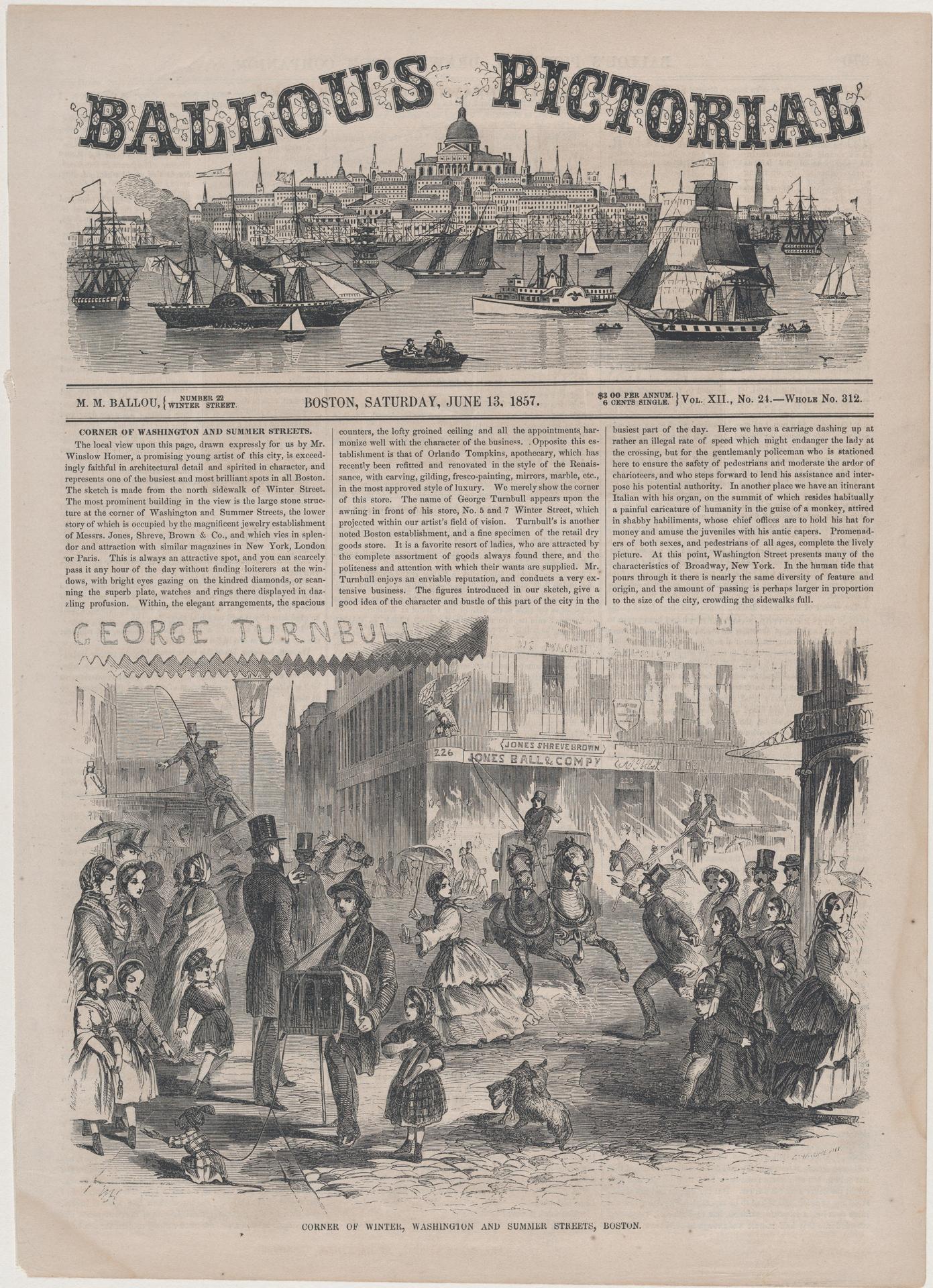
Corner of Winter, Washington and Summer Streets, Boston (Ballou's Pictorial Drawing Room Companion, Vol. XII)
Original title: Corner of Winter, Washington and Summer Streets, Boston (Ballou's Pictorial Drawing Room Companion, Vol. XII)
kurzbeschreibung
Unlike many contemporary city views that single out monuments, this wood engraving turns its attention to everyday life at a crossing: Winslow Homer drew the busy corner of Winter, Washington, and Summer Streets in Boston. The illustration appeared on June 13, 1857, in Ballou's Pictorial Drawing Room Companion. As a wood engraving, it belongs to the print techniques then common for magazine pictures.
Description
Pedestrians in period clothing fill the street: women in long skirts, children, men in suits, some with umbrellas open, suggesting wet weather. Behind the crowd, detailed buildings, churches, and a harbor with sailing ships are layered in receding planes. The monochrome black and white, with sharp contours and fine internal drawing, defines the image. Evenly distributed light strengthens the realistic impression of the wood engraving.
Context
In the 1850s, Winslow Homer worked as a freelance illustrator for magazines such as Ballou's Pictorial Drawing Room Companion, long before he became famous as a painter. This work falls into that early phase, when he engaged with scenes of everyday life and urban activity. Boston was then growing into a port metropolis, its cityscape transformed by trade and immigration. Wood engravings made such images accessible to a broad public in popular print media.
Impact
The even lighting and precise linework give the print a clear, almost documentary character that draws the viewer directly into the action. The dense layering of figures and architecture captures the bustle of a nineteenth-century metropolis.
Technique
Wood engraving is a relief process: the design is cut into a wood block, the raised areas are inked, and an impression is pulled on paper. Fine lines and hatching allow for detailed reproduction, as was customary for book and magazine illustrations of the time. The paper format of 15 1/2 by 10 11/16 inches points to a generous presentation in the magazine.
AI-generated description text
Source: Metropolitan Museum of Art · Public Domain (CC0 1.0)