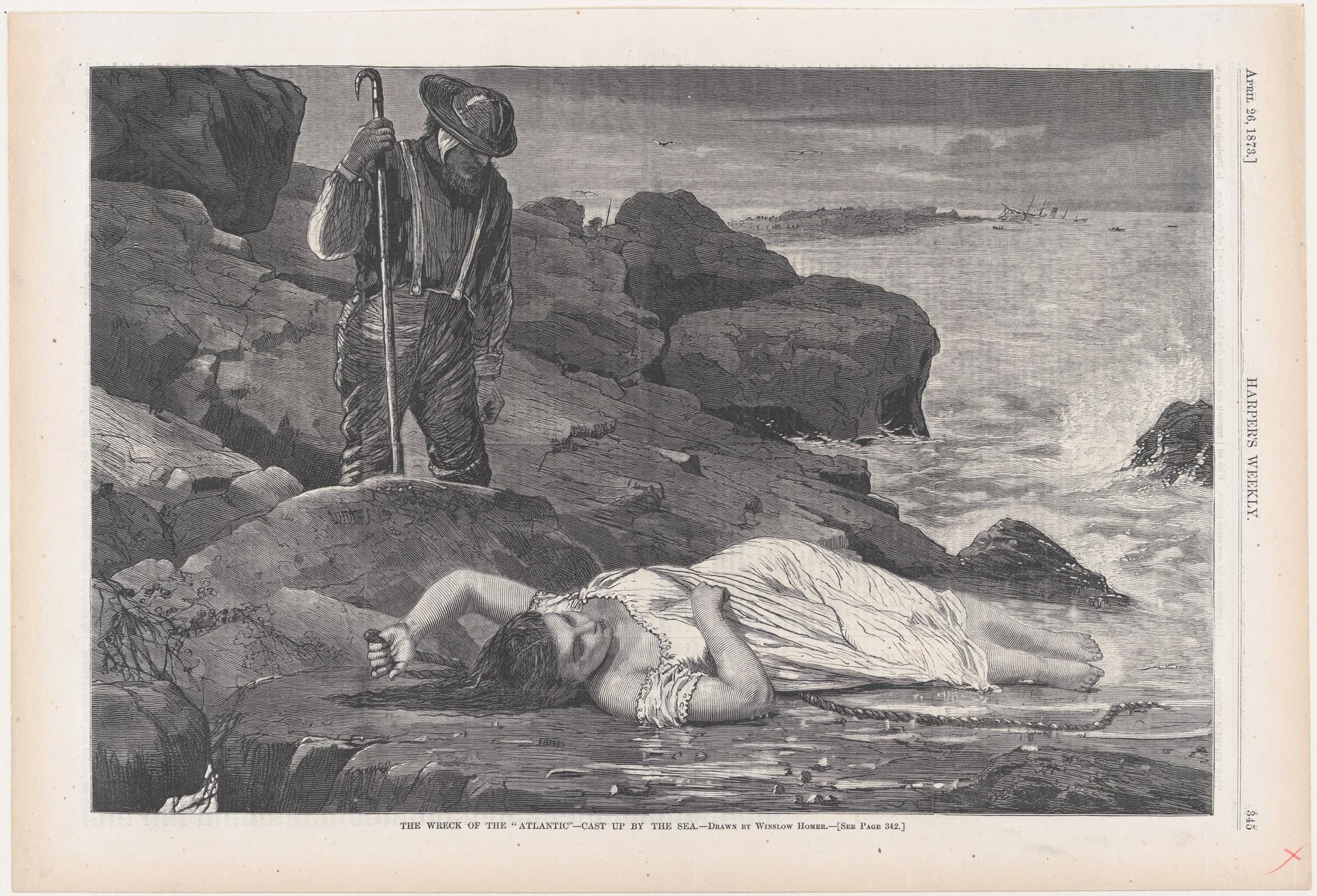
The Wreck of the "Atlantic" – Cast Up by the Sea (from "Harper's Weekly," Vol. XVII)
Original title: The Wreck of the "Atlantic" – Cast Up by the Sea (from "Harper's Weekly," Vol. XVII)
kurzbeschreibung
Winslow Homer's 1873 wood engraving presents a lifeless woman in a pale dress stretched out on the sand, a man with a stick standing over her. Published in Harper's Weekly, the print records the aftermath of a shipwreck.
Description
The eye is drawn first to the pale figure of the woman lying face down on the sand, her head turned away, arms resting loosely at her sides. Beside her stands a man in a work apron and straw hat, a stick in his hand, looking down at her. Rocks rise behind the figures, and beyond them the sea appears in dark, rough tones that carry the sombre mood. The arrangement pulls the woman and the man forward while the sea and rocks close the frame. Grey values typical of wood engraving bring out the texture of the rocks and the interplay of light and shadow.
Context
The engraving was made for Harper's Weekly, a widely read illustrated magazine of the day, and appeared on 26 April 1873. It refers to the sinking of the passenger steamer Atlantic off Nova Scotia on 1 April 1873, in which more than 500 people died. Homer was then working as an illustrator for the paper, recording current events in reportage-like pictures.
Impact
The woman's calm, almost statuesque pose, together with the man's thoughtful gaze, makes the scene feel still and oppressive at once. The dark, rough sea behind heightens the sense of loss and natural force without the scene becoming melodramatic.
Technique
Wood engraving is a relief process: the image is cut into a block of wood and printed from it. Precise hatching and fine lines allow detailed rendering of textures and contrasts of light and shade, as can be seen in the rocks and clothing.
AI-generated description text
Source: Metropolitan Museum of Art · Public Domain (CC0 1.0)