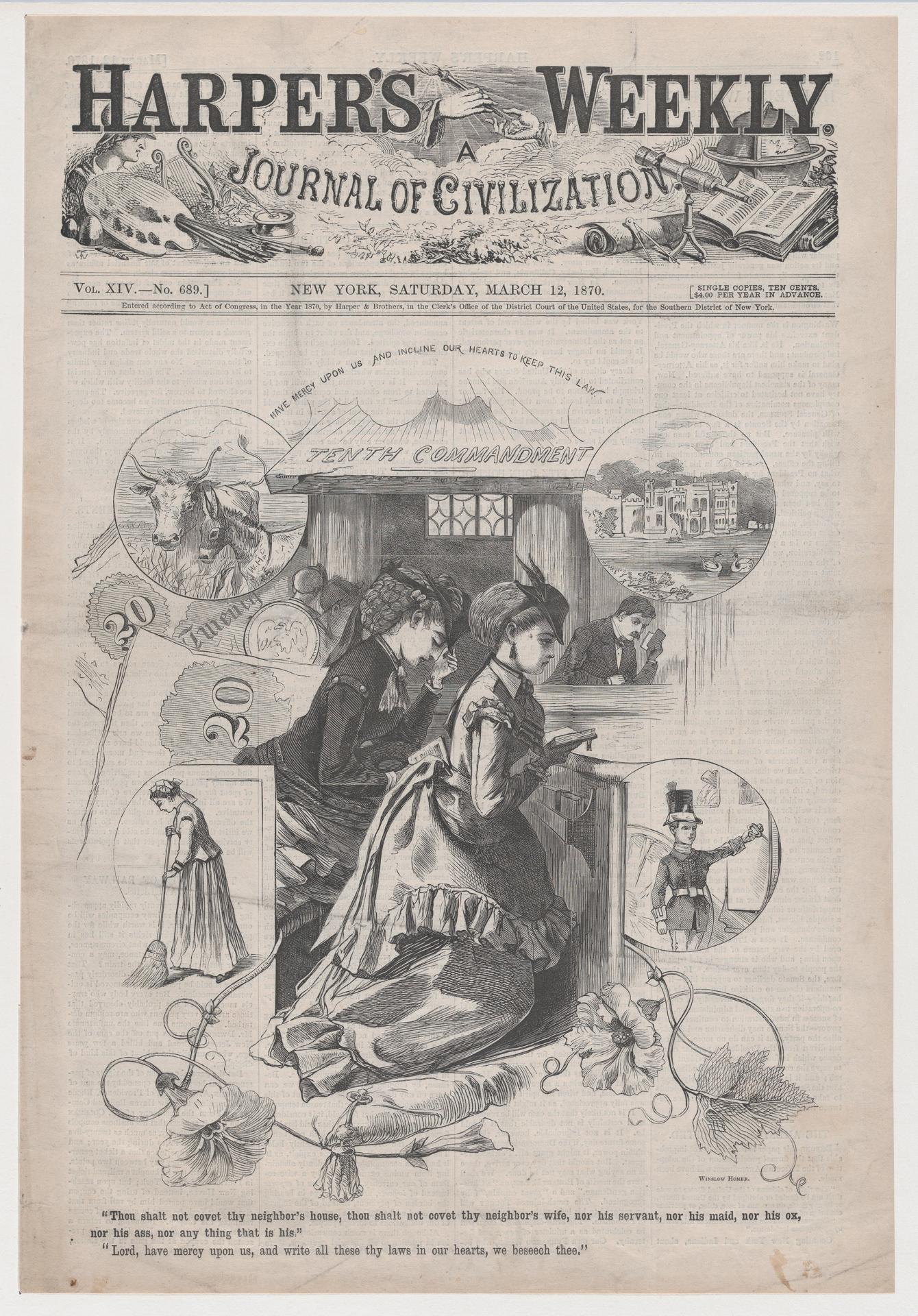
Tenth Commandment
Original title: "Tenth Commandment" (from "Harper's Weekly," Vol. XIV)
kurzbeschreibung
The tenth commandment provides the starting point for a wood engraving that Winslow Homer made in 1870 as a title page for Harper's Weekly. Above a house entrance runs the inscription "Tenth Commandment," while allegorical scenes bring to mind the biblical prohibition against coveting possessions and servants.
Description
A house bears the words "Tenth Commandment" over its door. To its left stands an ox; to its right, a building with a pond and ducks. Below appear a woman with a broom and a soldier—emblems of maidservants and menservants. The layout is symmetrical, with clear lines separating each element.
Context
The illustration was made in 1870 for Harper's Weekly, one of the leading American magazines of the nineteenth century. Winslow Homer was working as an illustrator at the time and often recorded scenes of American daily life. The motif takes up the tenth commandment, which held high importance in the Protestant tradition. The print was published during a period of social upheaval after the Civil War.
Impact
The clear symmetry and allegorical references give the image a didactic, moralizing tone. Realistic details meet symbolic elements, creating an instructive effect that prompts viewers to think about possession and desire.
Technique
In wood engraving, the design is cut into a woodblock and then printed. This method allowed for large print runs and was therefore suited to magazines such as Harper's Weekly. The precise handling of the material is evident in the fine lines and hatching.
AI-generated description text
Source: Metropolitan Museum of Art · Public Domain (CC0 1.0)