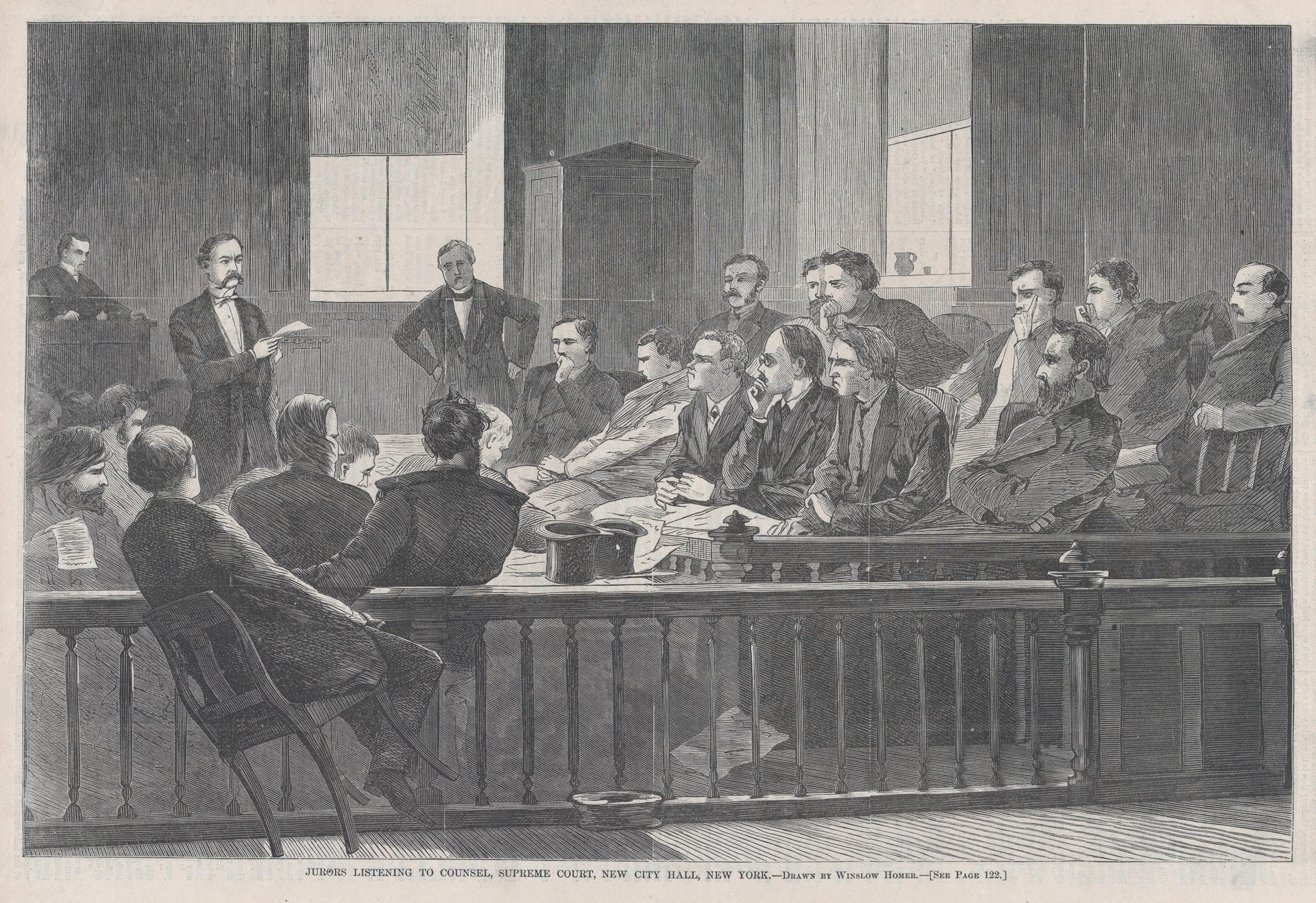
Jurors Listening to Counsel, Supreme Court, New York City Hall, New York (from "Harper's Weekly," Vol. XIII)
Original title: Jurors Listening to Counsel, Supreme Court, New York City Hall, New York (from "Harper's Weekly," Vol. XIII)
kurzbeschreibung
A lawyer stands before the jury, a sheet of paper in his hand, addressing the assembled jurors—this is how Winslow Homer's 1869 wood engraving portrays a trial at New York City Hall. The illustration appeared in Harper's Weekly in February of that year.
Description
In the foreground, several jurors have settled in, following the words of the suited man who stands before them with a paper in hand. Behind this group, other participants in the proceedings are spread across the room. Wood paneling divides the space, and several windows let in daylight. Fine hatching and graduated shading bring out the details of faces and clothing; the image remains entirely black and white.
Context
Homer drew regularly for Harper's Weekly, one of the most important illustrated magazines in the nineteenth-century United States, and contributed numerous sheets to it during the 1860s. At the time, the highest court of New York State held its sessions in New York City Hall. Illustrated weeklies of this kind made contemporary events and everyday scenes accessible to a wide readership.
Impact
The room feels still and attentive; all eyes are fixed on the speaker. Clear contours and deliberate shading give the print a sober, observational character that draws the viewer close to the action.
Technique
As a relief process, wood engraving involves cutting the design into a wood block; the raised areas take the ink. Hair-fine lines and hatched strokes allow people and space to be rendered in detail. The black-and-white execution matches the common practice of such magazine illustrations of the period.
AI-generated description text
Source: Metropolitan Museum of Art · Public Domain (CC0 1.0)