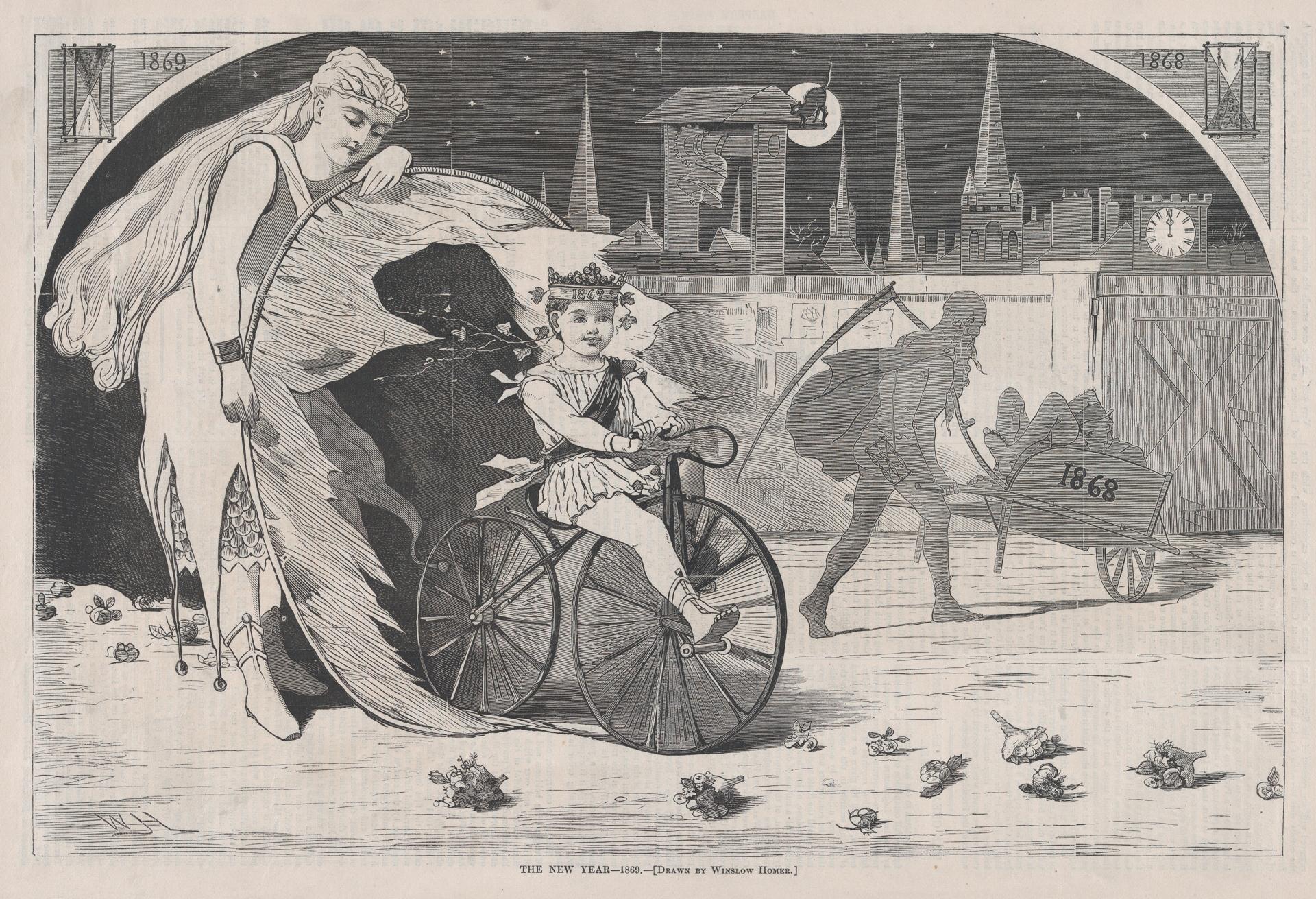
The New Year – 1869 – Drawn by Winslow Homer (from "Harper's Weekly," Vol. XIII)
Original title: The New Year – 1869 – Drawn by Winslow Homer (from "Harper's Weekly," Vol. XIII)
kurzbeschreibung
Winslow Homer drew this allegory of the turn of the year 1868/1869, and it appeared as a wood engraving on January 9, 1869. A woman with flowing hair holds a hose attached to a black ball, while a child sits in a small carriage nearby. Church towers, a moon and a man with a sickle and a flower cart fill the background.
Description
On a raised platform in the foreground stands a woman in a simple dress, her long hair held back by a headband. A hose runs from her hand to a large black ball. Beside her, a child in a two-wheeled carriage wears a headband and a small wreath and holds the reins. Behind the figures, a man with a sickle-shaped hat pulls a cart loaded with flowers and herbs; church towers and a moon belong to the night view. The year 1868 is legible on the cart and the sickle.
Context
Harper's Weekly published the engraving in its issue of January 9, 1869, taking up the transition from the old year to the new. Homer was then working as an illustrator for the magazine, which was known for its wood engravings. The familiar allegory of the changing year is used here: the old year appears as an old man with a sickle, the new year as a child.
Impact
Dark outlines meet light areas, giving the print a clear, graphic quality typical of wood engraving. Realistic details such as the church towers combine with allegorical elements like the black ball, creating a mysterious and thoughtful mood.
Technique
To make the wood engraving, the design was cut into a woodblock and then printed. This process produces the characteristic dark outlines and light background areas, all in monochrome. The image measures 22.9 x 34.9 cm; the sheet is 27.5 x 40.4 cm.
AI-generated description text
Source: Metropolitan Museum of Art · Public Domain (CC0 1.0)