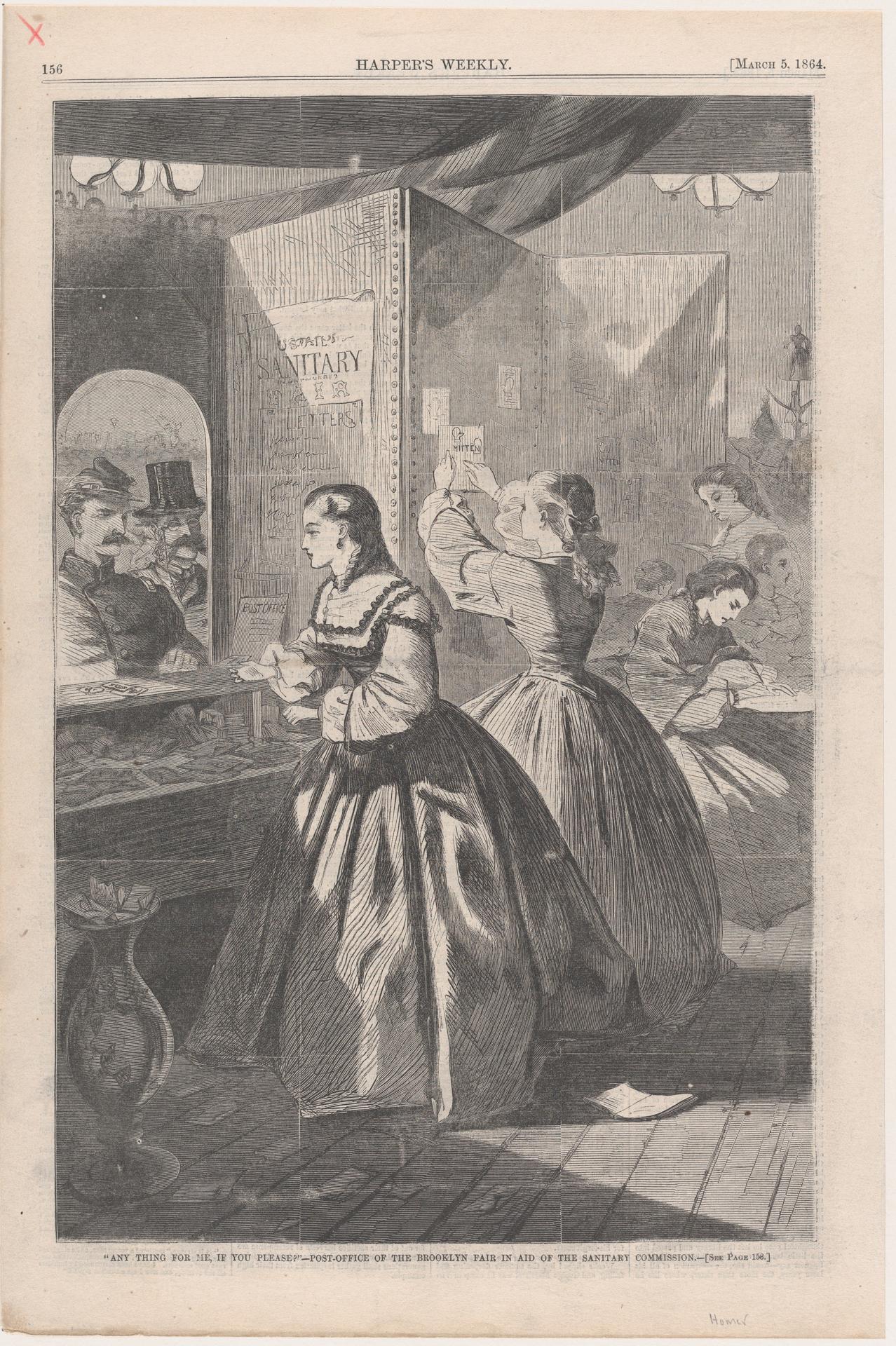
Any Thing for Me, if you Please? Post-Office of the Brooklyn Fair in Aid of the Sanitary Commission (from "Harper's Weekly," Vol. VIII)
Original title: "Any Thing for Me, if you Please?" Post-Office of the Brooklyn Fair in Aid of the Sanitary Commission (from "Harper's Weekly," Vol. VIII)
kurzbeschreibung
Winslow Homer's 1864 wood engraving takes us into the post office of the Brooklyn Fair, a charity event held during the American Civil War to benefit the United States Sanitary Commission. A woman hands letters across the counter while a man in uniform receives them. The print was published in Harper's Weekly.
Description
A woman in a long, striking dress steps up to the counter and passes letters to a man in uniform, likely a postal clerk, who takes them. Behind them, other figures busy themselves with mail. The room has wooden walls and a large window. On the wall hangs a sign reading 'U.S. SANITARY COMMISSION LETTERS.' Daylight streams through the window and falls from the front onto the figures, making their actions stand out clearly.
Context
The wood engraving was made in the middle of the American Civil War, when the United States Sanitary Commission was raising funds for wounded soldiers. The Brooklyn Fair was one of many local events that collected money and supplies for this organization. Homer was then working as an illustrator for Harper's Weekly, a magazine that reported on the war. The print shows how civilians supported the war effort through everyday actions like sending letters.
Impact
The clear layout and the emphasized encounter between the woman and the postal clerk give the view an immediacy and liveliness. The incoming daylight creates a calm, everyday mood that stresses the normality of wartime life. The precise rendering of figures and space feels documentary.
Technique
The image was reproduced as a wood engraving: the design is cut into a woodblock and then used as a printing matrix. This method allowed fine lines and details typical of nineteenth-century newspaper illustrations. It was printed in black and white, as was usual for Harper's Weekly.
AI-generated description text
Source: Metropolitan Museum of Art · Public Domain (CC0 1.0)