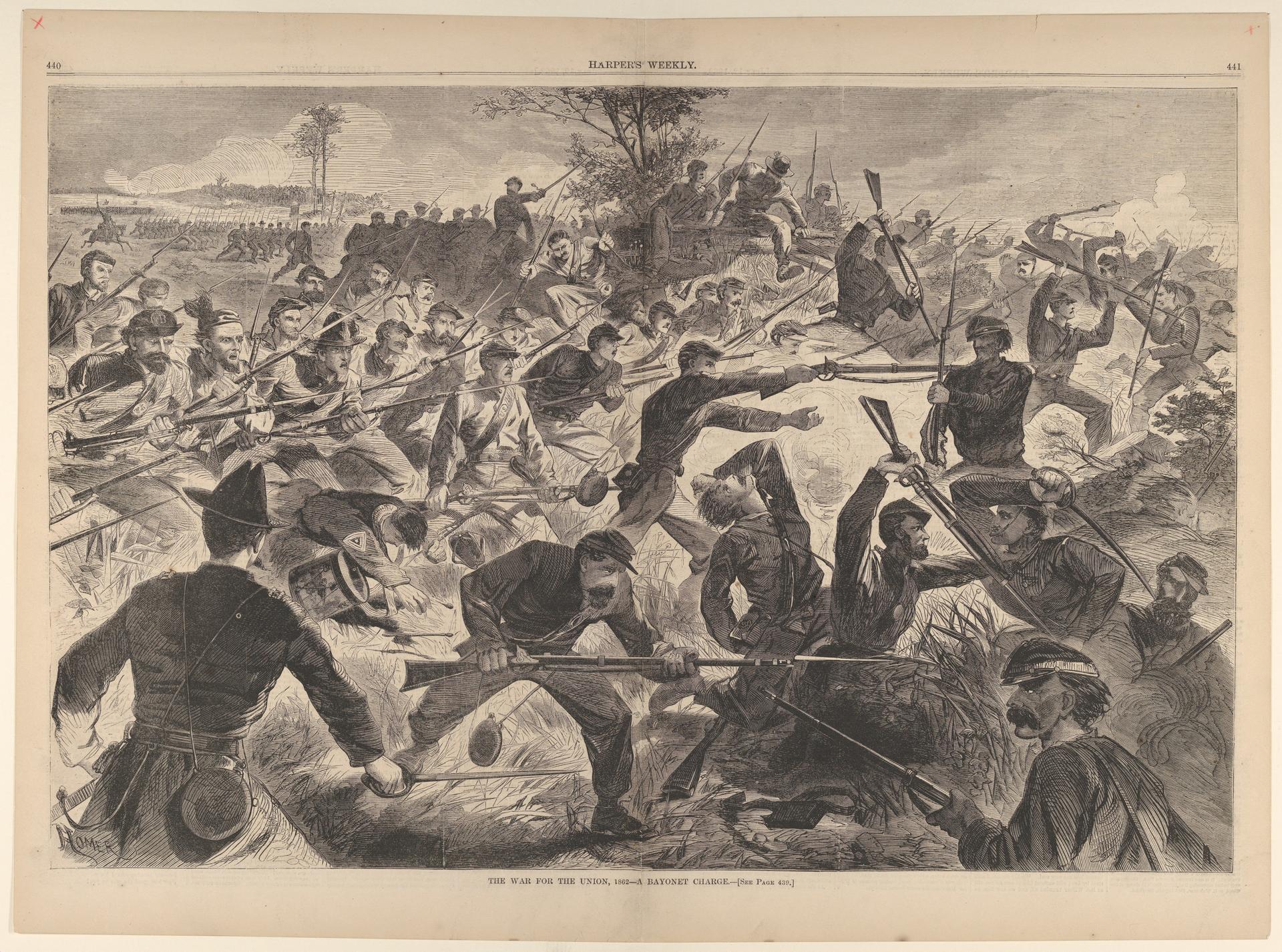
The War for the Union, 1862 – A Bayonet Charge (from "Harper's Weekly," Vol. VII)
Original title: The War for the Union, 1862 – A Bayonet Charge (from "Harper's Weekly," Vol. VII)
kurzbeschreibung
Winslow Homer’s wood engraving "Der Krieg für die Union, 1862 – Ein Bajonettangriff," published on July 12, 1862, departs from many contemporary battle pictures by omitting any recognizable leader or orderly formation. Instead, a dense throng of uniformed soldiers with rifles and fixed bayonets presses forward, with fallen men on the ground and others advancing. The print appeared in Harper’s Weekly, Vol. VII.
Description
Unlike clearly arranged combat scenes, this layout has no distinct center. Soldiers fill the foreground, moving in various directions—some lying down, others rising or pushing ahead—creating a sense of unrest and crowding. Behind the figures, additional soldiers and trees suggest a wooded or open terrain. Gray tones dominate, as is typical of wood engravings; the light is even, with no strong shadows. The rendering remains realistic and precise, with uniforms and equipment carefully detailed.
Context
During the American Civil War, Homer worked as an artist-correspondent for Harper’s Weekly and produced this wood engraving in that capacity. Its publication fell on July 12, 1862, as the war entered its second, more intense phase. Much of what he drew was based on his own observations at the front; whether this print records a specific engagement cannot be proven.
Impact
What sets this print apart from calmer battle scenes is the closeness of the action: the crowded arrangement and the movement of the figures convey something of the urgency of close combat, almost chaotic. Even lighting and precise details feel objective, almost documentary; heroic elevation is absent.
Technique
Unlike etching, a wood engraving is a relief print: the image is cut into a woodblock, which is then printed. The depth of the cuts determines how much ink is taken up, producing fine lines and gradations of gray. In this way, the print could be distributed in large numbers in periodicals such as Harper’s Weekly.
AI-generated description text
Source: Metropolitan Museum of Art · Public Domain (CC0 1.0)