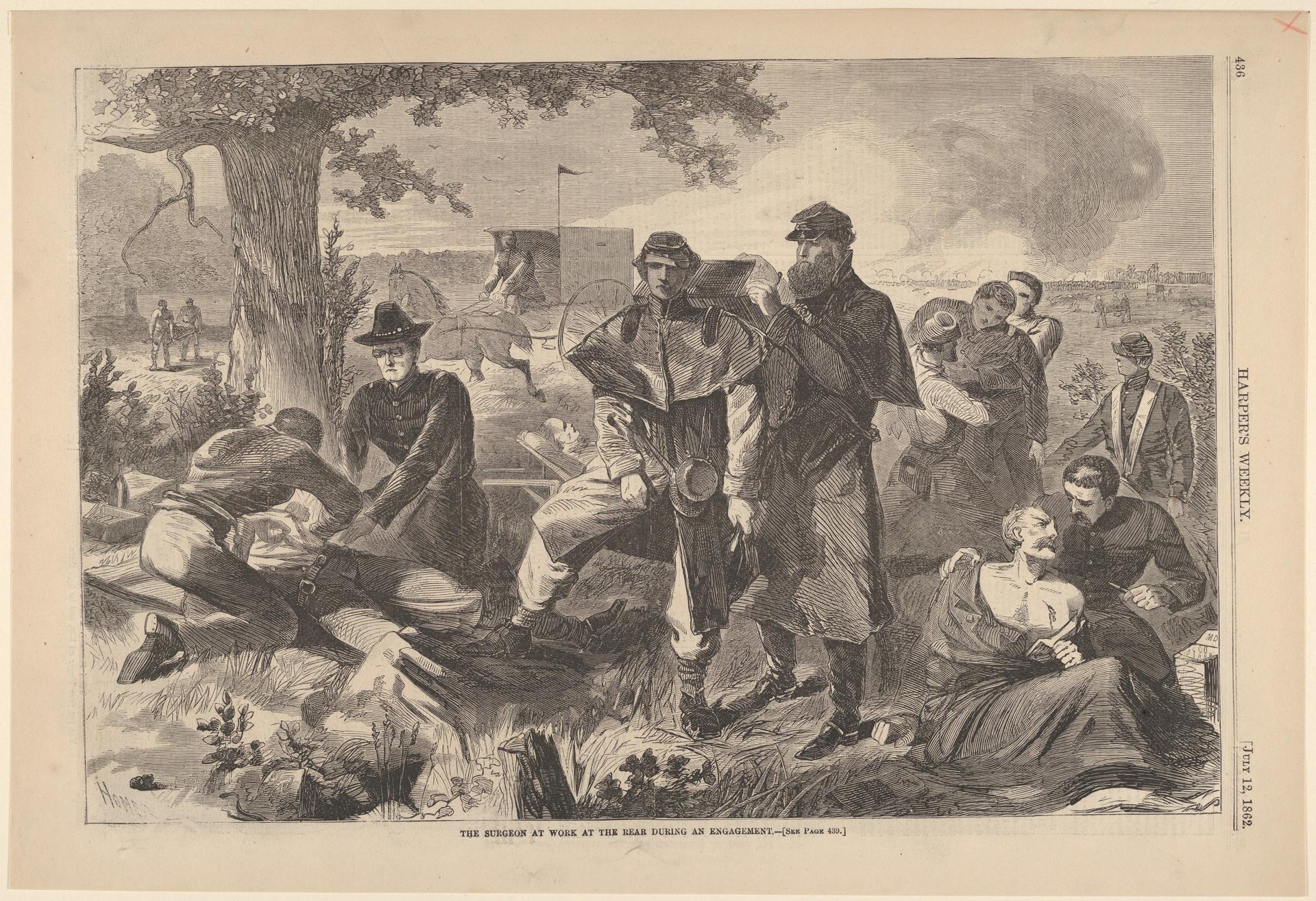
The Surgeon at Work at the Rear During an Engagement
Original title: The Surgeon at Work at the Rear During an Engagement (from "Harper's Weekly," Vol. VII)
kurzbeschreibung
Published in Harper's Weekly on July 12, 1862, Winslow Homer's wood engraving 'The Surgeon at Work at the Rear during an Engagement' places a medical man beside a wounded soldier in the midst of battle. The black-and-white illustration comes out of the American Civil War and carries the matter-of-fact tone of reportage.
Description
A doctor kneels over a soldier stretched on the ground, tending his wound. Several soldiers and civilians stand around the pair, watching. Beyond them the eye travels to more troops and a horse-drawn wagon at the rear, while trees and a clear sky mark the rural setting. The layout gives the medical work the central place.
Context
Homer made the engraving during the Civil War years of 1861 to 1865, when he worked as an illustrator for Harper's Weekly. In 1861 and 1862 he spent time at the front, drawing scenes from everyday military life. When it appeared on July 12, 1862, the print brought field medicine into view, a subject made urgent by the sheer number of wounded.
Impact
The print feels sober and documentary; the horrors of war are not glossed over. A quiet, almost ordinary mood underlines how necessary and how routine medical work is in wartime. The image invites reflection on what an engagement leaves behind.
Technique
Made as a wood engraving, the design was cut into a woodblock and then printed on paper. Fine lines and hatching build detail and shading in the manner typical of nineteenth-century magazine illustration. The image measures 23.2 x 34.9 cm, the sheet 27.2 x 40 cm.
AI-generated description text
Source: Metropolitan Museum of Art · Public Domain (CC0 1.0)