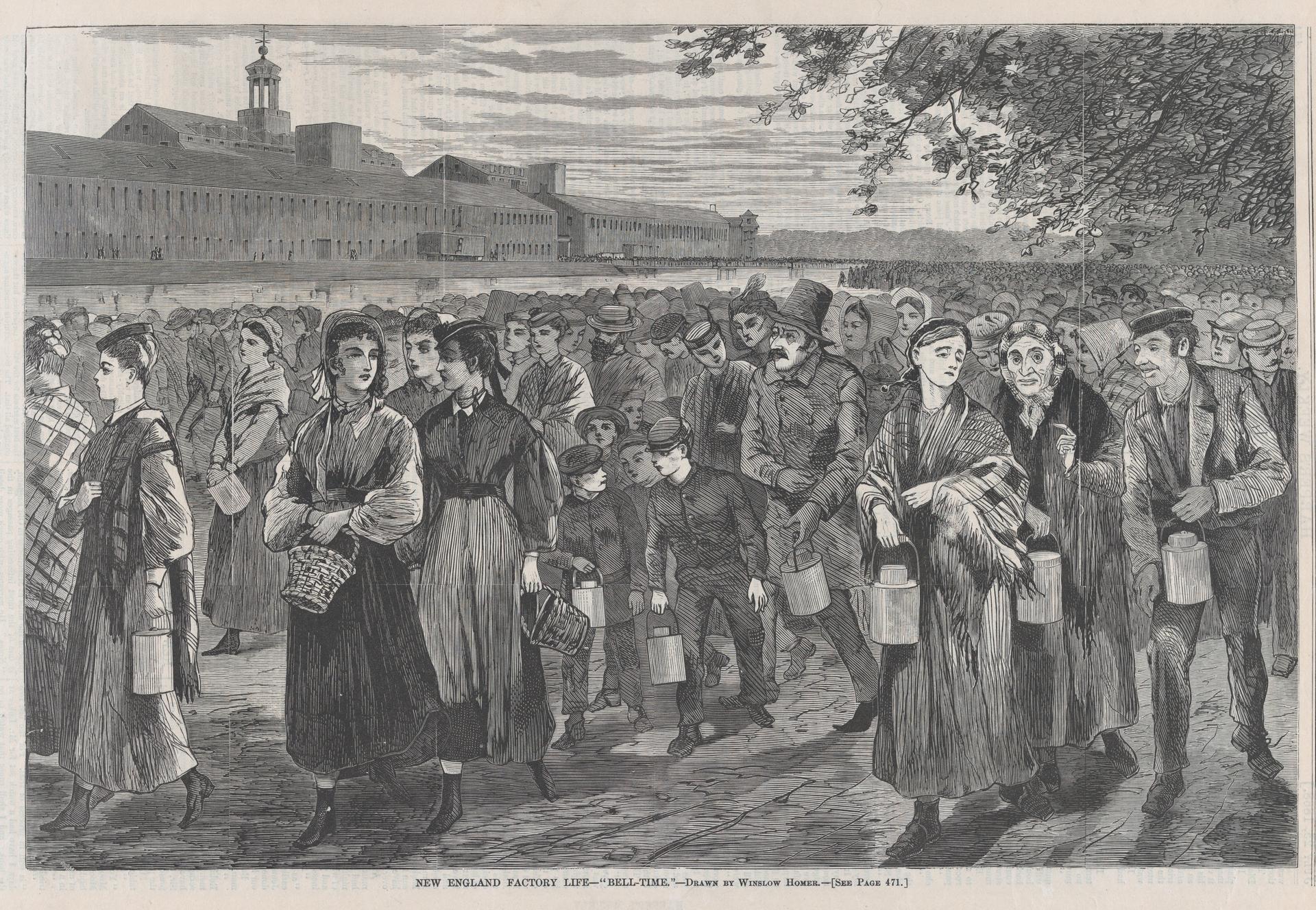
New England Factory Life – "Bell Time" (from "Harper's Weekly," Vol. XII)
Original title: New England Factory Life – "Bell Time" (from "Harper's Weekly," Vol. XII)
kurzbeschreibung
Workers make their way along a path past a New England factory, caught in the pause announced by the mill bell. Winslow Homer drew the subject in 1868 for Harper's Weekly, and it was reproduced as a wood engraving.
Description
Several of the women and men carry baskets and containers; others walk with aprons, coats and hats along the road that runs by the factory buildings. The figures are staggered across the full width of the sheet, and behind them rise several mill structures. The layout stays flat and broadly spread, with foreground and factory backdrop kept clearly apart. Black and white dominate, and the light falls evenly across the whole view, as is usual in wood engraving.
Context
Harper's Weekly, then a widely read illustrated magazine, published the print on July 25, 1868. During the 1860s Winslow Homer repeatedly recorded everyday life and the world of work in the United States. "Bell Time" refers to the moment when a bell signal interrupts work in the factories. The subject points to the growing weight of industrialization in New England after the Civil War.
Impact
The row of figures feels calm and matter-of-fact, almost like a recorded account. Because the image stays monochrome and the engraving is finely worked, clothing and faces stand out clearly without the scene being prettified.
Technique
In wood engraving the design is cut from a hard block of wood and then printed. For Harper's Weekly a large edition was produced, one that allowed fine lines and precise reproduction. The image measures 22.2 x 32.7 cm; the sheet format is larger and includes the magazine's lettering.
AI-generated description text
Source: Metropolitan Museum of Art · Public Domain (CC0 1.0)