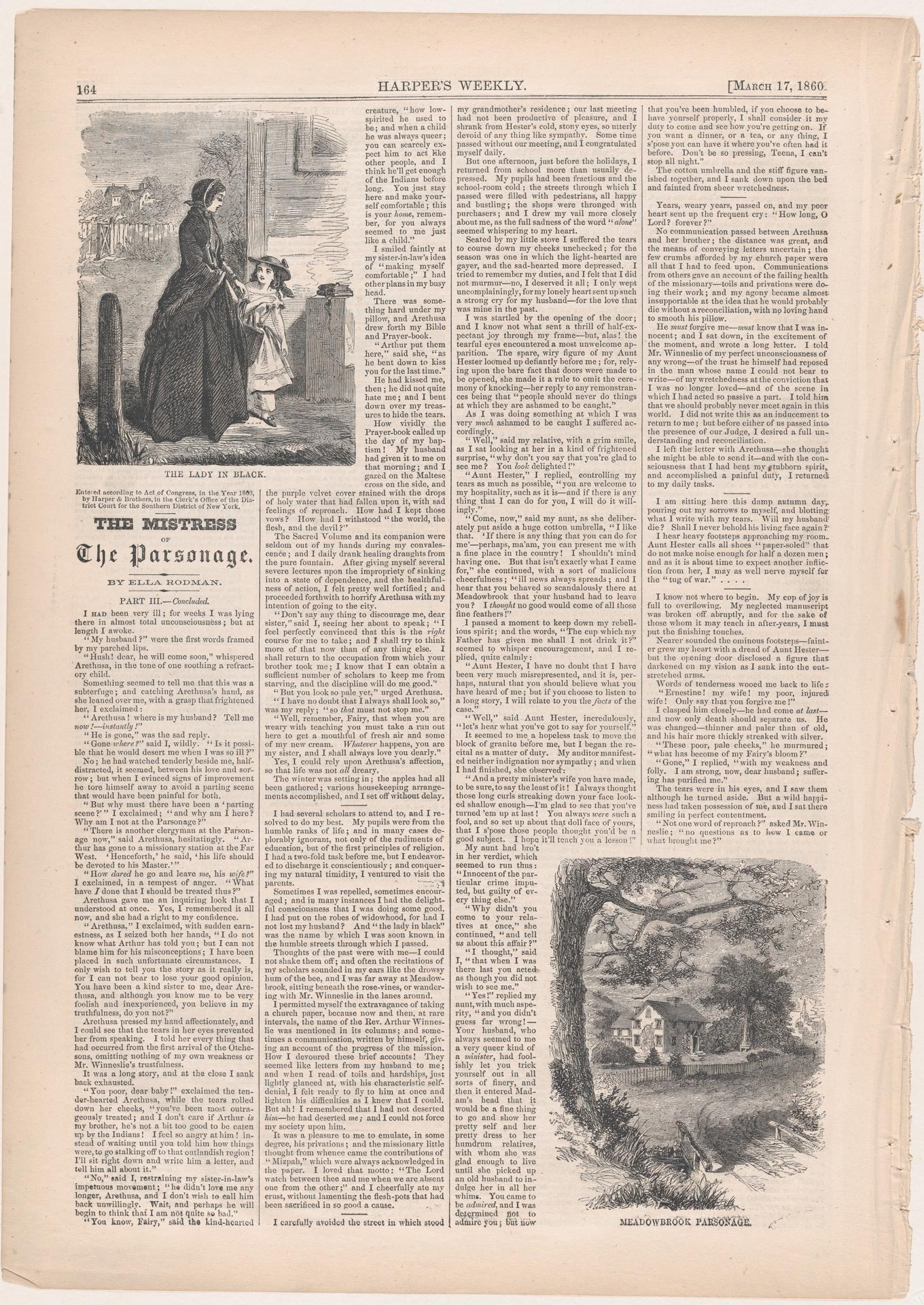
The Lady in Black, Meadowbrook Parsonage (from "The Mistress of the Parsonage," in "Harper's Weekly")
Original title: The Lady in Black, Meadowbrook Parsonage (from "The Mistress of the Parsonage," in "Harper's Weekly")
kurzbeschreibung
Winslow Homer contributed this wood engraving to the story "The Minister's Housekeeper," which appeared in Harper's Weekly on March 17, 1860. Two women meet in a garden before a parsonage, with the central figure dressed in black. At the time, wood engraving was the standard reproduction method for magazine illustrations.
Description
A woman in a black dress stands upright, looking toward her counterpart, a young woman in white who is speaking to her. Buildings and trees suggest a property suited to a parsonage. The contrast between the black and white dresses stands out clearly. The lines and hatching of the wood engraving are finely worked, giving figures and surroundings a sense of volume. The light appears natural and falls evenly across the scene.
Context
In 1860, Winslow Homer worked as a freelance illustrator for Harper's Weekly, one of the leading illustrated magazines in the United States with a large readership. The illustration accompanied a literary story, as was common at the time. During this period, Homer focused mainly on genre scenes and everyday occurrences.
Impact
The encounter feels quiet and familiar, like a brief moment in the daily routine of the two women. The strong light-dark contrast of the dresses draws the eye to the figures and their interaction. Despite the small format, the precise execution gives the print considerable presence.
Technique
For wood engraving, a hard woodblock was worked so that the raised lines would take up the printing ink. This allowed fine shading, and the method suited the high print runs of magazines. Homer used the medium's possibilities to render textures and lighting effects accurately.
AI-generated description text
Source: Metropolitan Museum of Art · Public Domain (CC0 1.0)