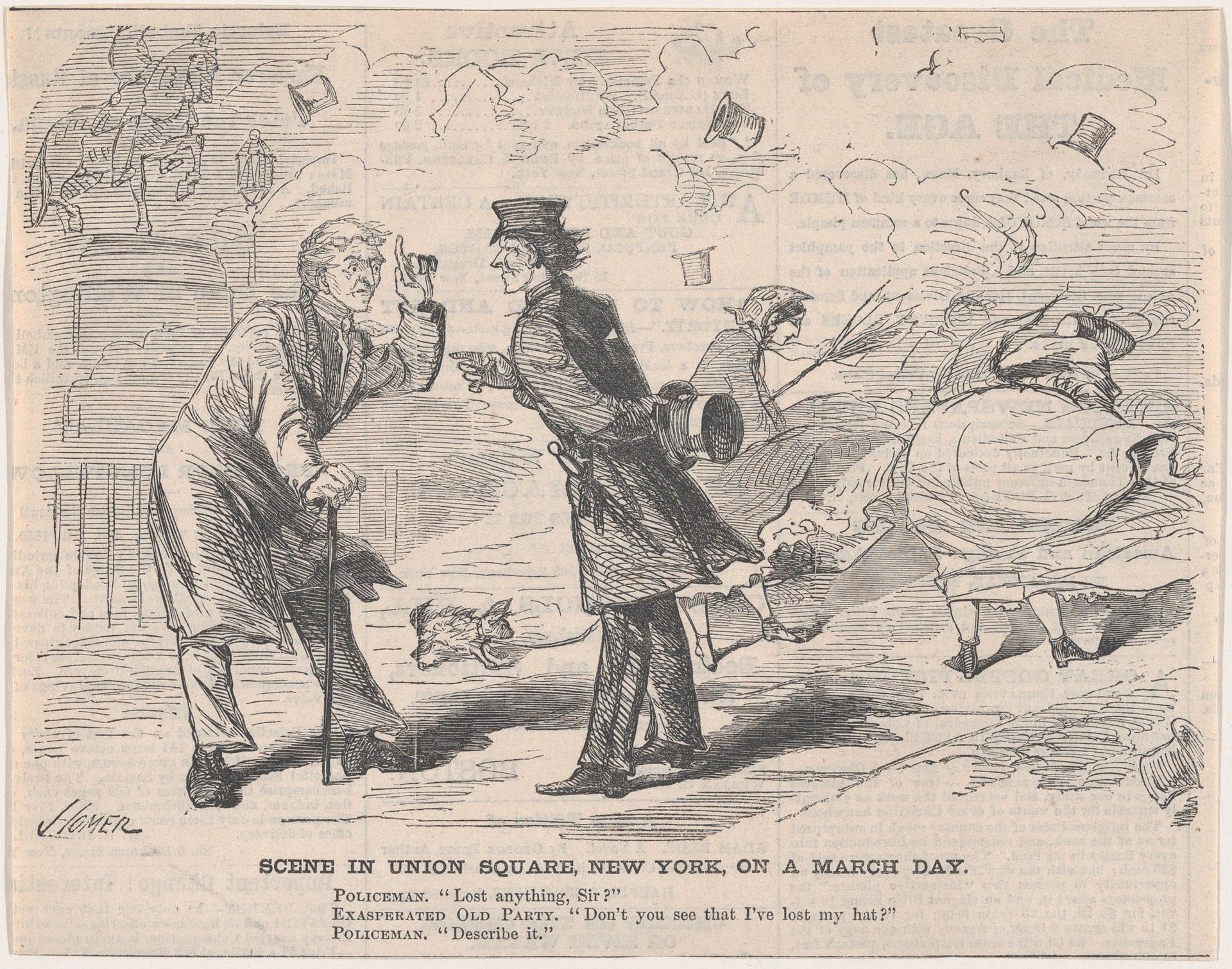
Scene in Union Square On a March Day (from "Harper's Weekly," Vol. IV)
Original title: Scene in Union Square On a March Day (from "Harper's Weekly," Vol. IV)
kurzbeschreibung
Winslow Homer made this wood engraving for the April 7, 1860, issue of Harper's Weekly. The image presents a lively everyday scene in New York's Union Square, where a policeman questions an older man. The print appeared as part of an illustrated magazine.
Description
A policeman in the foreground turns to an older man with a stick and jacket; the man raises his hand and looks confused or irritated. Behind them, other figures are visible, including a woman with a broom and a person in motion. Flying hats and a dog in front add further dynamism. The monochrome layout shows figures moving in various directions, with even lighting throughout.
Context
This wood engraving was intended for Harper's Weekly, a magazine founded in New York in 1857 that became one of America's leading illustrated papers. In the late 1850s, Winslow Homer worked as a freelance illustrator for the magazine before gaining fame as a painter. The print reflects urban life in New York on the eve of the Civil War, when Union Square was a central public place. Everyday scenes like this were typical of the magazine's reportage illustrations.
Impact
The scene feels lively and casual, like a captured moment of city life. The realistic style with caricatural touches creates an amusing yet observant distance. Through the dynamic arrangement of figures, the small format gains surprising movement.
Technique
This print is a wood engraving: the drawing was cut into a woodblock and served as a printing matrix. Fine lines and even gray tones are characteristic of this technique, which was widely used in illustrated magazines. The impression on paper was made by letterpress printing.
AI-generated description text
Source: Metropolitan Museum of Art · Public Domain (CC0 1.0)