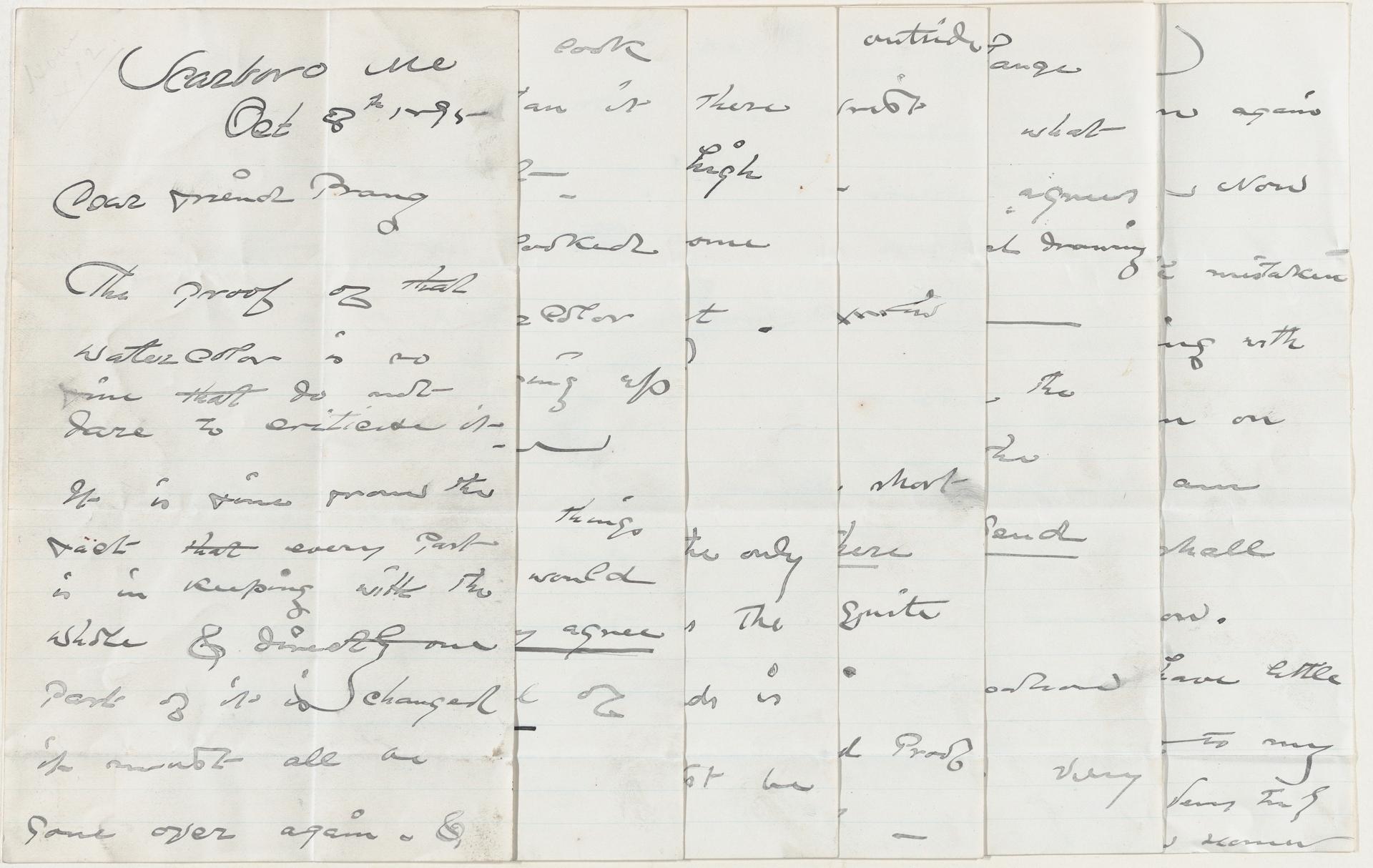
Autograph Letter to Louis Prang, Discussing lithograph of "The Eastern Shore"
Original title: Autograph Letter to Louis Prang, Discussing lithograph of "The Eastern Shore"
kurzbeschreibung
Here is a handwritten letter from Winslow Homer to Louis Prang, dated October 8, 1895. Executed in pen and ink with graphite, the sheet measures 22.8 by 13.6 cm. The letter concerns the lithographic reproduction of Homer's painting 'The Eastern Shore.'
Description
Several lines of handwriting are distributed across the white paper, arranged in columns. The script flows and feels personal and irregular; the size and slant of the letters vary slightly. Dark ink stands out clearly against the ground, with no illustrations or decorative additions. Despite the fluctuations, the handwriting remains legible.
Context
The recipient was Louis Prang, a leading printing entrepreneur and pioneer of color lithography in the United States. In those years Homer was increasingly engaged with the printed reproduction of his images. Prang's reputation rested on high-quality chromolithographs, which makes a professional exchange about the realization of Homer's motif likely. The letter documents the concrete collaboration between artist and printer in the late nineteenth century.
Impact
Homer's own handwriting, along with his working method, meets the viewer directly. The fluid, spontaneous script creates a familiar closeness to the artist. Though the sheet may not be a major work, it gains aesthetic appeal as an authentic document and through its historical background.
Technique
Pen and dark ink were used on paper, supplemented by graphite. This allowed precise yet fluid writing. For correspondence this combination was common in the nineteenth century and reveals the artist's routine handling of writing instruments.
AI-generated description text
Source: Metropolitan Museum of Art · Public Domain (CC0 1.0)