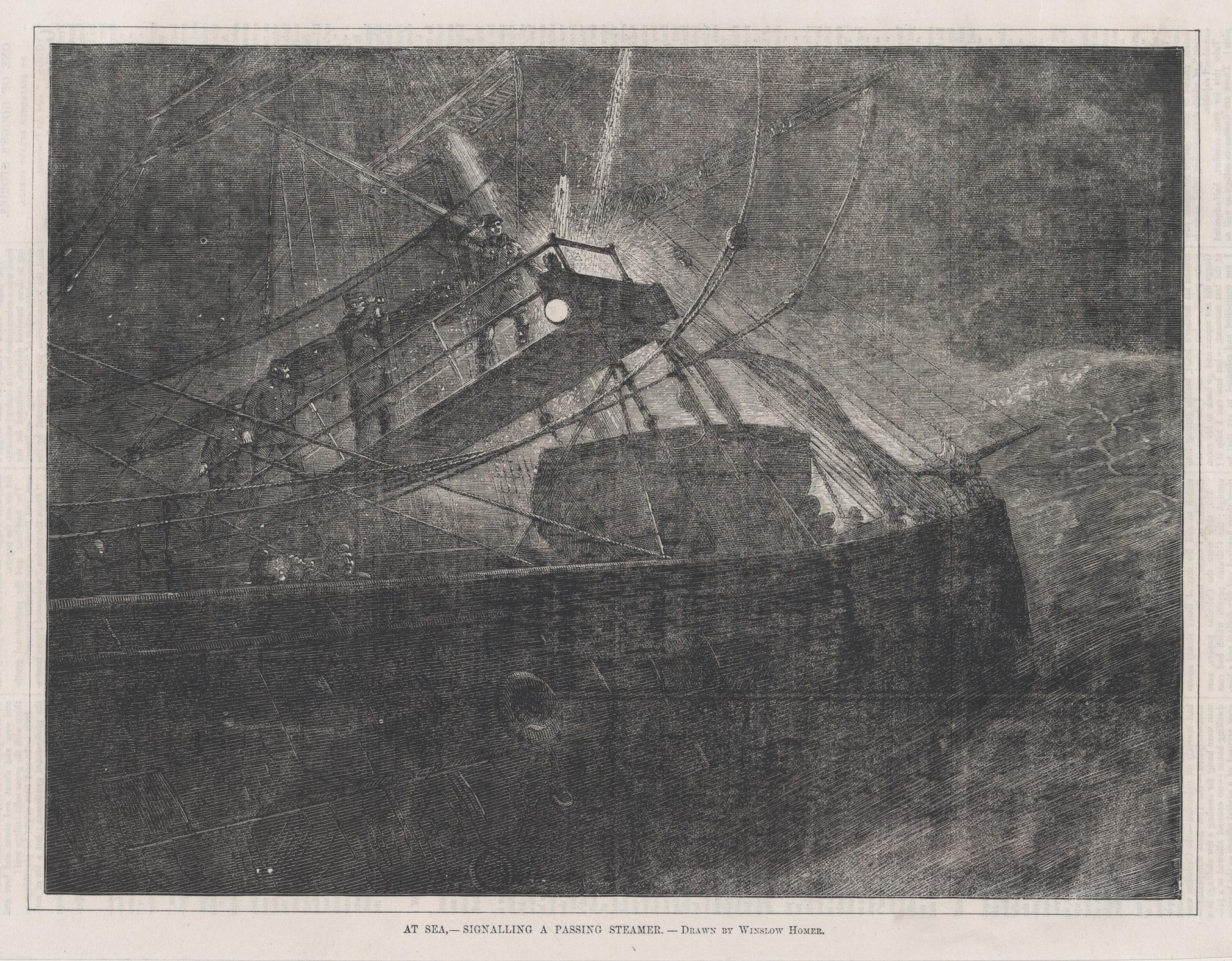
At Sea—Signalling a Passing Steamer (Every Saturday, Vol. II, New Series)
Original title: At Sea—Signalling a Passing Steamer (Every Saturday, Vol. II, New Series)
kurzbeschreibung
A lantern is held aloft at night, its beam falling on a passing steamer. Winslow Homer's 1871 wood engraving 'At Sea—Signalling a Passing Steamer' captures such an encounter on the open sea: in the foreground, a sailing ship with several people on deck look up at the sky and toward the distant steamer. The print was made for the magazine 'Every Saturday' and belongs to Homer's early career as an illustrator.
Description
Deep darkness dominates the image, broken by the bright glow of the signal light that one of the figures on board the large sailing ship holds up. Several people stand on deck, their gazes directed upward and toward the distant steamship passing in the background. The layout draws the eye toward the exchange between the two vessels. Fine lines and hatching give structure to the sails and planks; the linear style reflects the wood engraving technique of those years.
Context
Homer drew this illustration for 'Every Saturday,' a weekly literary and art magazine published in Boston between 1866 and 1874. During this period he worked as a freelance illustrator for various publications before turning increasingly to painting in the 1870s. The sea and the coast remained his subjects throughout his life. The fact that here a sailing ship signals to a steamer points to the transformation of shipping in the 19th century.
Impact
The contrast of light and dark lends the nighttime scene tension and brings the signal light into focus. The dynamic arrangement and dense hatching create a narrative richness characteristic of Homer's early illustration work.
Technique
This is a wood engraving: in this relief printing process, the design is cut into a woodblock with burins. The hard boxwood allows for the finest lines and hatching, resulting in highly detailed and precise images. The block was used for printing in the magazine; the image area of 22.2 x 29.5 cm corresponds to the typical format of illustrations in weekly magazines of the time.
AI-generated description text
Source: Metropolitan Museum of Art · Public Domain (CC0 1.0)