Life in Camp, Part 2: In the Trenches; Good Bye; Fording; Extra Ration; The Field Barber; The Girl He Left Behind Him; Drummer; A Deserter; Home on Furlough; The Rifle Pit; Teamster; Our Special
Original title: Life in Camp, Part 2: In the Trenches; Good Bye; Fording; Extra Ration; The Field Barber; The Girl He Left Behind Him; Drummer; A Deserter; Home on Furlough; The Rifle Pit; Teamster; Our Special
kurzbeschreibung
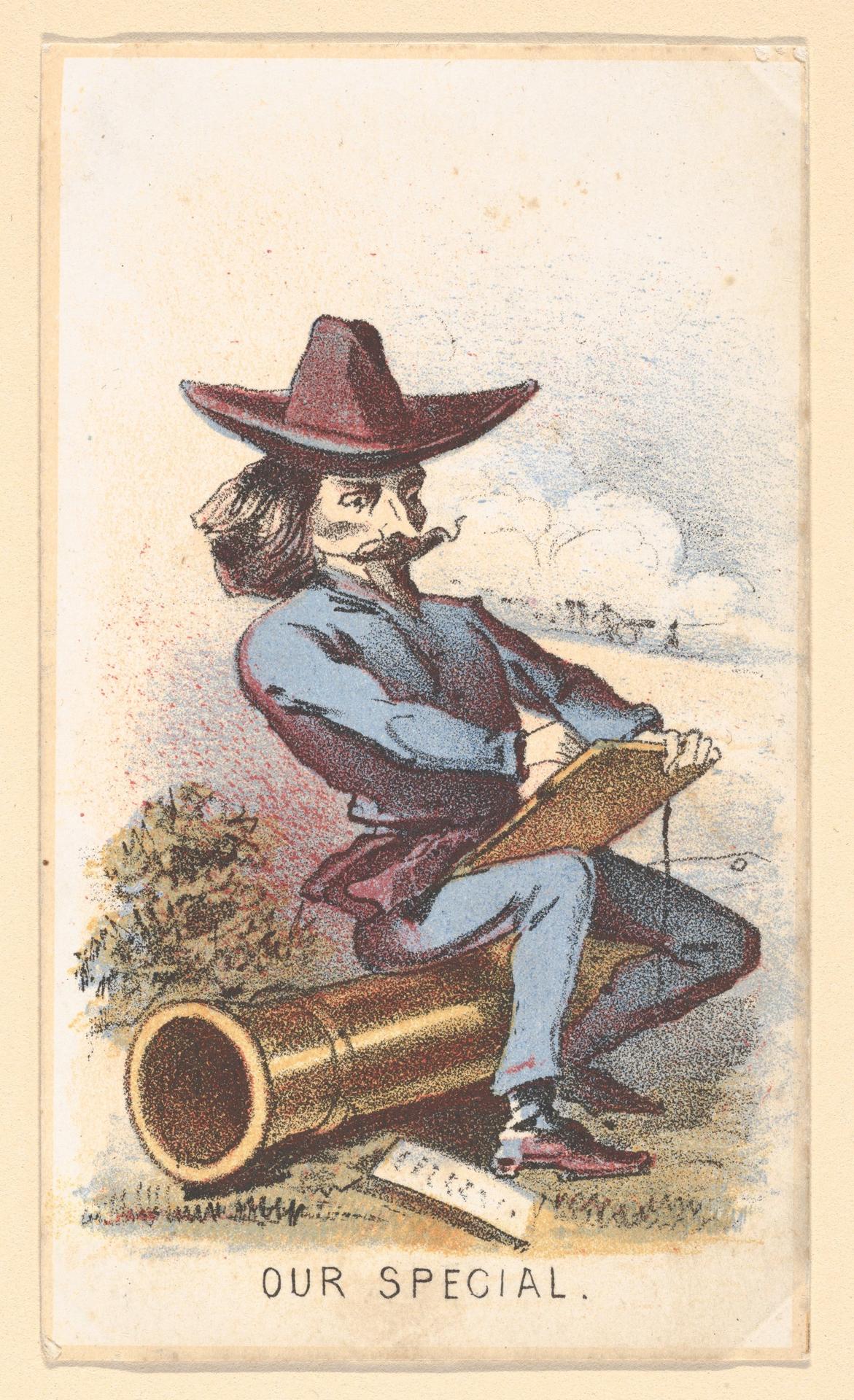
A soldier drawn with a mocking touch squats on the barrel of a cannon — so begins one of twelve small-format sheets that Winslow Homer issued as color lithographs in 1864, in the middle of the American Civil War. Military routine appears here mixed with humorous exaggeration.
Description
A man sits astride a massive cannon barrel. His red hat stands out; he wears a blue-gray jacket, blue trousers and red boots. In his right hand he holds a sheet of paper, which his left hand touches, while his gaze seems rather pensive, even a little troubled. Trees and a cloudless sky close the scene at the top, and below one reads in large capitals the words 'OUR SPECIAL.'
Context
Winslow Homer worked as an illustrator for Harper's Weekly during the Civil War; from this came his approach to realistic, often cheerful portrayals of soldier life. The 1864 series was made when the war had already lasted three years and the public craved both news and distraction. The sheets were sold as collectible pictures or prints that accompanied the daily life of the troops with a satirical undertone.
Impact
Comedy and pensiveness form an odd alliance here: despite the exaggerated outfit, the soldier wears a serious expression. Strong colors and cleanly drawn lines give the sheet graphic sharpness and support the cheerful basic tone without letting the figure slip into the grotesque.
Technique
The sheet was printed as a color lithograph, a process based on the repulsion of grease and water and requiring a separate plate for each color. The small dimensions of about 10 x 6 cm per sheet suggest careful detailed work that demanded precise print quality. Red, blue and gray dominate the palette — usual for printing practice at the time and at the same time suited to setting the figures clearly apart from the background.
AI-generated description text
Source: Metropolitan Museum of Art · Public Domain (CC0 1.0)