Four Bathers
Original title: Four Bathers
kurzbeschreibung
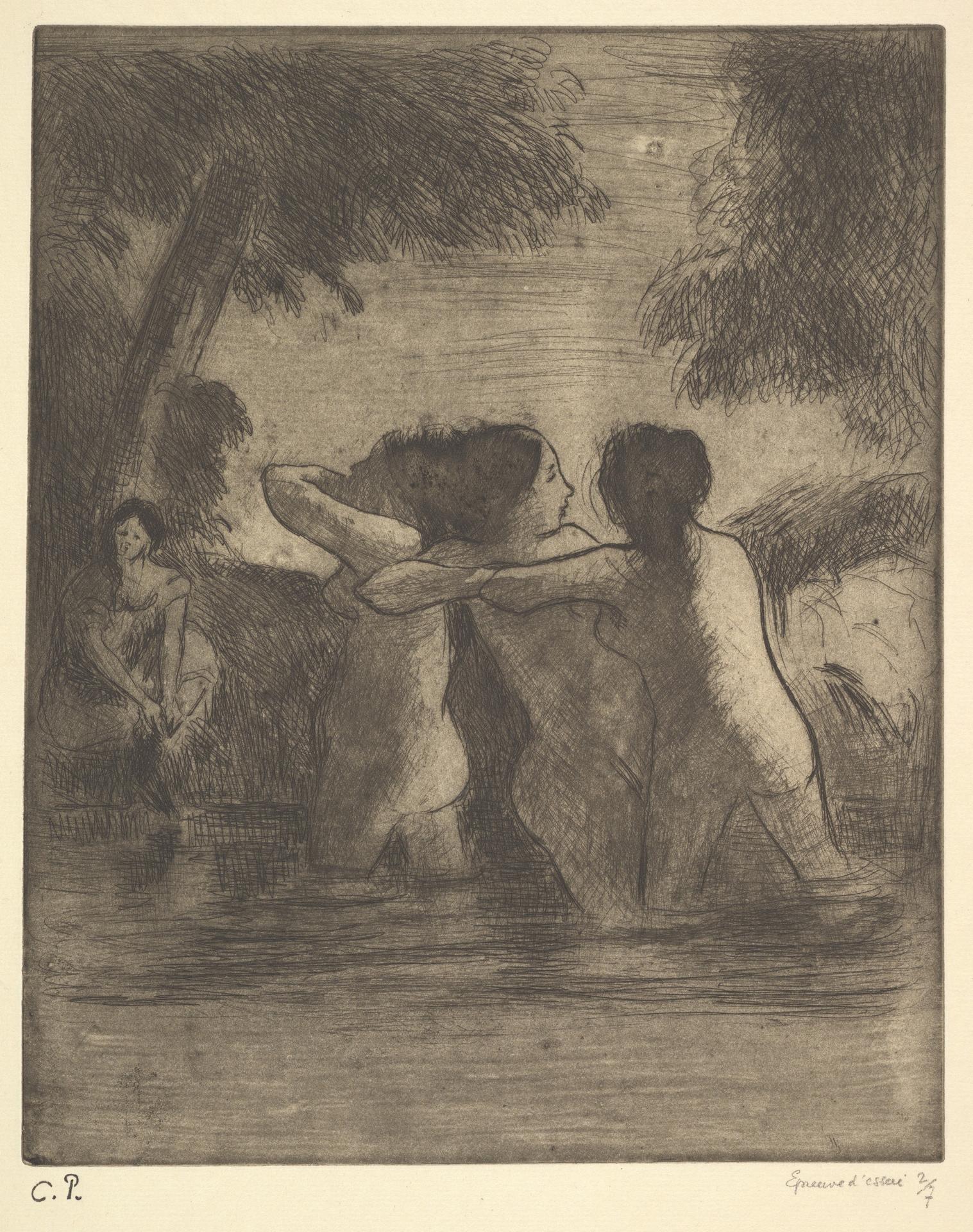
Camille Pissarro made the etching 'Vier Badende' in 1895, which shows four nude figures in shallow water. The image was created as an etching with drypoint on wove paper; the present impression is from the second state and was printed posthumously.
Description
Four nude people appear in the water. Two stand in the foreground, one with arms raised above the head. Another person is behind them in the water, while trees and plants fill the background. The water is shallow, reaching the figures' knees. The layout is built on horizontal and vertical lines, with the figures at the centre. The colouring remains monochromatic in various shades of grey; the light comes diffusely from above, creating even illumination.
Context
The etching dates from 1895, when Pissarro was deeply engaged with printmaking. It belongs to a series of bather depictions the artist made in the 1890s. The subject of bathers was widespread in the late 19th century and was also treated by contemporaries such as Degas and Cézanne. That this is the second state and a posthumous impression indicates the sheet was printed after Pissarro's death in 1903.
Impact
The calm, naturalistic rendering of the bathers and the soft grey tonalities give the sheet a harmonious and serene air. Because the figures are embedded in the natural setting, an idyllic mood arises.
Technique
Pissarro worked here with etching and drypoint on wove paper – a process that allows fine lines and gentle tonal gradations. The second state and the posthumous impression attest to a later printing, as is characteristic of Pissarro's printmaking.
AI-generated description text
Source: Metropolitan Museum of Art · Public Domain (CC0 1.0)