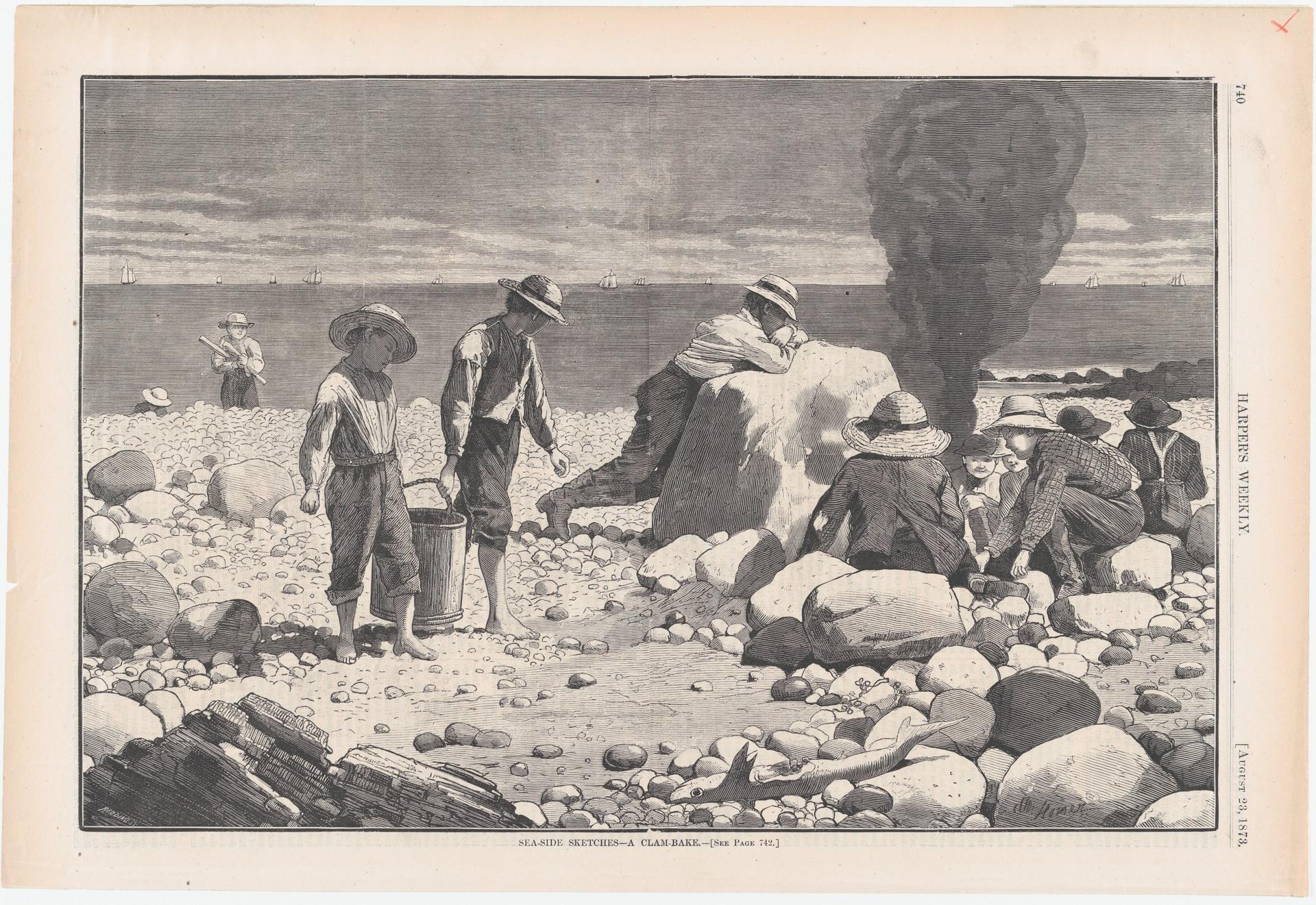
Sea-side Sketches – A Clam Bake (from "Harper's Weekly," Vol. XVII)
Original title: Sea-side Sketches – A Clam Bake (from "Harper's Weekly," Vol. XVII)
kurzbeschreibung
Created in 1873, Winslow Homer's wood engraving "Sea-side Sketches – A Clam Bake" captures a beach scene where a group of people gathers around a smoking pile of stones. The black-and-white print served as an illustration for Harper's Weekly and offers a glimpse of sociable doings along the American coast in the nineteenth century.
Description
A cluster of figures has formed in the foreground around a large mound of stones, with smoke rising from it. One person carries a bucket; others stand or sit nearby. Beyond this group, more people are scattered across the rocky shore. Boats appear on the water, rounding out the stretch of coastline. The layout runs horizontally, emphasizing the breadth of the beach.
Context
This wood engraving was made for the August 23, 1873 issue of Harper's Weekly, a magazine that was then widely read in the United States. In nineteenth-century New England, clambakes were a popular social tradition in which shellfish were cooked in earthen ovens. During the 1870s Homer worked regularly as an illustrator for periodicals before turning increasingly to painting.
Impact
The black-and-white reproduction lends the image documentary clarity and brings the interaction among the people to the fore. Calm, even lighting creates a peaceful, summery mood. The careful rendering of rocks and figures makes the beach life feel vivid.
Technique
A wood engraving — a relief process in which the design is cut into a block of wood — allows for fine lines and hatching that produce nuanced gray tones, typical of the medium. Homer used the expressive means of the technique to render the textures of stone and clothing with precision.
AI-generated description text
Source: Metropolitan Museum of Art · Public Domain (CC0 1.0)