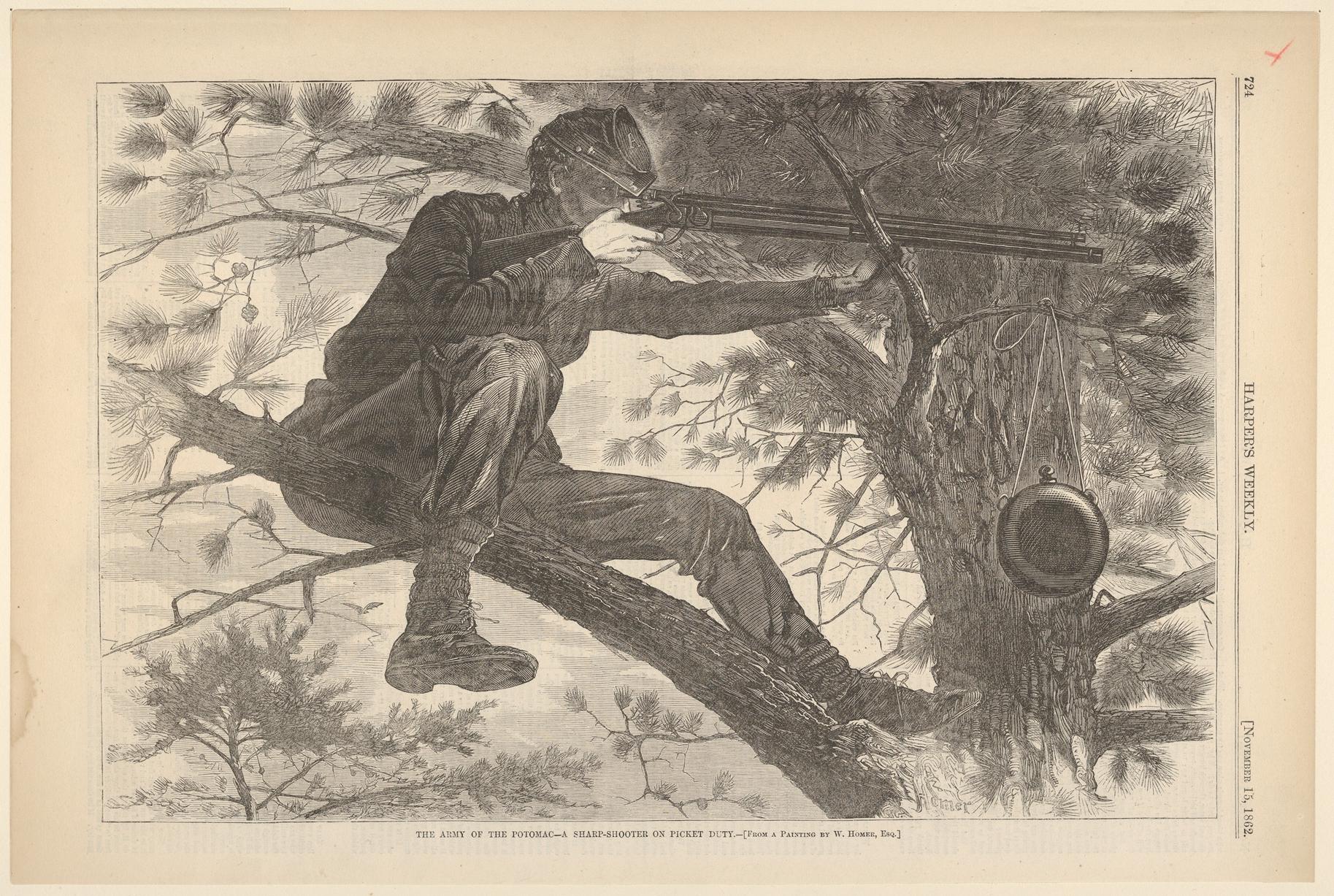
The Army of the Potomac – A Sharp-Shooter on Picket Duty (from "Harper's Weekly," Vol. VII)
Original title: The Army of the Potomac – A Sharp-Shooter on Picket Duty (from "Harper's Weekly," Vol. VII)
kurzbeschreibung
Winslow Homer's 1862 wood engraving shows a sharpshooter of the Army of the Potomac during the American Civil War. Seated on a tree trunk, the soldier holds his rifle and appears wide awake. The image was published as a double-page spread in Harper's Weekly.
Description
Fine hatching and graded tones structure the gray-scale image. A soldier in a dark uniform and headscarf sits on a tree trunk, rifle in hand; his posture conveys the concentration and alertness that guard duty demands. Trees and branches surround him, capturing the sharpshooter's natural environment. A metal container hangs from a nearby tree. The layout brings the man and his weapon forward, while clothing and equipment fill in the surroundings with many details.
Context
During the American Civil War, Homer worked as an artist-correspondent for Harper's Weekly. The illustration appeared on November 15, 1862, at a time when the Army of the Potomac under General George B. McClellan was in action. Homer spent several stints at the front, recording soldiers' lives. A sharpshooter on guard duty was an unusual subject then: it did not glorify war but showed the daily routine and tension of the troops.
Impact
Out of the picture's calm grows a quiet threat that puts the viewer in the sentinel's place. Uniform and gear are rendered so precisely that the print feels documentary and credible. Unagitated yet thought-provoking, this view stands apart from contemporary war images.
Technique
Lines and hatching of a wood engraving create the tonal values here, and the fine gradations in particular reveal the precise rendering of textures. In this relief printing process, the motif is cut into a woodblock. For the magazine print, the plate served mass production, allowing the illustration to circulate in large numbers.
AI-generated description text
Source: Metropolitan Museum of Art · Public Domain (CC0 1.0)