Camping Out in Adirondacks (from "Harper's Weekly," Vol. XVIII)
Original title: Camping Out in Adirondacks (from "Harper's Weekly," Vol. XVIII)
kurzbeschreibung
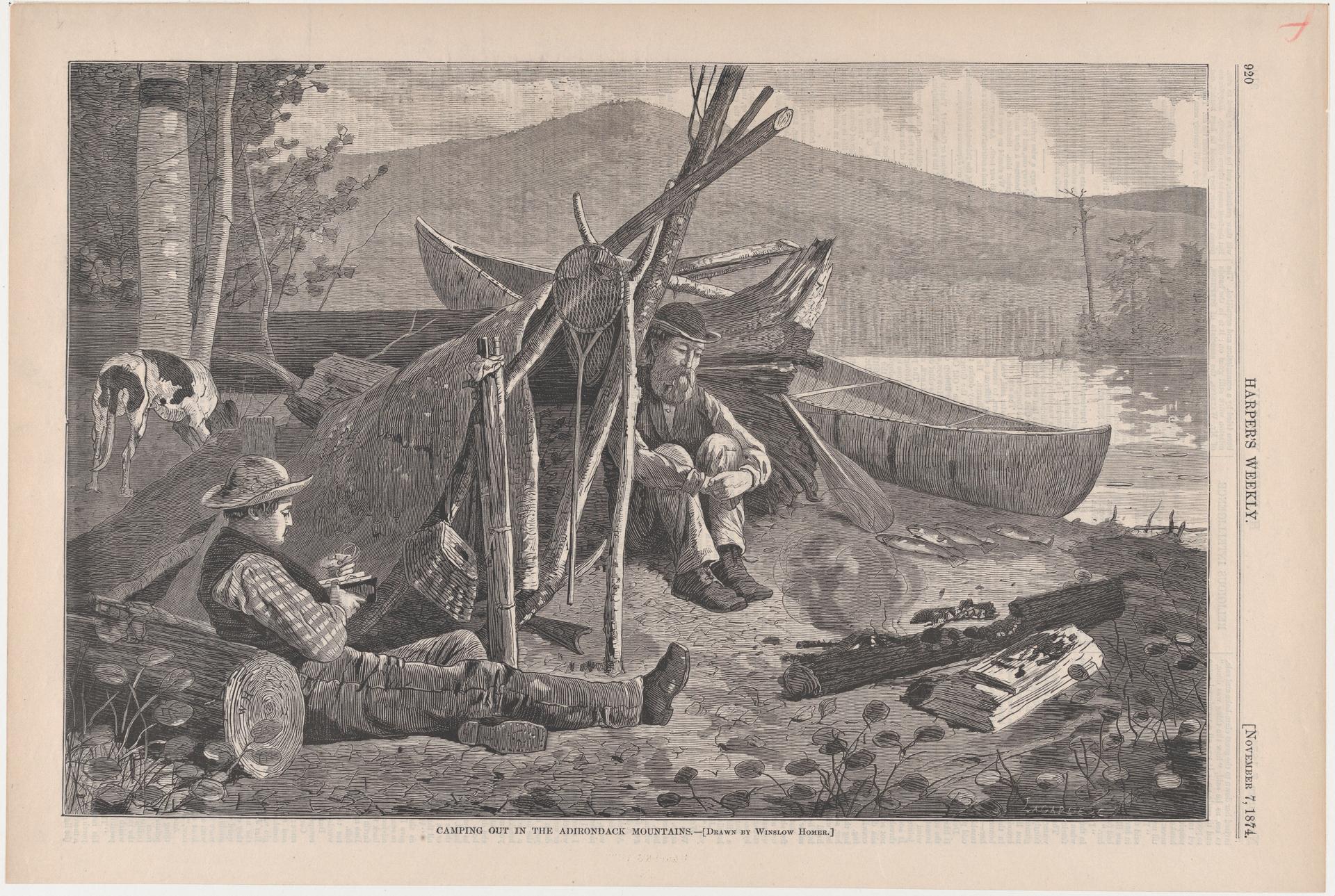
A man with a pipe sits before a makeshift shelter of branches and cloth, a child stretched out beside him. Winslow Homer's wood engraving 'Camping Out in Adirondacks,' published on November 7, 1874, captures just such a campsite in the wilds of the Adirondack Mountains. Canoes, trees, mountains, and a cow in the background complete the rural idyll.
Description
Squatting on the ground, a pipe in his mouth, a man faces a tent pieced together from sticks and a length of fabric. A child lies stretched out next to him, holding an object. Behind this pair, a canoe rests at the water's edge while another floats on the water; trees and mountains form the backdrop. On the left, a cow stands, underscoring the rural character. Black and white and the characteristic lines of wood engraving define the entire image.
Context
This illustration was made for Harper's Weekly, a widely circulated American magazine of the time that used wood engravings for reproduction. During the 1870s, Winslow Homer worked regularly as an illustrator for the publication before turning more toward painting. In the nineteenth century, the Adirondacks were a popular destination for outdoor enthusiasts and artists who sought to capture untouched nature. The publication date was November 7, 1874—a time when Homer's interest in leisure activities and encounters with nature was growing in his work.
Impact
Camp life in the wilderness comes across as calm and almost idyllic. Tent, canoes, and landscape are rendered in detail, inviting the viewer to share in the peaceful atmosphere. The black-and-white technique lends the scene something documentary and authentic, reinforcing the impression of a real event.
Technique
A wood engraving—a relief process in which the design is cut into a woodblock—underlies this work. Fine lines and hatching create tonal gradations and textures suited to magazine reproduction. The image area measures 9 1/8 x 13 3/4 inches (23.2 x 34.9 cm), the sheet 10 11/16 x 15 15/16 inches (27.2 x 40.5 cm).
AI-generated description text
Source: Metropolitan Museum of Art · Public Domain (CC0 1.0)