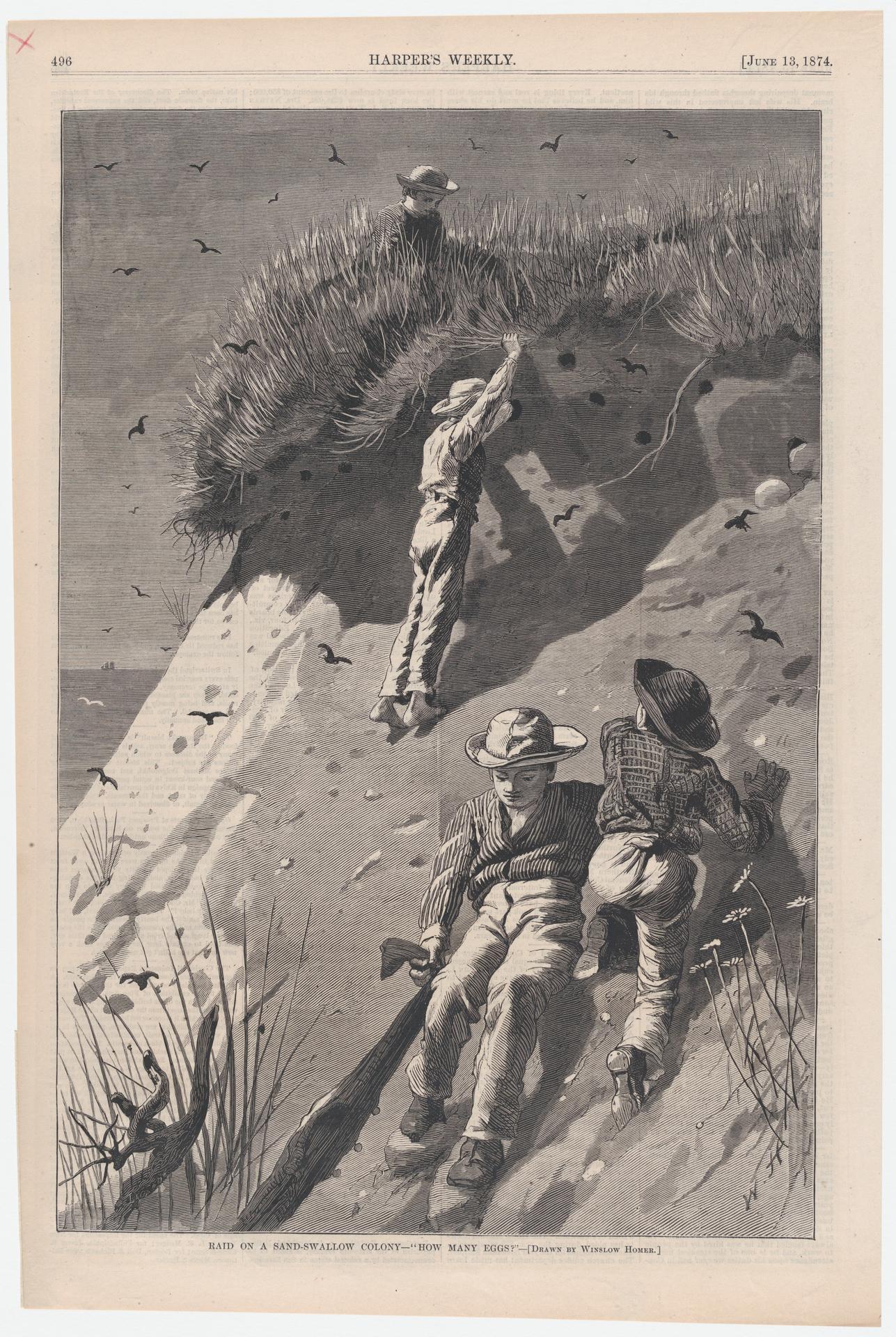
Raid on a Sand-swallow Colony – "How Many Eggs?" (from "Harper's Weekly," Vol. XVIII)
Original title: Raid on a Sand-swallow Colony – "How Many Eggs?" (from "Harper's Weekly," Vol. XVIII)
kurzbeschreibung
This wood engraving by Winslow Homer, dated June 13, 1874, comes from the circle of Harper's Weekly. It shows a group of children stealing eggs from a swallow colony in a sand dune. The illustration combines naturalistic observation with a narrative slice of everyday life.
Description
Three children appear in different poses: one holds up a large tuft, another crouches on the ground, and a third lies on their back. Swallows fly around the colony, while grasses and the sand dune capture the surroundings in detail. The black-and-white print, with even lighting, matches the character of wood engravings. The dynamic layout emphasizes the act of egg theft.
Context
The illustration was made for the American magazine Harper's Weekly, known in the nineteenth century for its wood-engraved illustrations. In the 1870s Homer worked regularly as an illustrator for the paper, often taking up rural life and scenes of children. Publication on June 13, 1874, falls in a period when Homer had already gained recognition as a painter but continued to work for the print market.
Impact
The detailed rendering of nature and figures gives the scene an immediate liveliness. The children's raid stirs mixed feelings—curiosity and unease at once, as the destruction of the bird colony becomes visible. The even distribution of light and clear contours give the print a calm, documentary note.
Technique
For this work Homer used wood engraving, a relief process in which the design is cut into a wood block. Fine lines and hatching allow precise reproduction of textures such as grass and feathers. The printing plate served mass production in the magazine, which explains the compact image size of about 34 x 23 cm.
AI-generated description text
Source: Metropolitan Museum of Art · Public Domain (CC0 1.0)