Saved
Original title: Saved
kurzbeschreibung
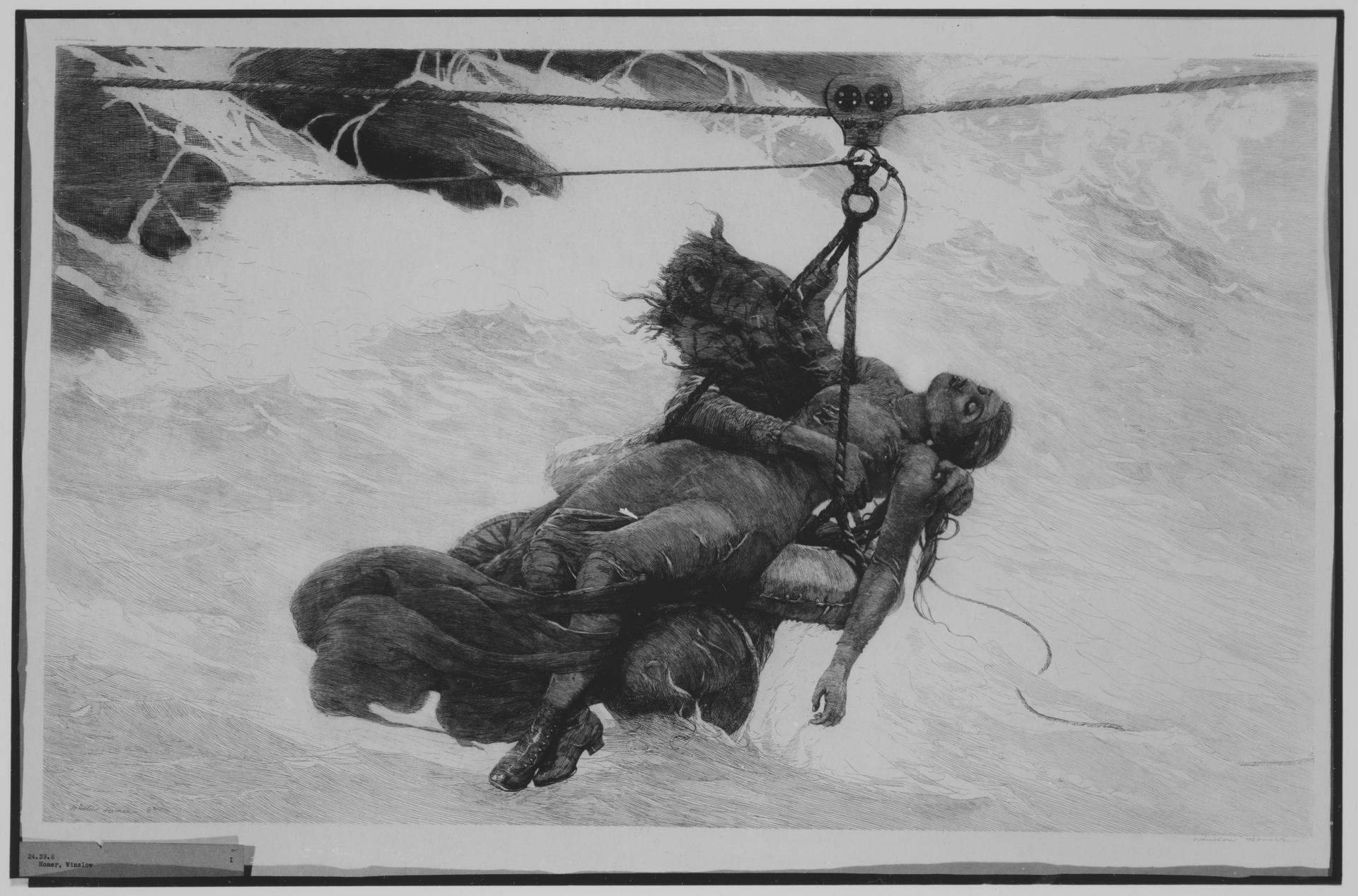
Unlike many contemporary rescue pictures that observe the event from a certain distance, Winslow Homer's 1889 etching Gerettet (Saved) puts the moment of retrieval itself front and centre: a person is lifted from the sea by a winch. Homer chose drypoint for this.
Description
Bright areas meet deep shadows, creating a powerful tension. A figure hangs mid-frame, held by a rope, arms flung wide, head slightly tilted back. Torn clothing flutters around the body, underscoring movement and urgency. Suggested waves at the bottom point to the sea. Light from above emphasises the contours of the figure and the rope, while the rest of the space remains dark.
Context
The etching was made in 1889, when Homer was increasingly preoccupied with distress at sea and rescue. It followed his 1884 painting Saved, which treats the same theme. The print appeared as part of a series of graphic works reflecting Homer's interest in the dangers of the sea and human courage. He was living in Prouts Neck, Maine, at the time, where he could study the coast and ocean at close hand.
Impact
The dramatic lighting and expressive pose of the figure produce a palpable emotional tension. By limiting itself to shades of grey, the event gains seriousness and a timeless, almost monumental presence. The viewer is drawn into the threat and the rescue at once.
Technique
In drypoint, lines are scratched directly into the copper plate with a needle, producing soft, velvety strokes. Printing was done with black ink on paper; the light-dark contrasts arise from the interplay of etching and printing. The image measures 57.8 x 82.9 cm and demonstrates Homer's assured handling of the graphic medium.
AI-generated description text
Source: Metropolitan Museum of Art · Public Domain (CC0 1.0)