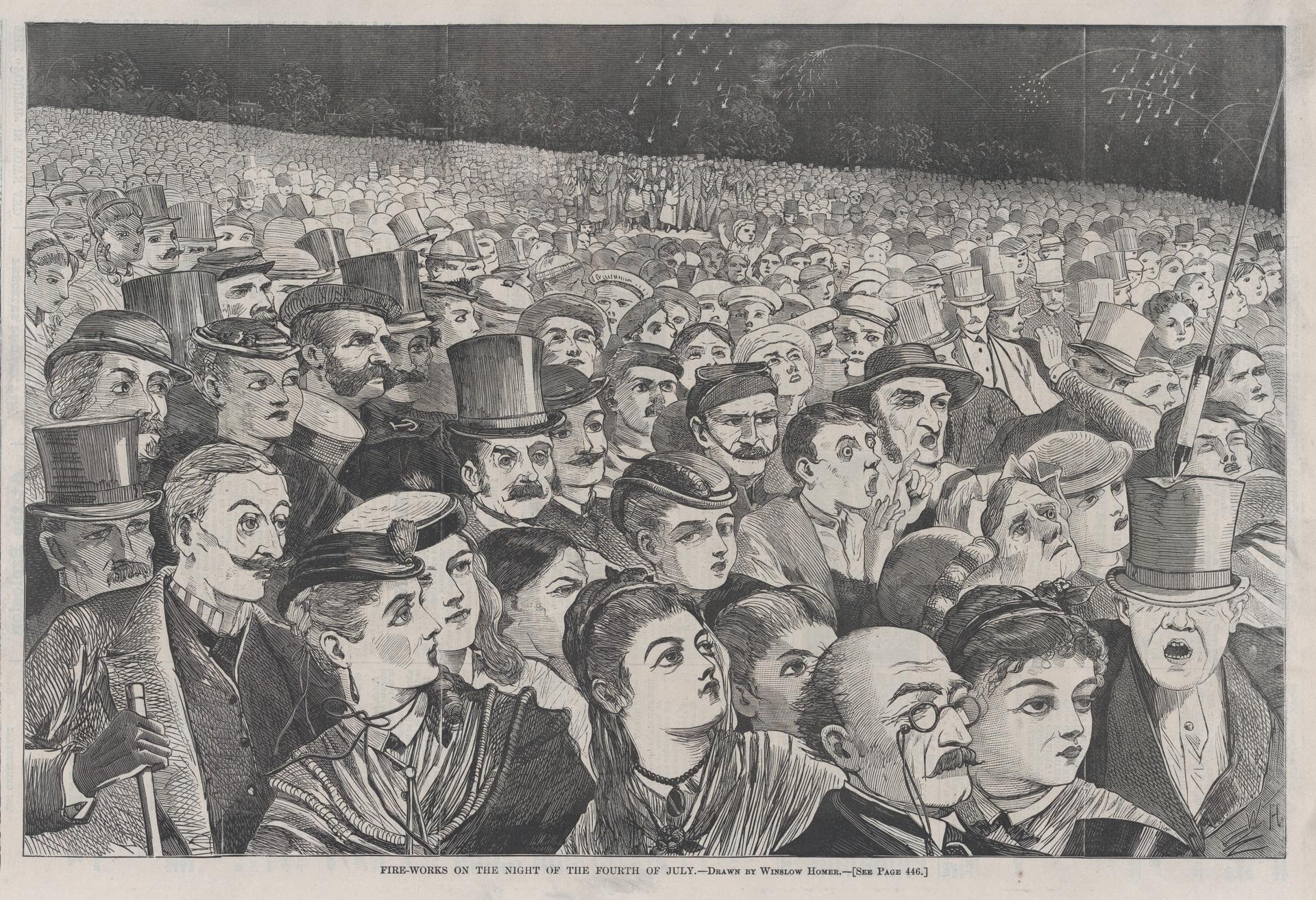
Fire-Works on the Night of the Fourth of July (from "Harper's Weekly," Vol. XII)
Original title: Fire-Works on the Night of the Fourth of July (from "Harper's Weekly," Vol. XII)
kurzbeschreibung
Winslow Homer's wood engraving captures a crowd gathered on the evening of July 4, 1868, watching fireworks burst overhead. Published in Harper's Weekly, the illustration stayed black and white, and it preserves the patriotic mood of American Independence Day.
Description
Packed closely together, the spectators look up in all directions as fireworks explode above them. Many wear hats and suits, suggesting a formal public occasion. More onlookers can be made out behind them, following the spectacle too. The layout runs horizontally, and the crowd's movement pulls toward the sky. The detailed rendering of figures and fireworks matches the wood-engraving illustration of the period.
Context
The work dates from 1868, just three years after the end of the American Civil War. Harper's Weekly was among the leading illustrated magazines in the United States and reached a wide readership. Homer had worked as an illustrator for the paper since the 1850s. This account of the Fourth of July reflects the national celebration culture of the Reconstruction era.
Impact
Rising fireworks and the dense crowd pull the eye upward at once. The black-and-white illustration creates a dynamic, festive atmosphere. Homer's realistic handling of the figures conveys the collective attention and enthusiasm of the audience. Horizontal lines and the variety of viewing directions give the image a lively, almost cinematic quality.
Technique
Wood engraving on paper, printed in black and white. The medium allowed fine lines and shading that were reproduced in Harper's Weekly. Homer used contrasts between light and dark areas to bring out the explosions and the silhouettes of the crowd.
AI-generated description text
Source: Metropolitan Museum of Art · Public Domain (CC0 1.0)