Snap the Whip
Original title: Snap the Whip
kurzbeschreibung
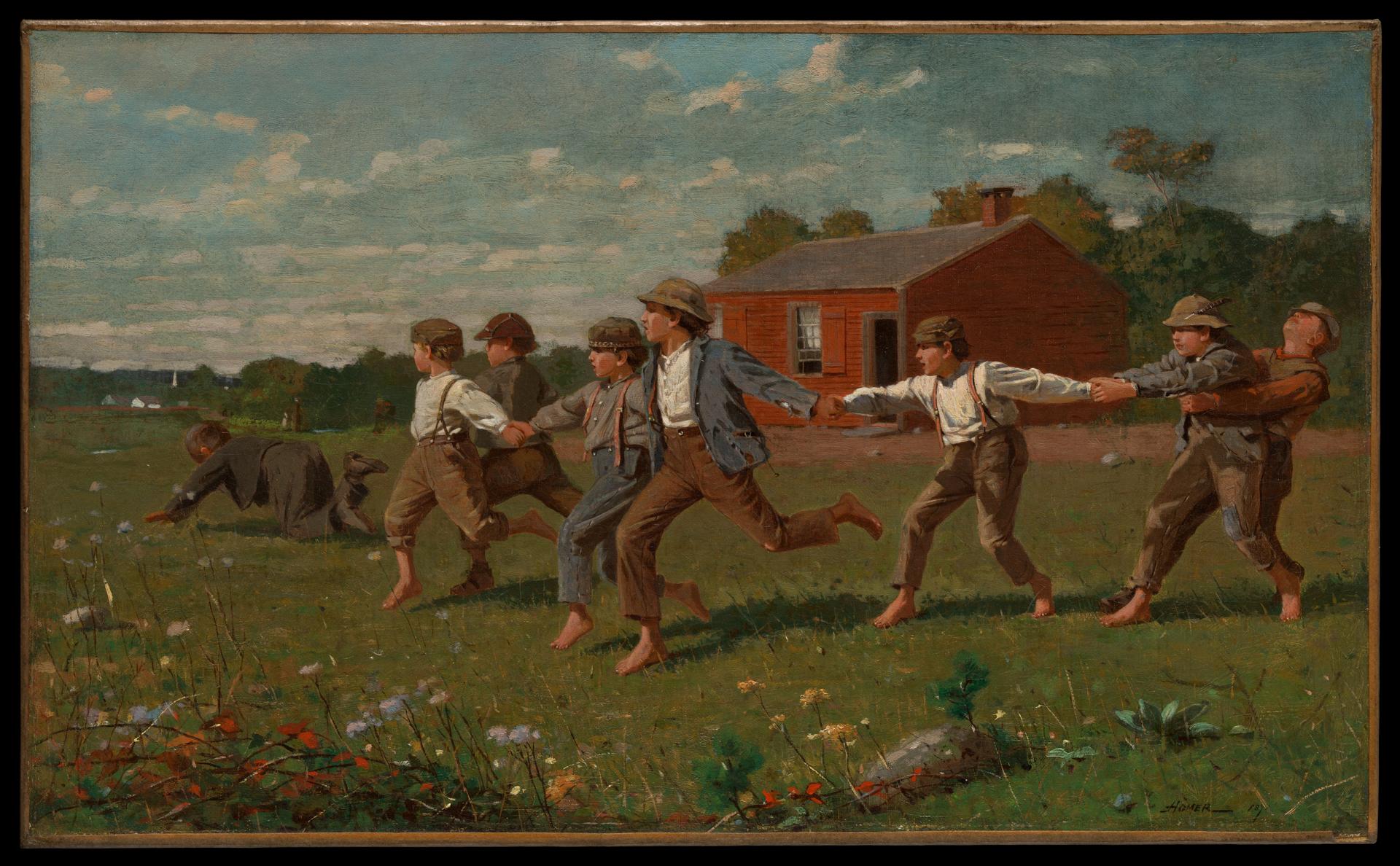
Where many contemporary genre pictures tuck children into the landscape as quiet accessories, Winslow Homer's Das Tauziehen of 1872 puts the boisterous movement itself front and center. A pack of boys romps across a meadow in the middle of a game, captured in oil on canvas measuring 30.5 by 50.8 cm. The picture condenses a moment of rural childhood into one lively scene.
Description
A chain of children stretches across the field, hands clasped together, in shirts, trousers and hats. Behind them rises a red house with roof and chimney, set in grass and scattered flowers. A cloudy sky hangs over the setting; earth tones along with greens and blues govern the palette, while the children's colorful garments add bright accents.
Context
Homer painted the picture in 1872, when a longing for country life was spreading through the United States after the Civil War. The artist was known for his accounts of American everyday life, especially children and landscapes. In this climate, childhood was often idealized as a carefree time, a motif that found wide appeal in nineteenth-century American art.
Impact
Movement and the field's layering in depth give the image a palpable liveliness and a feeling of freedom. The earthy, natural tones and the idyllic surroundings create a calm yet energetic mood that draws the viewer's eye into the action.
Technique
Executed in oil on canvas, the medium allows for rich colors and fine detail. Homer worked realistically and left the brushstroke visible, so that grass, clothing and sky gain in texture. The colors feel strong and at the same time natural, as was characteristic of his work in those years.
AI-generated description text
Source: Metropolitan Museum of Art · Public Domain (CC0 1.0)