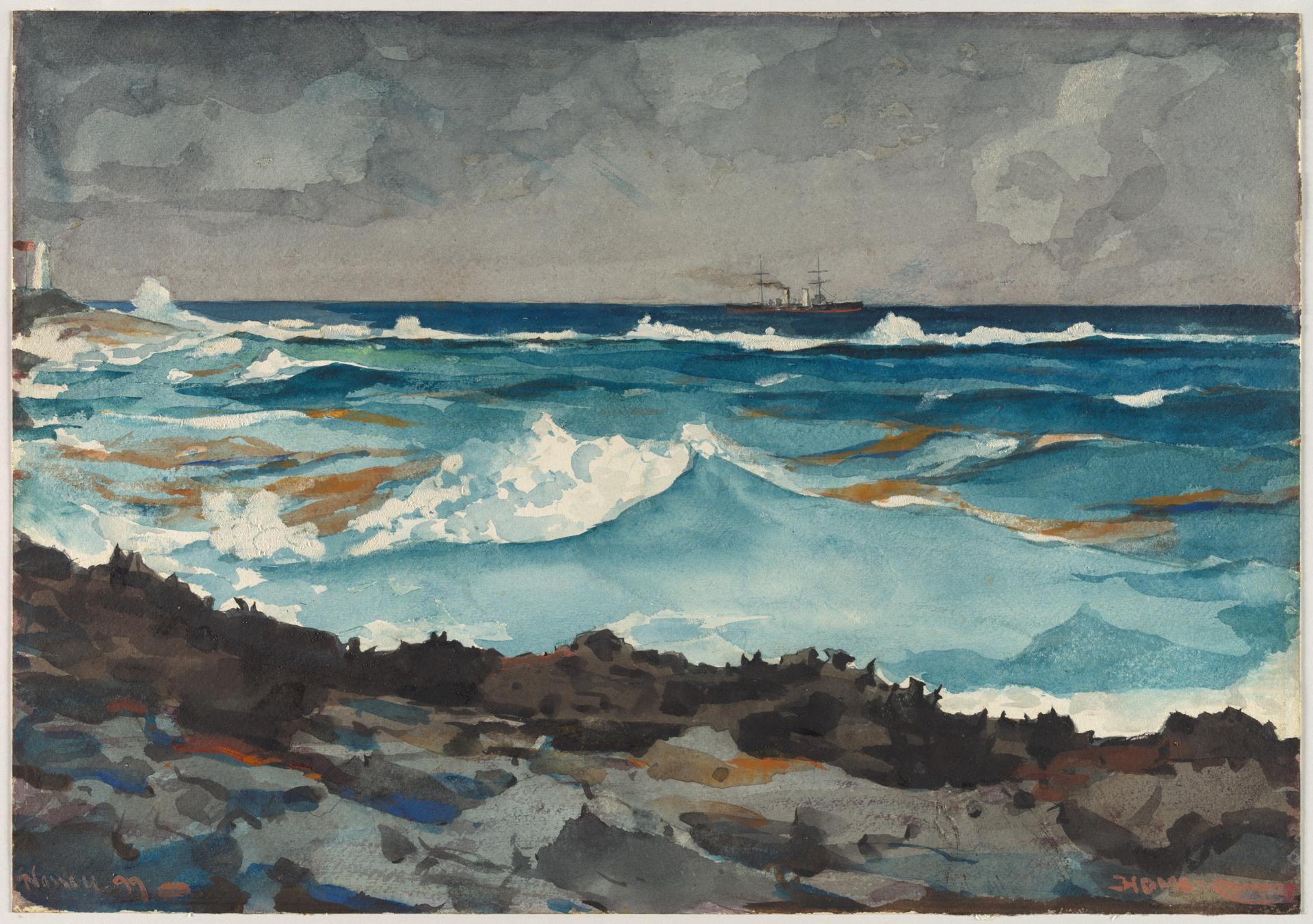
Shore and Surf, Nassau
Original title: Shore and Surf, Nassau
kurzbeschreibung
Winslow Homer captured a stretch of coast near Nassau in 1899 using watercolor and graphite on off-white wove paper. Breaking waves meet rocky shore, and beyond that a ship rests on the open sea. The artist layers translucent washes with drawn accents that record both the flow of the water and the structure of the stone.
Description
Across the sheet, surf rolls against a dark, jagged edge of rock beneath a cloud-heavy sky. A ship lies far out on the water. Tones shift between deep blue and foaming white, tracing the swell's movement. Wet shadows and bright reflections on the stones suggest spray and the wetness of the surface.
Context
Homer traveled to the Bahamas several times in the late 1890s; this watercolor dates from one of those stays. Nassau was then a popular destination for American artists and travelers. Watercolor served Homer as a medium for travel sketches, and along the way he moved toward a freer, more expressive manner of painting.
Impact
Between the crash of the waves and the motionless rock, a tension arises from movement and stillness. The shifting blue of the water and the wet stones make the tropical coast feel immediate, almost physically close.
Technique
Watercolor and graphite on off-white wove paper: transparent layers of color are combined with dry brushstrokes, giving water and rock distinct textures. Graphite lines organize the layout and define the rock forms with contours; the loosely applied areas of color remain open in many places, leaving the brushwork visible.
AI-generated description text
Source: Metropolitan Museum of Art · Public Domain (CC0 1.0)