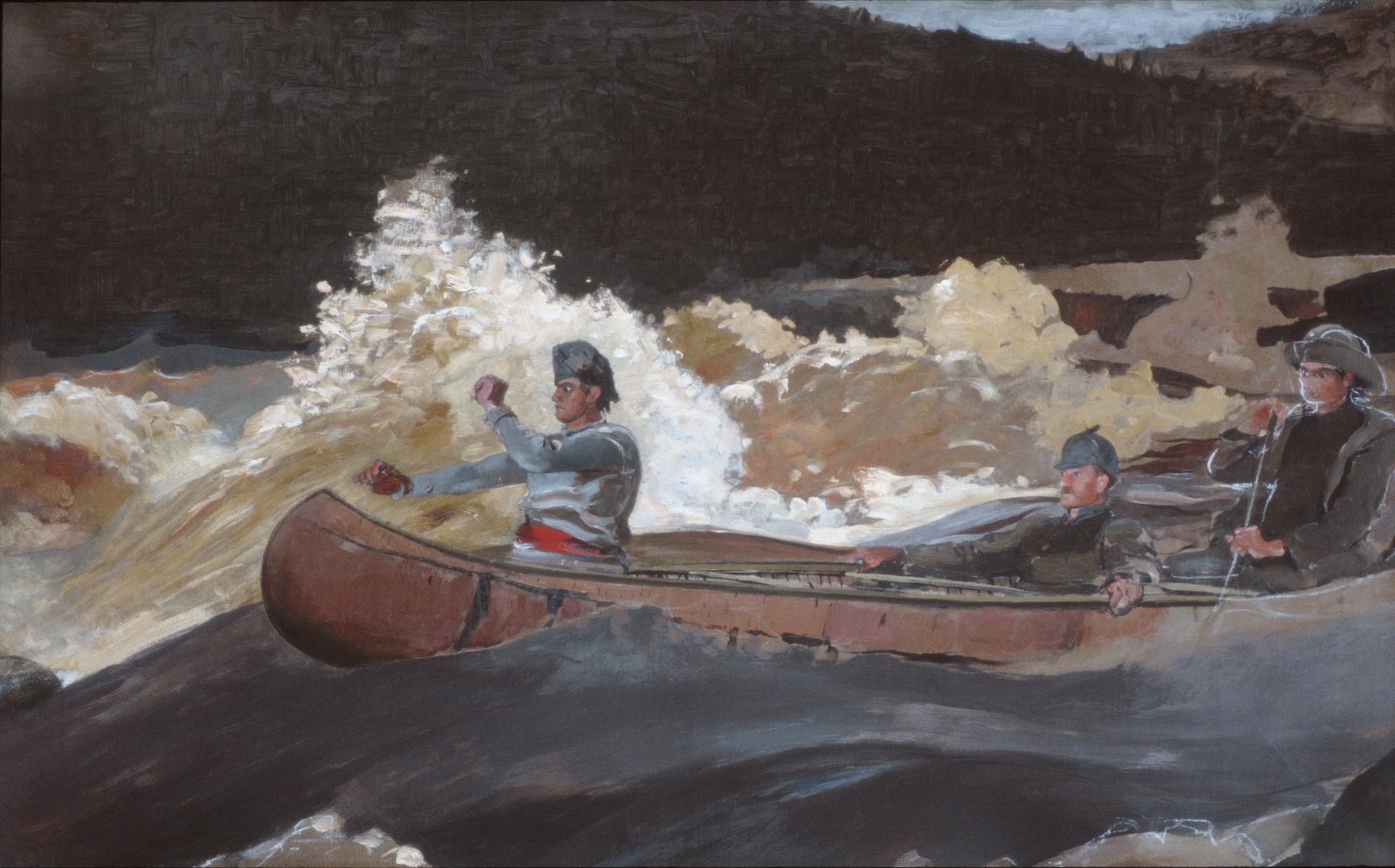
Shooting the Rapids, Saguenay River
Original title: Shooting the Rapids, Saguenay River
kurzbeschreibung
Winslow Homer's "Through the Rapids, Saguenay River" (1905–10) presents a canoe carrying several figures as it forces its way through churning water. Painted in oil on canvas with added chalk, the picture holds fast to a tense moment of river travel in the Canadian wilderness.
Description
Several people sit in a canoe running a fast-moving channel. Their clothing looks traditional, recalling uniforms of an earlier era. At the stern a man steers with his paddle, his gaze fixed downstream; two more occupants, amidships and aft, look the same way. Churned waves and spray stress the water's force, while dark rocky banks reinforce the wildness of the place.
Context
Homer painted this in his late years, when he returned again and again to the country around the Saguenay River in Quebec. The rapids belong to his long engagement with the harsh nature of North America, recorded in many watercolors and oils. That the paddlers wear historicizing dress points to the routes of the Canadian fur trade. In this phase of his work, the forces of nature and human endurance moved further to the fore.
Impact
Waves and the gathered gazes of the canoe's occupants produce a tension one feels at once. The dark, muted palette with its bright crests gives the scene something menacing and alluring together. Looking at it, the viewer is drawn into the event and senses the physical effort of the passage.
Technique
Oil paint on canvas, combined with chalk as a ground, yields a textured surface. The chalk lends waves and spray added physical presence. Largely dark and subdued, the picture lets the pale water stand out in strong contrast.
AI-generated description text
Source: Metropolitan Museum of Art · Public Domain (CC0 1.0)