Palm Tree, Nassau
Original title: Palm Tree, Nassau
kurzbeschreibung
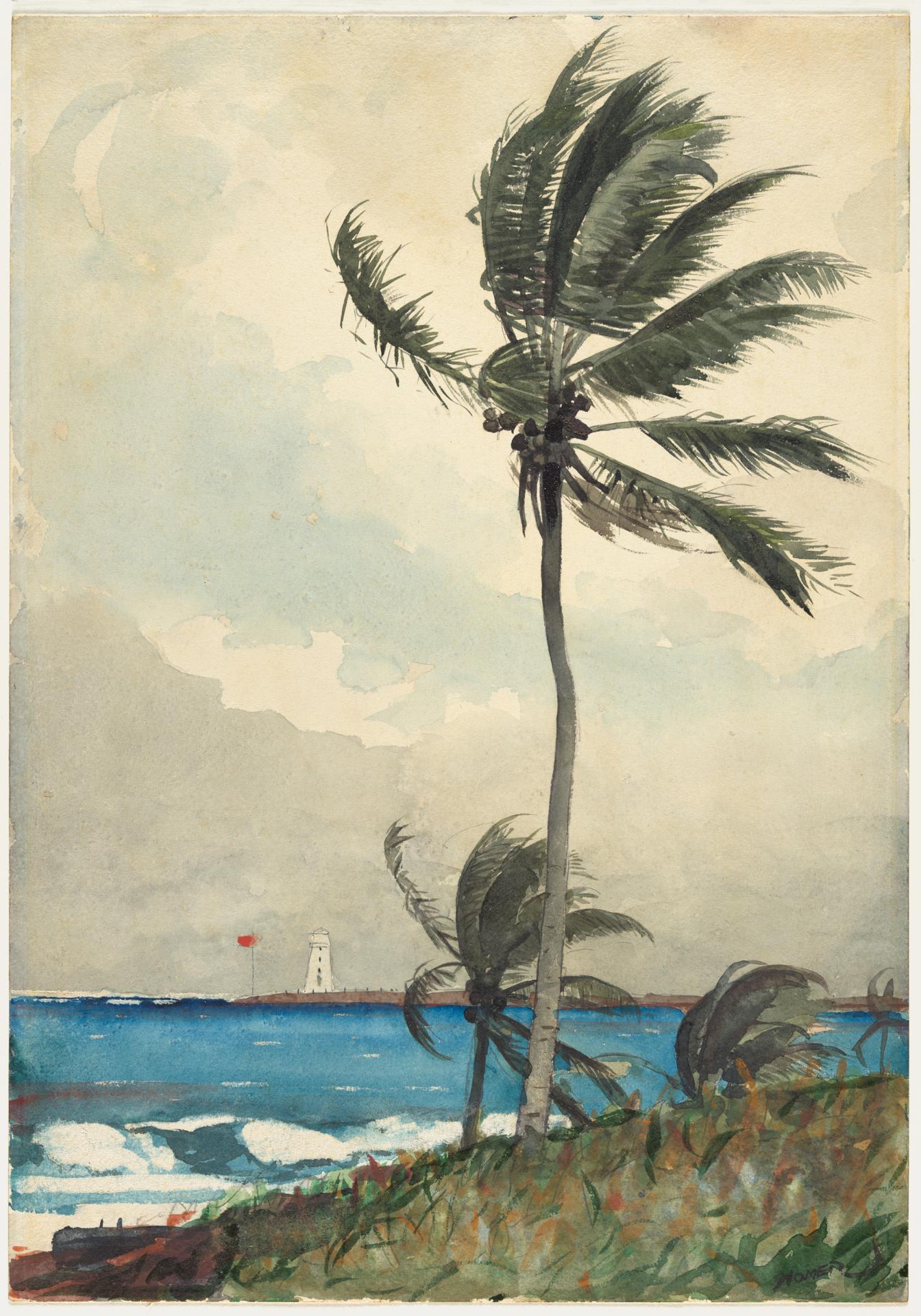
A lone palm leans into the wind, a spit of land with a lighthouse behind it, a cloud-filled sky above, and the sea in several shades of blue. Winslow Homer painted this motif in 1898 in watercolor and graphite on cream-colored wove paper.
Description
The palm dominates the foreground, tilting slightly to the right, its fronds individually worked and full of movement. On the headland behind, a lighthouse rises, topped by a flag. Gray clouds fill the sky, and the sea shifts from dark blue in the foreground to pale blue at the horizon. Grasses and shrubs in various greens line the coast. Light falls soft and diffuse; no people or other objects appear.
Context
During the 1890s Winslow Homer traveled several times to the Bahamas, producing numerous watercolors of tropical subjects. Nassau was then a popular destination for American travelers, and Homer used these stays to capture the light and atmosphere of the Caribbean. This sheet dates from 1898, when he devoted himself especially intensively to watercolor; palms and lighthouses recur in his works from this region.
Impact
Muted grays and blues give the sheet a quiet, almost meditative presence. The slanting palm adds a touch of movement, which the overcast sky settles again. The arrangement remains balanced and naturalistic, without dramatic climax.
Technique
Watercolor and graphite on cream wove paper come together here. The colors flow softly and fluidly, while graphite strokes record details in the palm fronds and coastal vegetation. At 54.3 by 37.8 cm, the sheet follows a format common for watercolors of the period, allowing precise working of the motifs.
AI-generated description text
Source: Metropolitan Museum of Art · Public Domain (CC0 1.0)