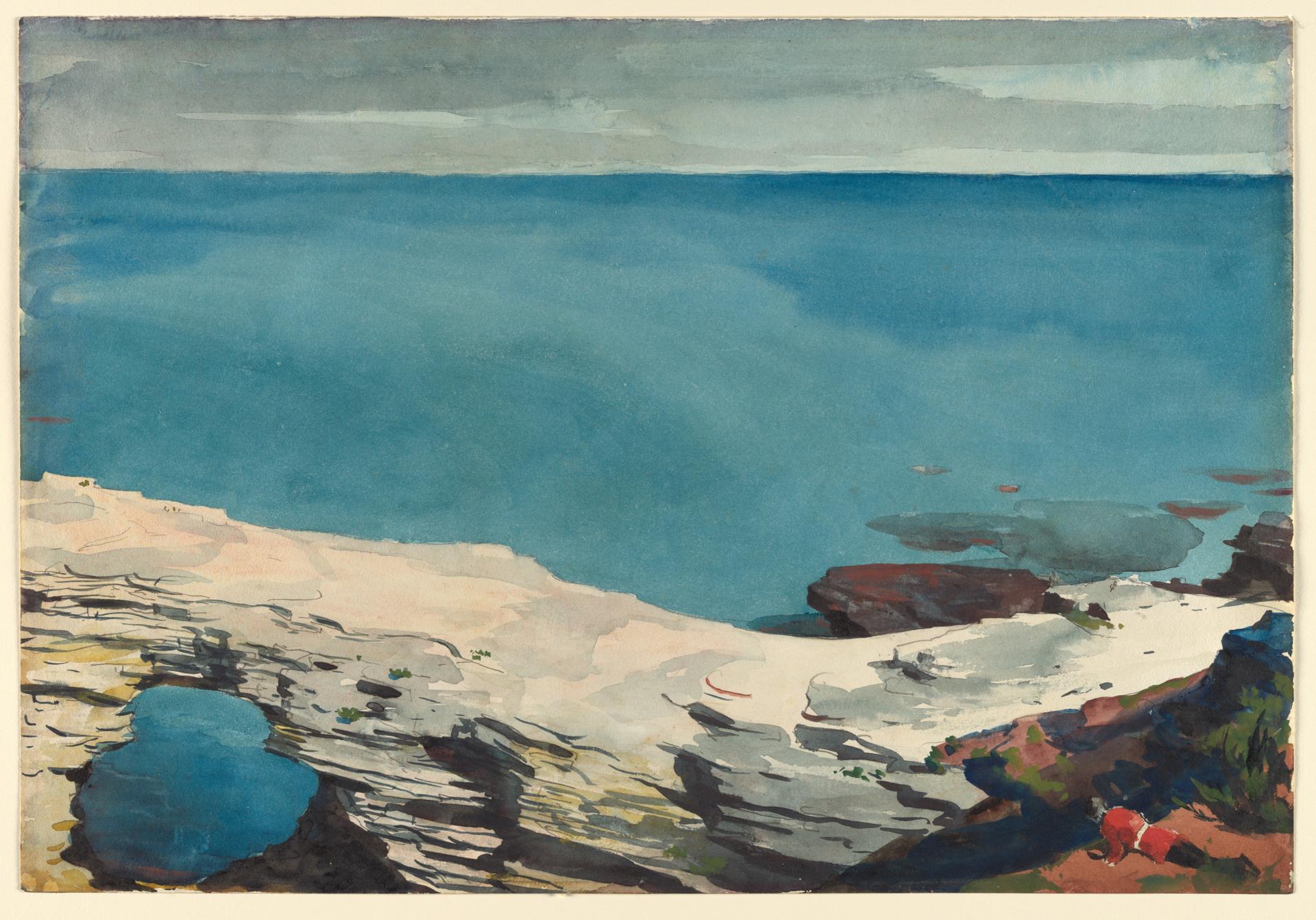
Natural Bridge, Bermuda
Original title: Natural Bridge, Bermuda
kurzbeschreibung
Winslow Homer painted Natural Bridge, Bermuda around 1901, a coastal view built around a striking rock formation. Watercolor and graphite on white wove paper, measuring 36.7 x 53.3 cm, place it among the works he made during his stays on the islands.
Description
A broad stretch of sea runs horizontally to the horizon. The foreground belongs to rocky coastal ground in greys, loosened here and there with touches of blue and red; small plants grow from the sandy soil. Water shifts through blues from deep tones to a pale turquoise near the horizon, while the sky is largely light, suggesting sunshine. No person or animal appears anywhere in the view.
Context
Between 1899 and 1901 Homer spent several periods in Bermuda and produced a large number of watercolors there. The islands were then a favored destination for American artists drawn to the subtropical light and coastal terrain. In these years Homer worked hard at the watercolor medium, often painting outdoors. This sheet was presumably made during his 1901 visit.
Impact
The mild, clear colors and bright light give the picture a calm, sunny mood. Loose brushwork and an unforced account of the coast make it feel immediate and fresh, which is characteristic of Homer's late watercolors.
Technique
Watercolor on white wove paper provides the base, with graphite for fine lines and details. Homer exploited the transparency of the medium to create effects of light in sea and sky, letting the paper show through in places. Paint is applied freely and expressively, producing a lively texture.
AI-generated description text
Source: Metropolitan Museum of Art · Public Domain (CC0 1.0)