The Gulf Stream
Original title: The Gulf Stream
kurzbeschreibung
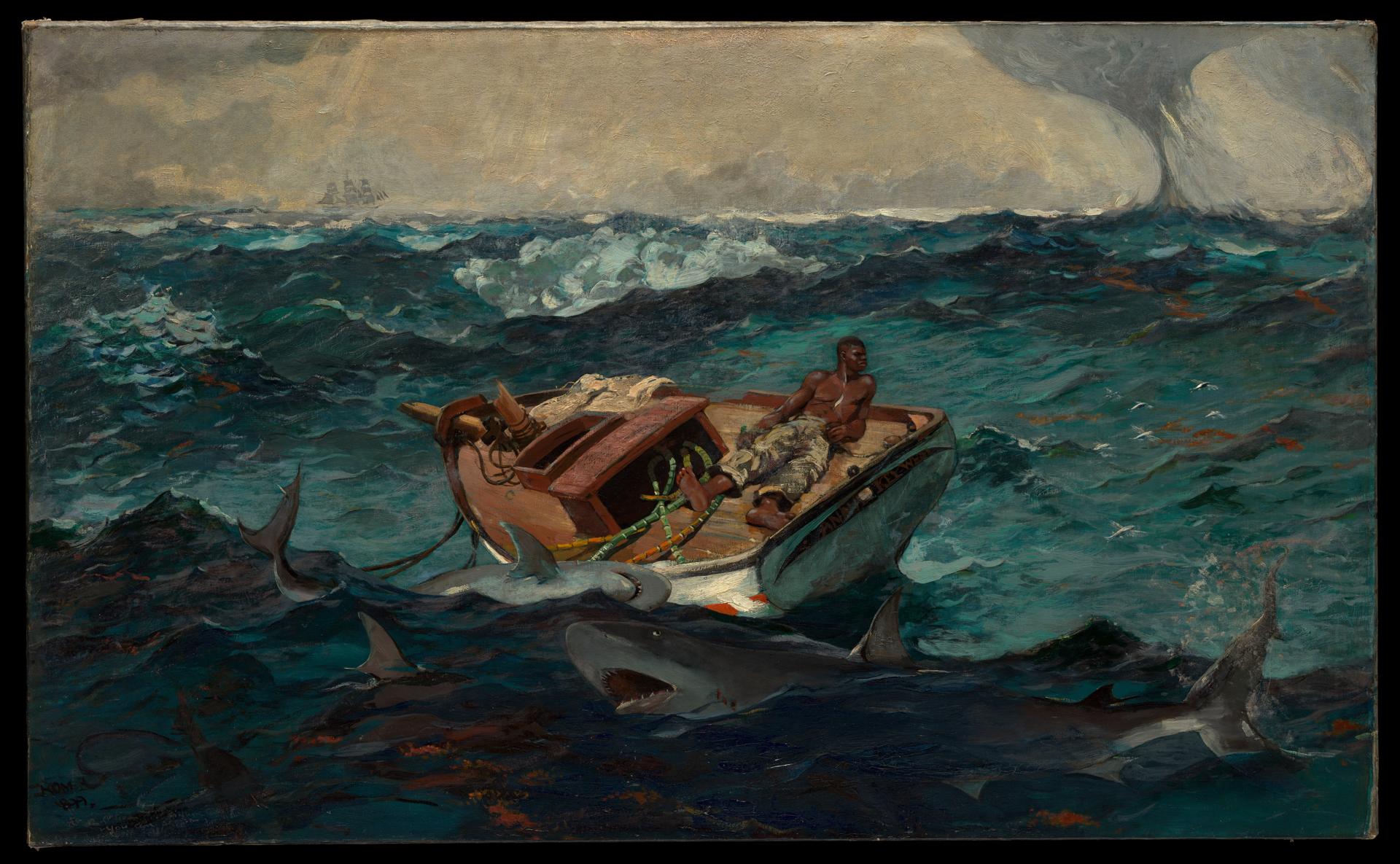
Oil on canvas, 71.4 by 124.8 centimeters: Winslow Homer's 'The Gulf Stream' of 1899, revised in 1906, shows a man in a capsized small boat with sharks pressing around him on the open sea. The painting ranks among the best-known seascapes of American Realism.
Description
In the foreground a man crouches in a small boat while sharks circle it; his gaze rises straight toward the middle of the picture. Rolling dark-blue water carries white crests that emphasize the movement. On the horizon another boat appears, and above it a cloudy sky with a brighter patch that suggests the sun. Muted tones dominate the palette, and the light feels natural and tied to a time of day. A realistic approach with impressionistic touches shows in the brushwork and in the way the water is set in motion.
Context
Homer painted this during his stays in Florida and the Bahamas, where he knew the Gulf Stream and the Caribbean from direct observation. Shipwreck and the threat of sharks connect to contemporary reports of maritime disasters and the dangers of seafaring. In 1906 Homer reworked the painting, presumably to heighten the drama; it was first exhibited in 1899. The work falls in a phase when Homer turned increasingly to existential themes and the power of nature.
Impact
Immediate tension arises: the lone man in the boat, surrounded by sharks, appears exposed and isolated. The calm yet menacing seascape heightens the sense of danger and uncertainty, and rescue is nowhere in sight.
Technique
Oil paint on canvas, applied in several layers, with Homer leaving the brushstrokes visible to capture the movement of the water. The subdued palette and nuanced lighting belong to his late, painterly style between Realism and Impressionism.
AI-generated description text
Source: Metropolitan Museum of Art · Public Domain (CC0 1.0)