The Bather
Original title: The Bather
kurzbeschreibung
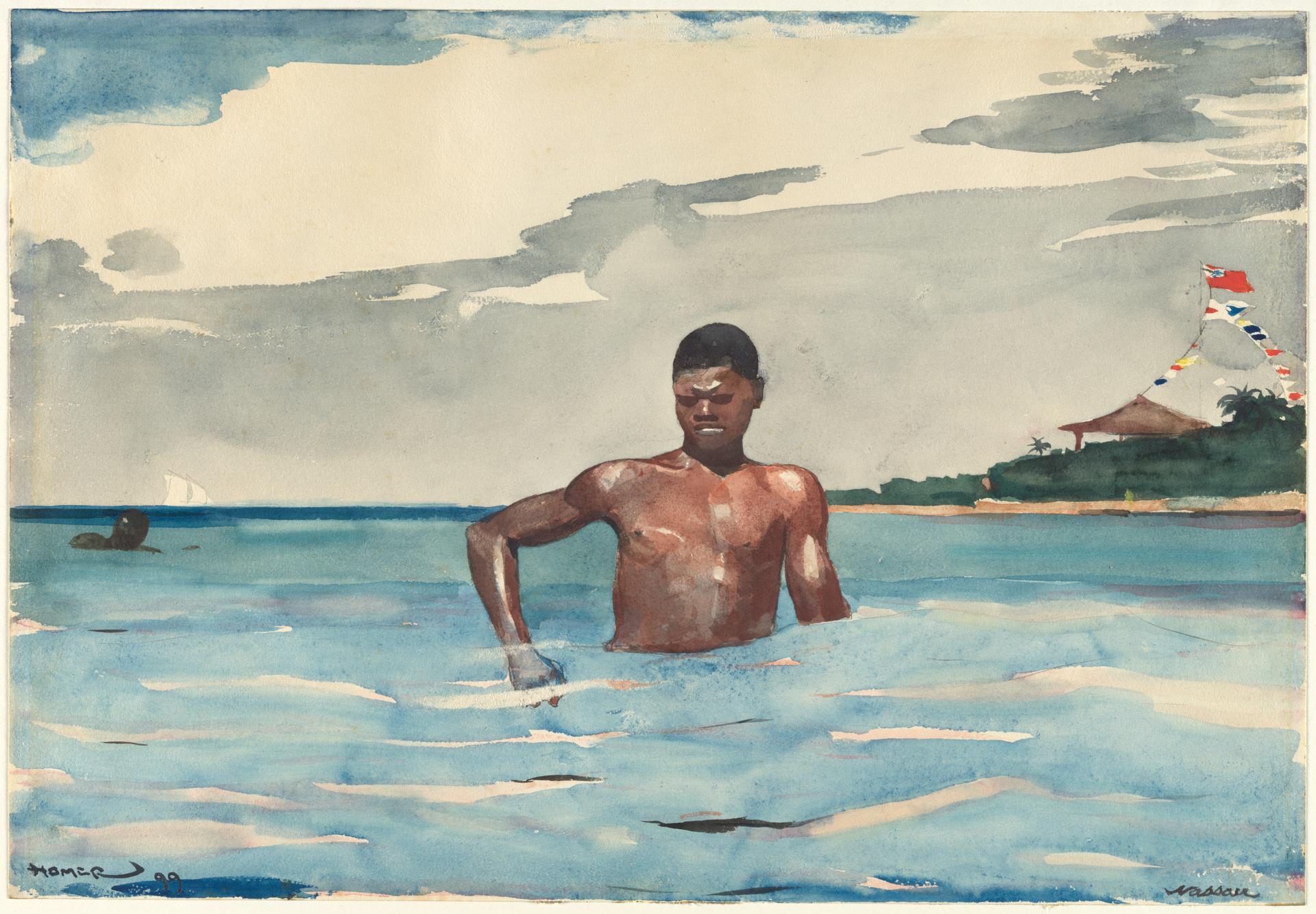
A man stands in the sea, leaning forward — this is Winslow Homer's watercolor "Der Badende" from 1899. Executed in watercolor and graphite on off-white wove paper, the sheet measures 36.7 x 53.5 cm.
Description
In the foreground, a dark-haired man wades in the water, wearing only trousers, and leans forward as if to wash or submerge himself. A cloudy sky hangs over the sea; on the horizon, a spit of land with a pavilion and flag appears, while a small boat drifts on the waves. The layout runs horizontally, with the bather as the focal point and the horizon line governing the arrangement. Blue dominates in water and sky, while muted touches of color accent the background.
Context
The watercolor was made in 1899, when Winslow Homer was deeply engaged with the coastal life of Maine. He spent his summers in Prouts Neck, where he took up the sea and bathers as motifs. In the 1890s, Homer increasingly experimented with watercolor, which he used for open-air studies and spontaneous observations. This sheet belongs to the late phase of his career, when he was already known for his seascapes.
Impact
A quiet, familiar mood emanates from the watercolor, drawing the viewer into the moment of bathing. Soft brushstrokes and restrained color create a poetic note that captures the calm of the sea. The man appears natural and unforced — this lends the image a lively credibility.
Technique
Homer worked with watercolor on off-white wove paper, supplementing it with graphite lines for details. Gentle transitions between water, sky, and land arise from soft brushstrokes and wet washes. The transparency of watercolor is used to convey the light of the coast.
AI-generated description text
Source: Metropolitan Museum of Art · Public Domain (CC0 1.0)