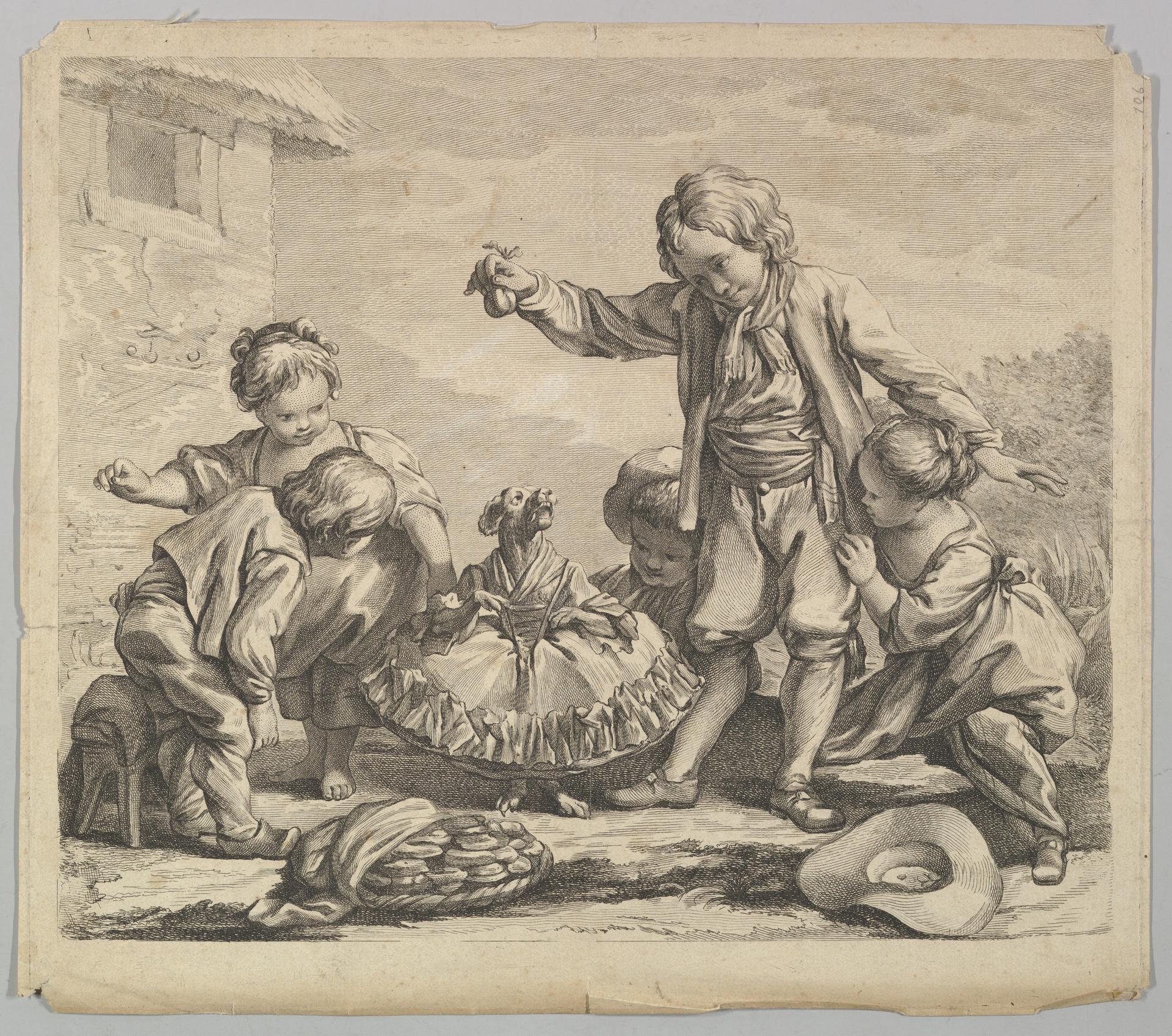
Five Children with Dancing Dog
Original title: Five Children with Dancing Dog
kurzbeschreibung
An etching from eighteenth-century France whose maker is unknown. Five children surround a dancing dog, and the print works in shades of grey that catch the liveliness of the figures.
Description
Five children settle around a dog that springs up or dances in their midst. Their clothes differ, some in plain garments, others in more elaborate dress. One child in the foreground carries a filled basket. A plain stone wall closes off the back of the picture and suggests a rural setting. The postures of the children and the dog bring movement into the arrangement, while light falls evenly across the sheet and sets hardly any shadow or contrast.
Context
Printed graphics circulated widely in eighteenth-century France and often took up scenes of everyday life. That the author of this sheet is not recorded matches the practice of the time: many etchings passed around as single sheets or in series without a signature. Children with animals were a common motif, meant to entertain but also to instruct. Etching as a technique allowed fine lines and details, as can be seen here too.
Impact
The dancing dog as the pivot and the children around it create a cheerful, almost playful mood. Even light and fine lines give the sheet something calm and balanced without hiding the movement of the figures. Looking at the picture, one follows the interplay of child and animal, lively and idyllic at once.
Technique
The motif was etched into a metal plate, an intaglio process in which acid deepens the drawn lines. How precisely this technique works is shown by the fine lines and the detailed rendering of figures and background. Grey tones dominate the sheet, even in tonality throughout, typical of etchings of that period.
AI-generated description text
Source: Metropolitan Museum of Art · Public Domain (CC0 1.0)