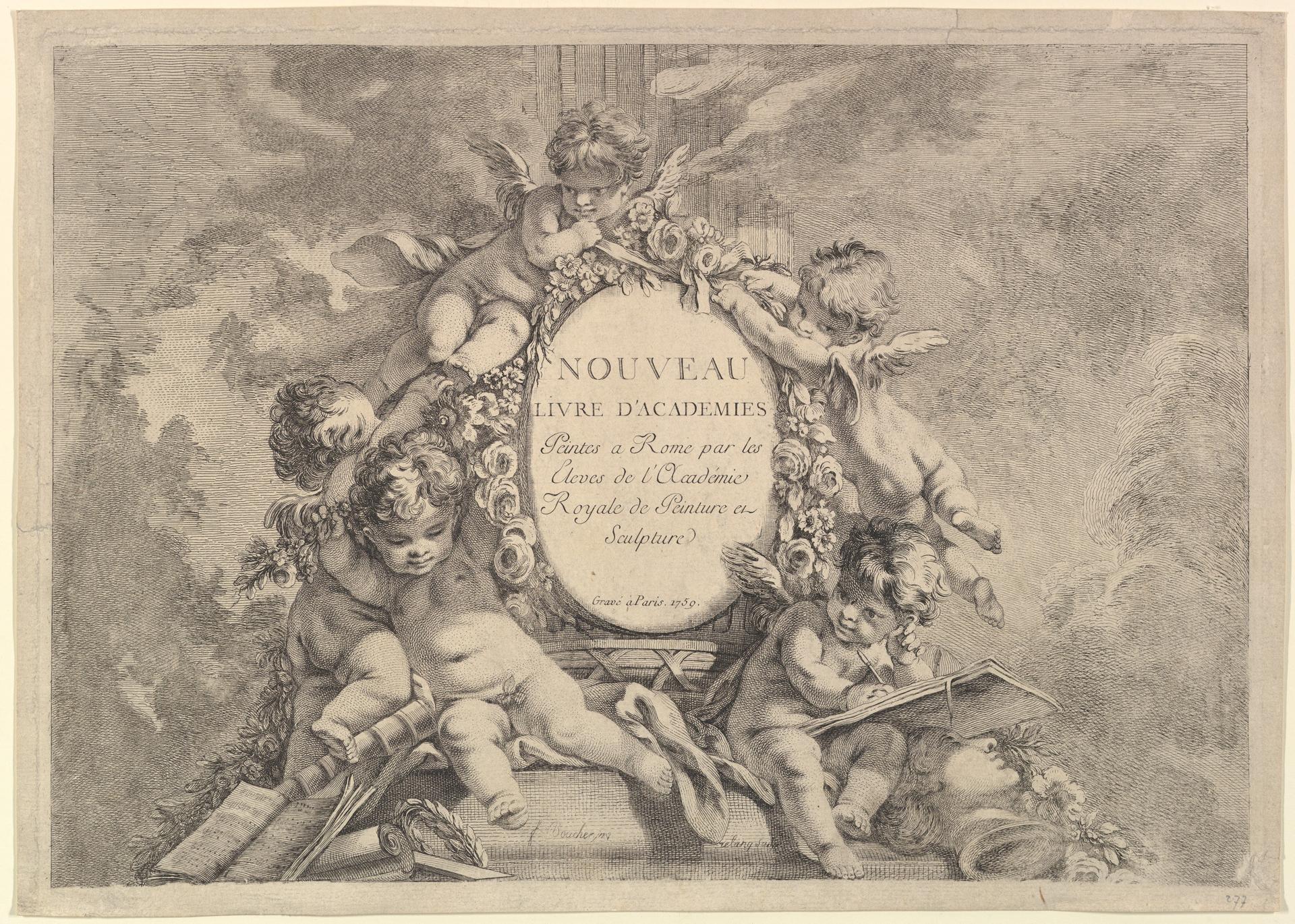
Frontispiece, from Nouveau Livre d'Academies Peintes a Rome par les Eleves de l'Académie Royale de Peinture et Sculpture
Original title: Frontispiece, from Nouveau Livre d'Academies Peintes a Rome par les Eleves de l'Académie Royale de Peinture et Sculpture (New Book of the Academy Painted in Rome by the Pupils of the Royal Academy of Painting and Sculpture)
kurzbeschreibung
For the title page of the "Nouveau Livre d'Académies Peintes à Rome," François Boucher produced an etching with engraving in 1759. An oval coat of arms, flanked by four putti, stands out against clouds and a fragment of temple architecture. Allegorical and decorative traits of the Rococo come together in this print.
Description
An oval cartouche bearing the inscription "NOUVEAU LIVRE D'ACADEMIES Peintes à Rome par les Élèves de l'Académie Royale de Peinture et Sculpture" anchors the sheet. Four putti gather around it: one sits on a garland of flowers, another holds a bouquet, a third presents a book, and the fourth appears at the right side. Clouds and a hint of a temple fill the setting. Tonal greys and a symmetrical layout define the view.
Context
The sheet appeared in 1759 as the frontispiece to a collection that brought together academic studies by Roman pupils of the Académie Royale de Peinture et de Sculpture. François Boucher, a leading figure of the Rococo, made the etching on commission for this publication. The volume documented nude studies produced in Rome and stressed the value of academic training. Boucher was already well established at the time and taught as a professor at the Académie Royale.
Impact
A cheerful, festive mood comes across through the balanced arrangement and the graceful putti. The coat of arms, floral motifs and classicising temple point to the interplay of art, fame and classical tradition. The drawn line gives the image an elegant, almost dancing lightness.
Technique
This is an etching refined with engraving. Fine hatching and precise contours can be achieved with this method, and the printing was done in greys. The monochrome rendering, typical of its period, reinforces the sculptural presence of the figures.
AI-generated description text
Source: Metropolitan Museum of Art · Public Domain (CC0 1.0)