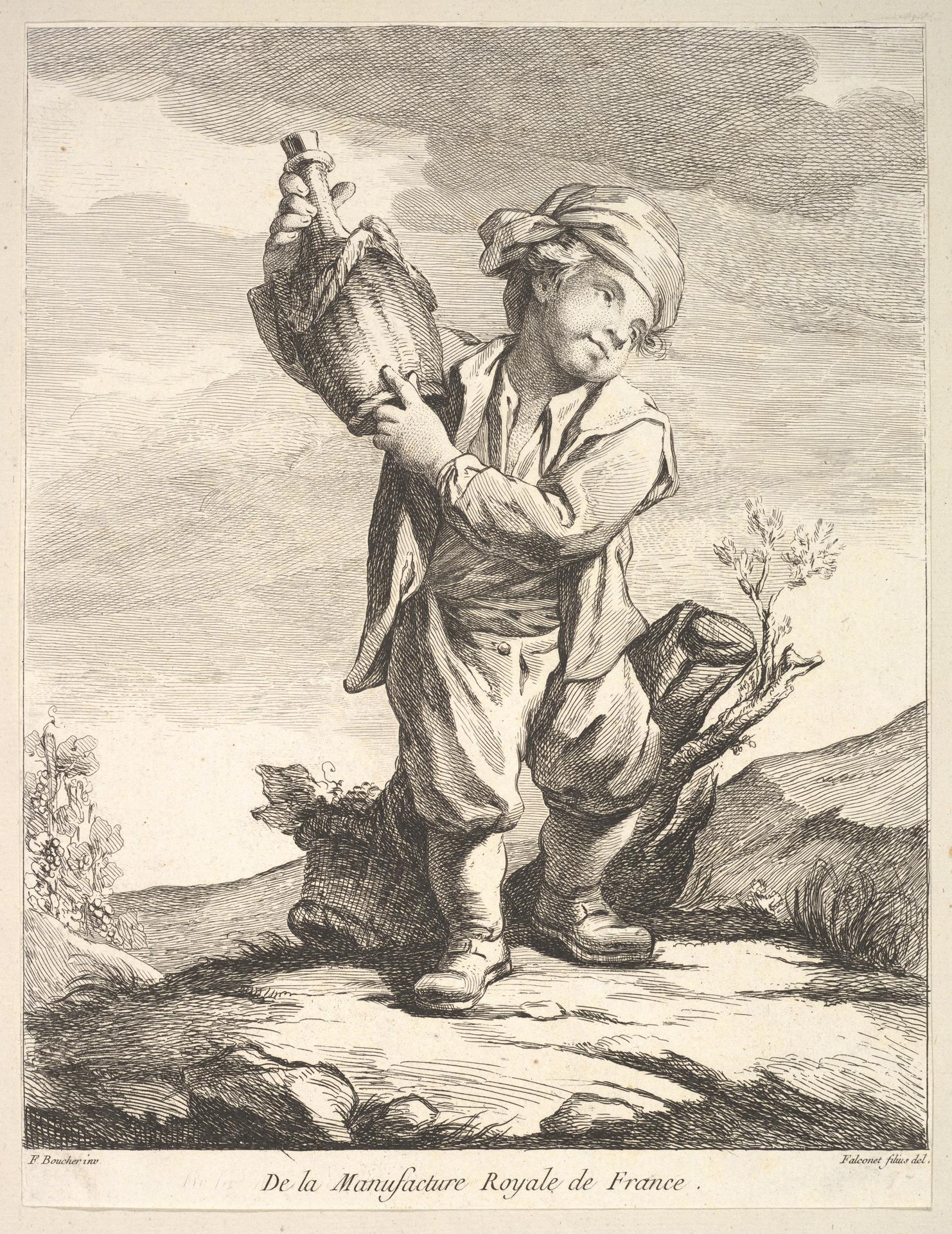
Little boy holding a vessel, from "Premier Livre de Figures d'après les porcelaines de la Manufacture Royale de France, inventées en 1757, par Mr. Boucher"
Original title: Little boy holding a vessel, from "Premier Livre de Figures d'après les porcelaines de la Manufacture Royale de France, inventées en 1757, par Mr. Boucher" (First Book of Figures after porcelains from the Manufacture Royale de France, devised in 1757, by Mr. Boucher)
kurzbeschreibung
Pierre Etienne Falconet made this etching and engraving in 1757 of a boy holding a vessel. It belongs to a series reproducing porcelain figures of the Manufacture Royale de France after designs by François Boucher. The sheet counts as ornamental printmaking.
Description
The boy's gaze turns left, and his body leans slightly that way too. He wears a simple shirt and trousers fastened to a turban; in his hands he carries a vessel. Scattered plants, a hilly landscape and a cloudy sky form the setting. Fine hatching and lines structure the monochrome rendering.
Context
The series was created in 1757 as a graphic translation of François Boucher's porcelain designs for the Manufacture Royale de France. Pierre Etienne Falconet, son of the sculptor Étienne Maurice Falconet, worked as a copperplate engraver. Such prints spread decorative motifs and were aimed at collectors and craftsmen alike.
Impact
Calm and elegant, the sheet meets the viewer, carried by its fine linework and balanced arrangement. The monochrome execution underlines the graphic character and gives the motif a classicist note.
Technique
Etching and copper engraving combine in this work, as can be seen in the precise lines and delicate hatching. The paper measures about 24.7 x 19 cm, a format common for single sheets of eighteenth-century print series.
AI-generated description text
Source: Metropolitan Museum of Art · Public Domain (CC0 1.0)