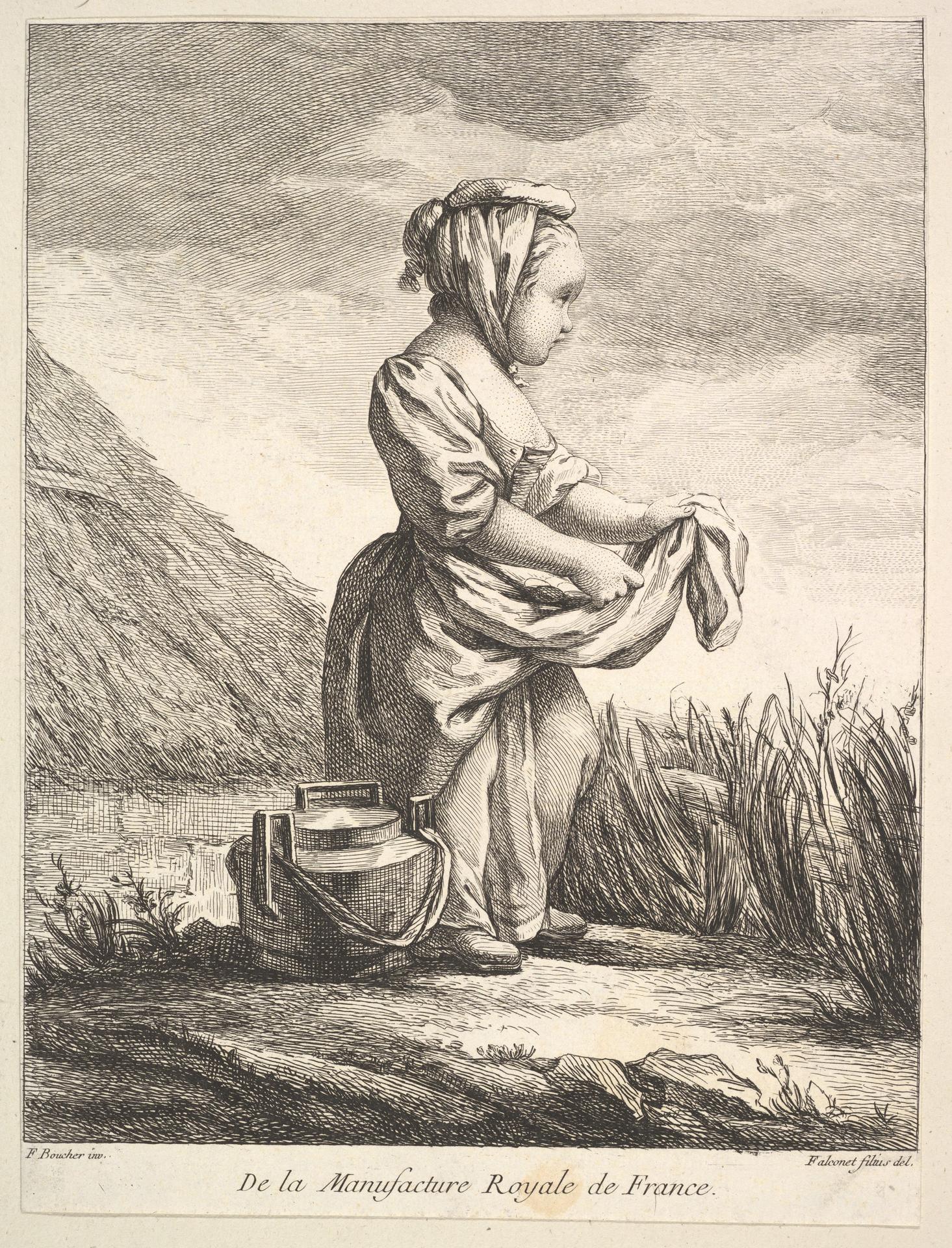
Little girl with a vessel by her feet, from "Premier Livre de Figures d'après les porcelaines de la Manufacture Royale de France, inventées en 1757, par Mr. Boucher"
Original title: Little girl with a vessel by her feet, from "Premier Livre de Figures d'après les porcelaines de la Manufacture Royale de France, inventées en 1757, par Mr. Boucher" (First Book of Figures after porcelains from the Manufacture Royale de France, devised in 1757, by Mr. Boucher)
kurzbeschreibung
Made in 1757, Pierre Etienne Falconet's etching "Kleines Mädchen mit einem Gefäß zu ihren Füßen" presents a young girl in a rural setting. The sheet belongs to the series "Premier Livre de Figures d'après les porcelaines de la Manufacture Royale de France" and was executed as an etching with engraving.
Description
A young woman appears in a plain, long dress and headscarf; her gaze is lowered, and she holds a cloth or piece of fabric between her hands. To her left, a container resembling a water jug rests on the ground. A roof in a rural landscape and a clouded sky close off the view behind her. The figure occupies the middle, with the vessel set to her left, giving the picture a balanced arrangement. The whole motif stays black and white, while carefully placed lines and hatching bring out textures and forms.
Context
The sheet was made in 1757 as part of a series gathering figures after porcelains of the Manufacture Royale de France. François Boucher had devised the porcelain models for this series in the same year. Pierre Etienne Falconet, son of the sculptor Étienne Maurice Falconet, produced the etchings as reproductive prints. The series bears witness to how porcelain art and graphic reproduction worked together in eighteenth-century France.
Impact
Calm and pensiveness shape the impression of this print, carried by precisely drawn lines. Subdued light and the balanced arrangement give the view something orderly and idyllic. Through dense shading the motif gains a plasticity characteristic of French art of the eighteenth century.
Technique
The sheet was executed as an etching and engraving on paper. Lines and shadows are worked precisely to convey textures and forms. The monochrome black-and-white treatment follows the conventions of printmaking of that period.
AI-generated description text
Source: Metropolitan Museum of Art · Public Domain (CC0 1.0)