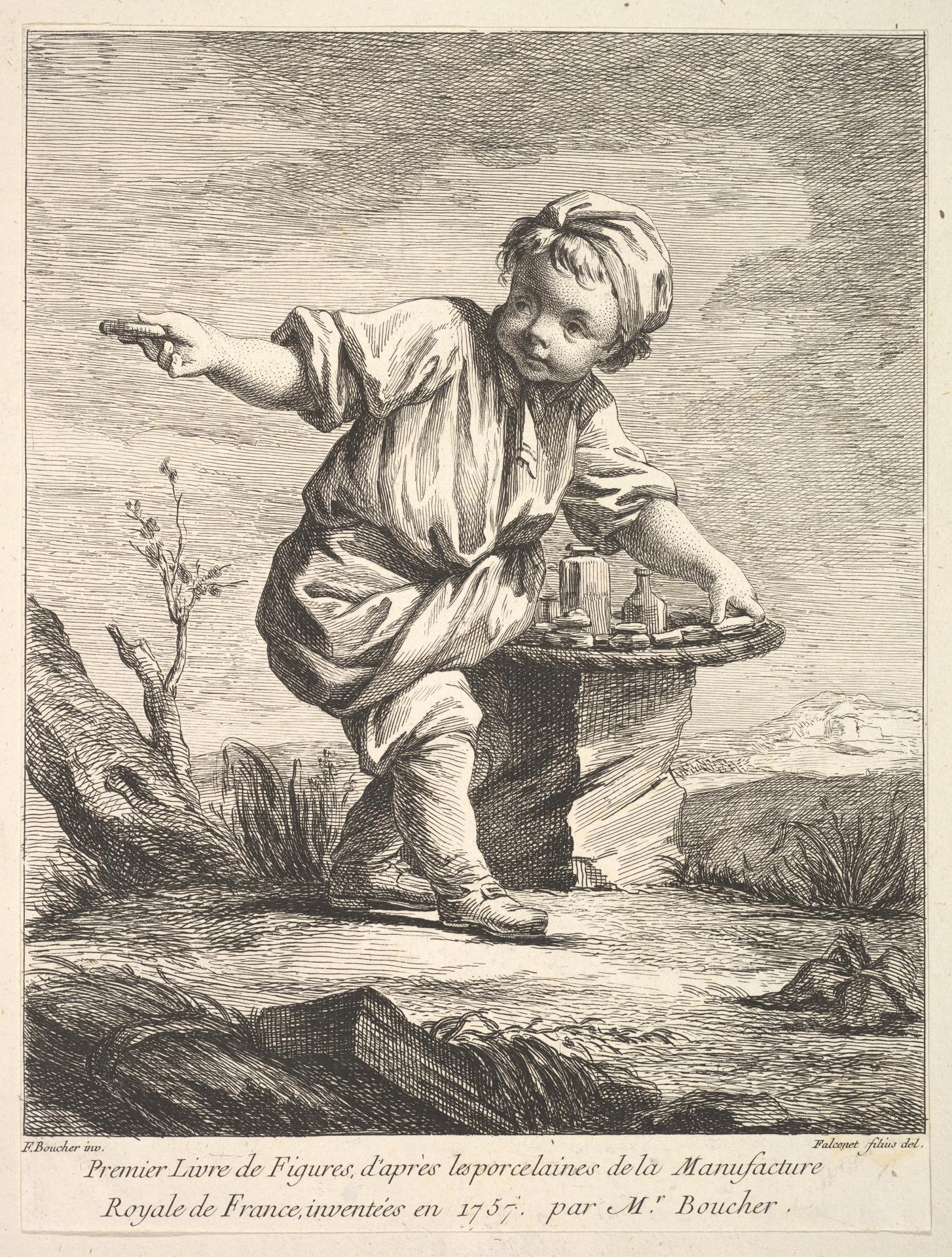
Frontispiece with little boy holding a basket, from "Premier Livre de Figures d'après les porcelaines de la Manufacture Royale de France, inventées en 1757, par Mr. Boucher"
Original title: Frontispiece with litte boy holding a basket, from "Premier Livre de Figures d'après les porcelaines de la Manufacture Royale de France, inventées en 1757, par Mr. Boucher" (First Book of Figures after porcelains from the Manufacture Royale de France, devised in 1757, by Mr. Boucher)
kurzbeschreibung
A young boy kneels on a rock, gesturing to the left with one hand while holding a bowl. Pierre Etienne Falconet made this frontispiece in 1757 as the title page for a series of figures after porcelain from the Manufacture Royale de France. The etching and engraving combine childlike grace with rural idyll and belong to the Rococo.
Description
Kneeling on a rock, a small boy points his finger to the left. In his hand he holds a bowl containing various objects, including bottles and a vessel. Bushes and a tree stump form the background of a rural landscape. Gray tones dominate the monochrome view, and the light appears diffuse and evenly distributed. Carefully executed lines and shading capture the texture of clothing and surroundings.
Context
This print was created in 1757 and belongs to a series of prints after porcelain figures from the Manufacture Royale de France. The designs were supplied by François Boucher, a leading Rococo painter who created the porcelain designs in 1757. Falconet translated them into etching and engraving. The Manufacture Royale de France, also known as the Vincennes porcelain factory, was a royal manufactory producing luxurious porcelain for the court.
Impact
Fine lines and soft shading give the sheet an elegant yet playful effect. The calm rural setting and the child's pose evoke a cheerful, idyllic mood. The boy's gesture draws the eye into the picture space and offers a glimpse of the aesthetic ideals of the French Rococo.
Technique
Etching and engraving come together here, resulting in precise line work and fine tonal gradations. Falconet used these techniques for soft transitions and textures. The sheet was printed on paper; its dimensions are 24.5 x 18.5 cm.
AI-generated description text
Source: Metropolitan Museum of Art · Public Domain (CC0 1.0)