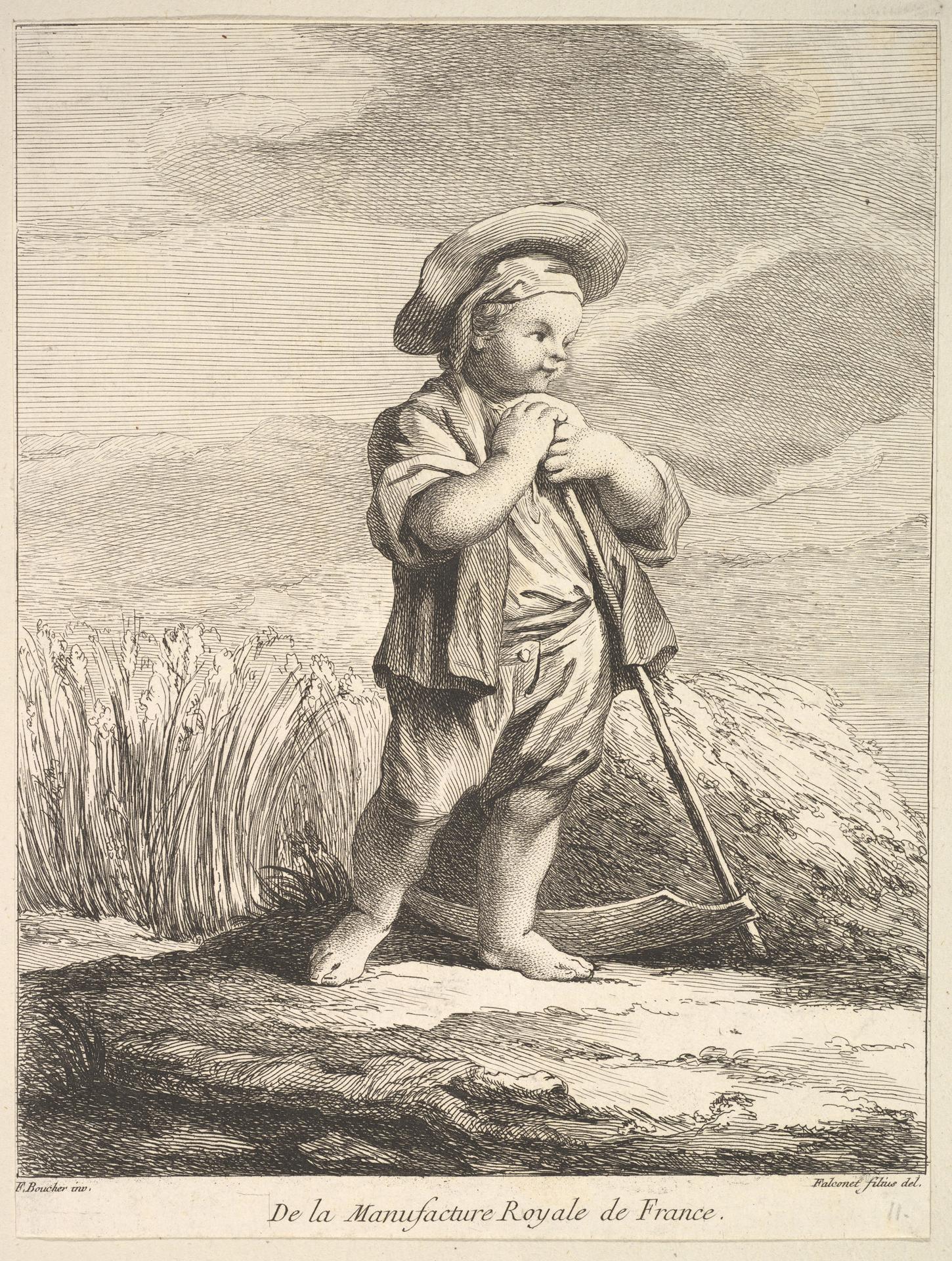
Little boy with a scythe, from "Premier Livre de Figures d'après les porcelaines de la Manufacture Royale de France, inventées en 1757, par Mr. Boucher"
Original title: Little boy with a scythe, from "Premier Livre de Figures d'après les porcelaines de la Manufacture Royale de France, inventées en 1757, par Mr. Boucher" (First Book of Figures after porcelains from the Manufacture Royale de France, devised in 1757, by Mr. Boucher)
kurzbeschreibung
A small boy holding a scythe in a rural field appears in this 1757 print by Pierre Etienne Falconet. The etching and engraving belongs to a series made after porcelain figures from the French Royal Manufactory. Monochrome in tone, the image reflects eighteenth-century French printmaking.
Description
The boy stands at the center, a scythe in his hand. He wears a wide-brimmed cap, a plain long-sleeved shirt, and trousers; his feet are bare. His gaze turns to the right, and his posture seems thoughtful and calm. Fields and a cloudy sky are suggested in the distance. Shadows and contours bring out the texture of his clothing and the scythe.
Context
The print was made in 1757 as part of a book of figures after porcelains from the Manufacture Royale de France. The porcelain models came from François Boucher, a leading Rococo artist. Falconet produced the prints as reproductions of these models so that porcelain art could reach a wider audience. Such printed works often served as models for collectors and craftsmen.
Impact
The scene feels quiet and idyllic, thanks to the boy's relaxed posture and the clear linework. The monochrome execution draws attention to the fine details of clothing and scythe, encouraging close looking.
Technique
Etching and engraving come together on this sheet, allowing fine lines and precise shading. The process permits a detailed rendering of textures and light effects typical of eighteenth-century printmaking.
AI-generated description text
Source: Metropolitan Museum of Art · Public Domain (CC0 1.0)