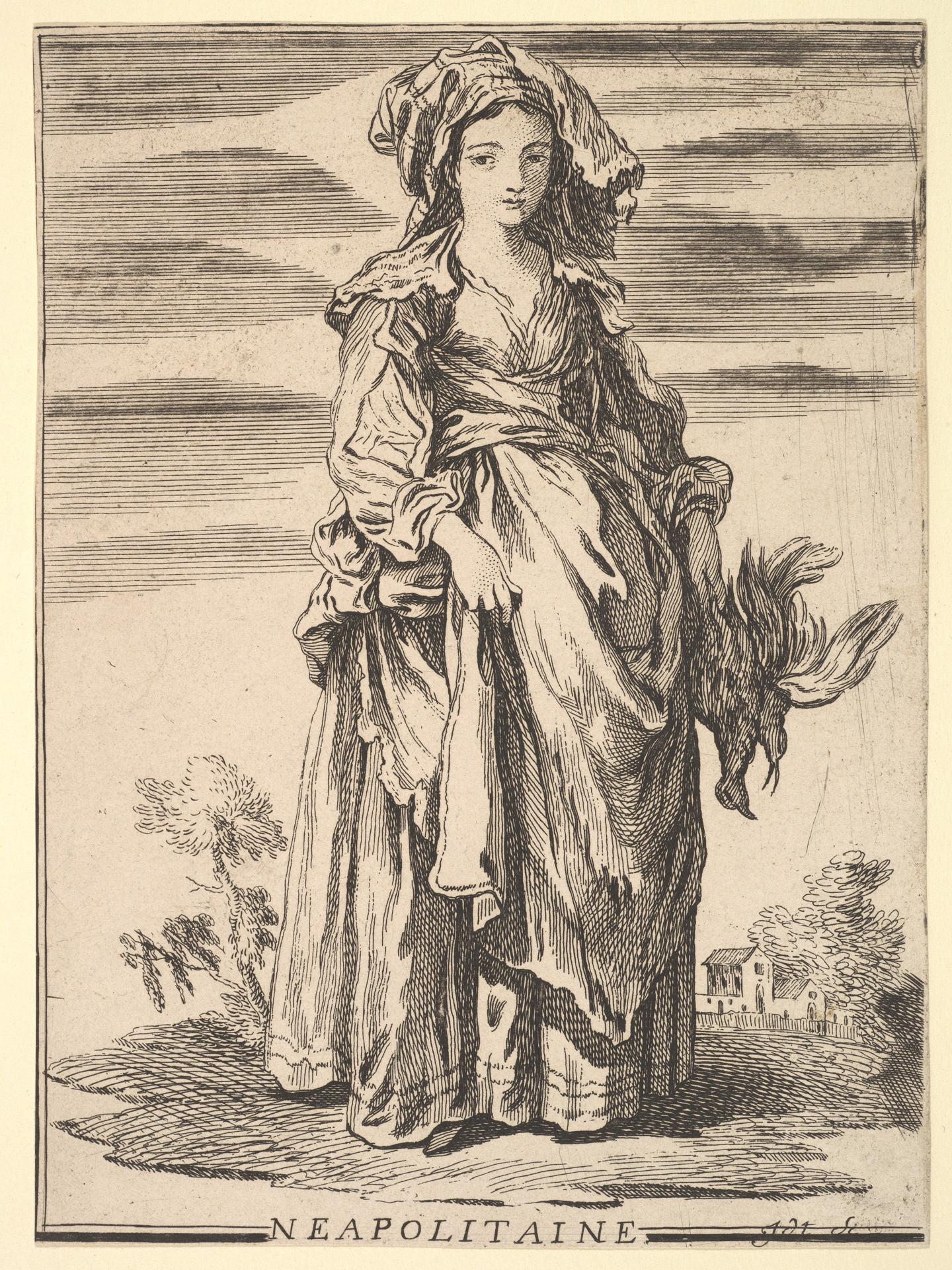
Reverse copy of Neapolitaine, from Recueil de diverses fig.res étrangeres Inventées par F. Boucher P.tre du Roy et Gravées par F. Ravenet (Collection of Various Foreign Figures, Devised by F. Boucher, Painter of the King and Engraved [etched] by F. Ravenet), plate 2
Original title: Reverse copy of Neapolitaine, from Recueil de diverses fig.res étrangeres Inventées par F. Boucher P.tre du Roy et Gravées par F. Ravenet (Collection of Various Foreign Figures, Devised by F. Boucher, Painter of the King and Engraved [etched] by F. Ravenet), plate 2
kurzbeschreibung
A woman in Neapolitan dress is seen in profile, though this eighteenth-century sheet is in fact the mirror-reversed copy of an etching and engraving by Simon Francis Ravenet the elder. The image measures 22.4 by 16.5 cm and was executed in etching and engraving.
Description
The Neapolitan woman stands upright and turns her face toward the viewer in profile. A cloth or apron draped over one shoulder falls across her long gown, and a headscarf covers her hair. In her right hand she carries a fish-like object. Behind her, stylized trees and a building suggest the setting. Monochrome lines and hatching shape the whole image, and the title 'NEAPOLITAINNE' runs along the lower edge.
Context
François Boucher, royal painter in France, designed the figures for this series, which Simon Francis Ravenet the elder engraved in copper in the eighteenth century. The present sheet is a mirror-reversed copy. Such sets of 'foreign figures' were highly popular in the Rococo and served to make European costumes and types vividly legible.
Impact
Calm and assured, the frontal profile view is carried by clear draughtsmanship. Since the background stays plain, attention settles entirely on the figure; posture and accessories give an ethnographic impression. The monochrome treatment underlines the graphic character of the sheet.
Technique
Etching and engraving were both used here, evident in the fine lines and hatching. With these techniques, details such as folds of fabric and facial features could be rendered precisely. The paper size of 22.4 by 16.5 cm matches the usual format for single prints from this series.
AI-generated description text
Source: Metropolitan Museum of Art · Public Domain (CC0 1.0)