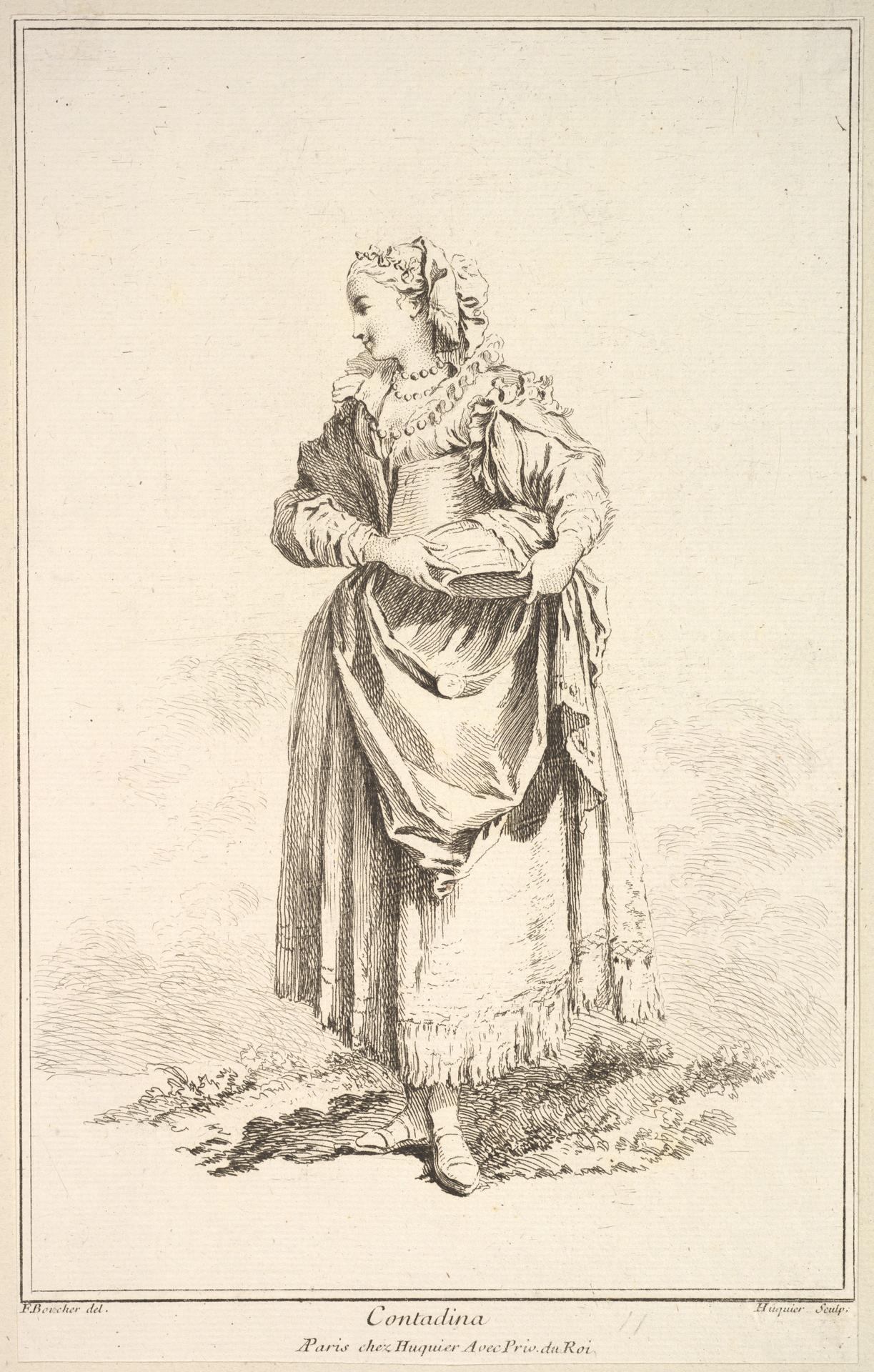
Contadina, plate 7 from "Recueil de diverses fig.res étrangeres Inventées par F. Boucher P.tre du Roy et Gravées par F. Ravenet"
Original title: Contadina, plate 7 from "Recueil de diverses fig.res étrangeres Inventées par F. Boucher P.tre du Roy et Gravées par F. Ravenet" (Collection of Various Foreign Figures, Devised by F. Boucher, Painter of the King and Engraved [etched] by F. Ravenet)
kurzbeschreibung
Gabriel Huquier’s etching 'Contadina' presents an eighteenth-century woman who stands quietly in traditional dress. She is an Italian peasant, her hair pinned up, carrying flowers and a book. The print belongs to a series based on designs by François Boucher.
Description
At the centre, the woman wears a long-sleeved top with puffed sleeves and a flowing underskirt adorned with a veil. Flowers are tucked into her updo, and a necklace circles her neck. In her hands she holds what appears to be a book or writing tablet. Behind her, a simple landscape of trees and bushes unfolds, rendered in black and white with delicate lines and hatching. At the bottom of the sheet appear the title 'Contadina' and publication details.
Context
The series of engravings derives from designs by François Boucher, which François Ravenet translated into copper; Gabriel Huquier was involved in the publication as publisher and engraver. Figure studies like this were popular in the eighteenth century because they recorded and circulated rural and foreign types. They appealed to an art-interested public enthusiastic about costumes and scenes of everyday life.
Impact
Her calm posture and clear lines give the figure an elegance without losing naturalness. Thanks to fine hatching, the figure gains plastic presence and draws the eye into the idyllic surroundings.
Technique
The sheet is executed as an etching, supplemented by engraving, which allows details and tonal values to be reproduced precisely. The lines run finely and evenly, and the hatching creates soft transitions in the shadows. The paper used is hand-made and has the texture typical of the eighteenth century.
AI-generated description text
Source: Metropolitan Museum of Art · Public Domain (CC0 1.0)